CIOs as Change Agents and Educators

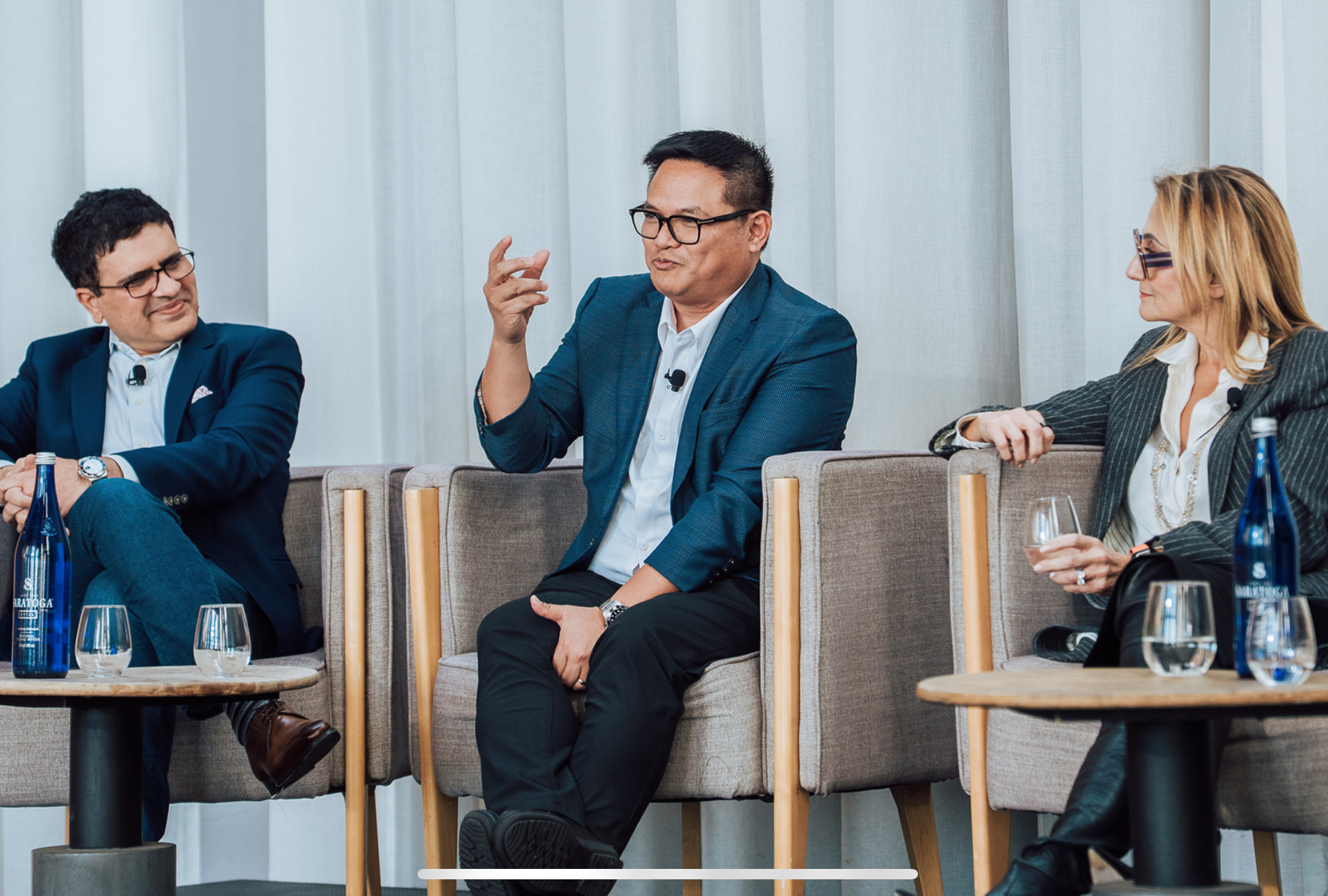
AI is no longer simply a technology agenda. It is reshaping how technology leaders show up — not as operators behind the scenes, but as educators, strategists, and catalysts for enterprise-wide change. This shift was on full display at the Metis Strategy Summit in New York, where I joined fellow CIOs for a conversation about how AI is redefining our role. What became clear is that the CIO is now expected to help the organization learn, adapt, and navigate ambiguity, all while shaping business strategy at the highest level.

Mojgan Lefebvre Chief Technology and Operations Officer of Travelers shared something that resonated deeply: the biggest barrier to AI adoption wasn’t technology, it was mindset. At Travelers, AI is no longer treated as a technology strategy; it is the business strategy. Once their leadership team fully embraced that perspective, acceleration followed. Their platform, TRAVAI, didn’t become successful because it was a tool; it became successful because leaders believed in it. She reminded us that readiness for AI begins with alignment at the top, and belief unlocks behavior.

Pawan Verma Chief Data and Information Officer of Cencora added a perspective that every CIO should internalize. He said our role now includes separating hype from truth — helping leaders distinguish between what is exciting and what is truly transformational. In his world, experimentation is encouraged, but experimentation for its own sake is not the goal. AI initiatives must tie back to clear business outcomes, measurable impact, and sustained value. His discipline around ensuring that enthusiasm never outweighs accountability was a grounding reminder that real transformation requires focus.

Listening to them, I reflected on where we are at Breakthru. I am early in my journey as CIO, but we are already building the foundation for AI — we want it to be an enabler to transformation. Early in my tenure, we held an AI summit with our executive team to build understanding, shared language, and curiosity. But AI literacy cannot stop at the C-suite. Jennifer Charters, CIO of Lincoln Financial, shared a framework introduced by Professor Ethan Mollick at Wharton: Leadership, Lab, Crowd. You begin with leadership, move into experimentation, and ultimately scale to the entire organization. That is exactly the path we are following. We started with leadership. We are now deep in the lab — testing and learning through tangible use cases. And soon, we will turn toward the crowd by launching a broader AI education program in partnership with our learning and development teams, because AI capability is only as strong as the workforce that can wield it.

Steven Norton our panel moderator closed with a personal question: what leadership muscle are you building right now? I reflected with my answer centered around purpose. In a time when AI can automate, accelerate, and optimize almost anything, purpose anchors us. Richard Leider says that purpose is not about what we do, but who we bring to what we do. That distinction matters. In the age of AI, my focus is not only on enabling transformation, but on ensuring we bring people with us. I think about my teams, my peers, my community — and my children who will inherit the world we are shaping.

AI is the most significant transformation driver of our time. And because of that, I think deeply about leadership that concerns itself not only with deploying AI, but with building the capability to educate on AI at scale in our society. Technology may accelerate progress, but leadership determines whether others are empowered to move forward with it. Our legacy will not be measured by how much AI we introduced — but by how many people we helped bring along.
AI Adoption in Mid-Sized Enterprises: Building on First-Mover Advantages

As AI adoption accelerates, the cost and volatility of AI investments are becoming significant challenges for organizations. Gartner estimates that GenAI costs could vary by as much as 500% to 1000%, with vendors raising prices by up to 30% as they integrate GenAI capabilities. This unpredictability is driven by factors such as data preparation, infrastructure needs, computational power, talent scarcity, token costs (price per NLP interaction), and regulatory requirements.

For those of us in mid-sized enterprises (MSE) who began exploring AI use cases a few years back, we may not yet be facing this level of cost volatility and cost spikes. While our models and applications haven’t fully scaled, our first-mover advantage lies in AI literacy and capability building. By diving in early, we engaged in hands-on, often scrappy AI projects, frequently co-innovating and co-investing with vendor partners. We built foundational machine learning models, applied large language models (LLMs) to generate human-readable results, and enabled interaction with existing models, all using platforms already familiar to our users. Successful use cases have generated financial benefits, with vendors offering additional resources to showcase our shared achievements.

My advice to MSEs:

  • Dive in NOW – Leverage existing platforms, data, and cloud capabilities.
  • Be Scrappy – Test and learn with vendor ecosystems; seek co-investment and co-innovation.
  • Invest in AI Literacy and Capability Building – Consider AI boot camps, AI leadership day, or AI executive retreat
  • Prepare to scale Enterprise-Wide – Establish governance, prioritize investment, and expand on successful use cases

Photo taken during AI Day with our vendor partners: Amazon Web Services (AWS), Salesforce, Microsoft, Softchoice, Adastra, NEORIS, Adobe, o9 Solutions and KPMG.

Beyond Productivity: The Revolutionary Role of Generative AI in Business Transformation

The advent of tools like ChatGPT has significantly intensified the hype around AI, marking a pivotal moment for AI’s entry into the mainstream. Consequently, when discussing AI nowadays, it’s common to reference ChatGPT and other similar tools that have emerged. This sudden surge in attention has made everyone eager to share their thoughts, resulting in the term Generative AI (GenAI) being frequently overused and misapplied, which only adds to the confusion. 

What is Generative AI and Isn’t?

Before diving into the main topic, it’s important to clarify widespread misconceptions surrounding GenAI. What exactly is GenAI, and what is not? Many companies have been leveraging AI since the early 2000s, driven by big data, enhanced machine learning, deep learning for predictive analytics, scenario planning, and data analytics. GenAI stands apart. It denotes a subset of AI technologies capable of generating new content that mirrors human-created work. Typically manifesting as text, video, images, or code, it closely resembles human output.

How can companies embrace GenAI now?

As GenAI technology swiftly evolves, the key question shifts from “if” to “how”. Companies need to make the choice between developing in-house or buying, assessing the required investment, addressing potential risks, and recruiting the right talent and developing talent within, all while considering the distinct needs of the company. With GenAI, I would lean to diving in now with the following actions: 

1. Dive in with organizational exploration and learning approach

2. Explore use cases with business-driven mindset

3. Find partners from your ecosystem to learn and co-innovate together 

4. Invest in sustainable technology foundation and get your proprietary data ready

5. Level up your responsible AI and compliance 

The future of GenAI as the ultimate user interface

Many assume that the capabilities of GenAI to generate diverse outputs could lead to significant productivity gains, to the extent that numerous job categories might be phased out in the coming years, replaced by artificial intelligence. However, I would argue that productivity gains are not the ultimate value of GenAI. Such gains, facilitated by tools like GenAI chatbots, may be easily replicated, and therefore not a source of differentiation. They are difficult to quantify in economic terms or captured as tangible benefits in a business case. For instance, a 30% improvement in process throughput does not necessarily translate into enhanced customer retention, product quality, reduced unplanned operational downtime, or better patient treatment outcomes. 

Speed does not equate to quality. Superior outcomes are defined by greater accuracy, reliability, responsibility, relevance, and reduced risk. These improvements are almost always aligned with the business context and strategic goals rooted in the organization’s mission.

The ability of GenAI to mimic human dialogue in interfacing with complex systems, data and technologic features has given us AI’s first true infliction point in broader adoption. GenAI serves as the ultimate user interface (UI) to various technology capabilities, including AI, ERP, CRM, Data Analytics, etc.

In the wake of the GenAI hype, numerous technology companies have positioned themselves as leaders in this field, highlighting their current offerings and future plans that incorporate GenAI. As a technology leader, I’ve attended several presentations and demos showcasing the GenAI strategies of these companies. Interestingly, most of the new GenAI features focus on making the user interfacing more human-like and intuitive, which isn’t surprising given that language processing is one of GenAI’s greatest strengths.

O9 has significantly enhanced its industry-leading integrated planning platform by integrating GenAI capabilities. This includes a prompt feature that allows users to access trusted insights. By facilitating decision-making via natural language queries and conversational analytics, this solution speaks in the user’s preferred language and gain insights from already existing Digital Brain.

SAP AI Copilot Joule offers users the ability to complete tasks using natural language and provides relevant help within the application itself. It enables users to navigate SAP solutions more efficiently, streamline tasks, receive smart insights on demand, and access customized content to get started on their work promptly.

Salesforce EinsteinGPT brings personalized content to every Salesforce cloud using GenAI, thereby enhancing the productivity of all employees and improving every customer interaction. Salesforce’s GenAI CRM technology aims to provide AI-created content across every interaction within sales, service, marketing, commerce, and IT, on a massive scale. With Einstein GPT, Salesforce is set to redefine customer experiences through the power of generative AI.

As illustrated by these examples, there’s a noticeable enhancement in the utilization of existing digital and technological capabilities within current platforms through the use of GenAI as an intermediary. Envision a future where users interact with their systems in human-centric ways, rather than through the transactional, step-by-step processes that are common today. 

For instance, you could instruct your order fulfillment system with a command like: “Identify any orders from the past week that have not been fulfilled due to stock shortages. Provide a list of affected orders and suggest alternative fulfillment strategies, prioritizing as high urgency.” The system then executes all the necessary steps for you. Essentially, you are conversing with the system, and based on the results, responses, or recommendations, you can tailor your next steps accordingly.

GenAI’s sophisticated understanding of historical context from transactional data, next best action from predictive models, summarization capabilities, will bring a new era of hyper-efficiency in front and back office – taking business process autonomy to a new level. We are looking at a future where GenAI interfacing with technology ecosystems of the future for business agility enabling business transformation journeys. It is, quite frankly, on another level compared to some organizations that have demonstrated the ability to pivot customer journeys on the fly for differentiation.

In conclusion, the value of GenAI extends far beyond mere productivity enhancements; it brings a new era of business transformation where human-like interactions with technology redefine efficiency, decision-making, and strategic agility. As companies navigate the complexities of implementing GenAI, the focus should not just be on the immediate gains but on the long-term potential to revolutionize how we work, think, and innovate within our industries. The journey towards fully embracing GenAI is not without its challenges, but the promise it holds for creating more intuitive, responsive, and intelligent business ecosystems is undeniably compelling.

Complementary Leadership

This year I engaged a fitness coach to assist with my strength program for the first time. One of the values I learned from this, is education about how our body works. The complexity of the human muscular system is mind-boggling. It is fascinating how each muscle group works together with the “core” to achieve strength, balance, and endurance.

It is the same way with teams. I had the pleasure of spending two days with our IT leadership team this week during our quarterly meeting. This is the third time we have started it with a reflective discussion. We call this section #Perspectives. This week’s topic was Complementary Leadership

We shared our leadership strengths and development opportunities (others called it needs). We became aware of our diversity; from our upbringing, experience, domain expertise, and leadership capabilities. We gave examples of where we rely on other strengths:

  • How leaders who are great in coordination help facilitate and co-lead initiatives between teams
  • How new leaders rely on the veterans for institutional knowledge and a breadth and depth of relationships across the business
  • How we learn from new leaders who are technical thought leaders; bringing new and emerging skills that don’t exist across

Our conclusion: We have diversity in leadership, and there’s nothing we need that we don’t have in this team and our extended team and network. With this conclusion, we challenged ourselves to deliberately empower our leadership compass to expand multi-dimensionally: 

  1. Up: find mentors and role models
  2. Down: mentor others, give back, and help the next one in line
  3. Out: find leader partners to support and complement your needs as well
  4. Within: improve leadership self-awareness, discover our strengths, and needs

Much like the muscular system of the human body, developing the core allows different muscle groups to work in harmony to achieve the best performance. If you do it the wrong way, you can risk injuries that can set you back. Fitness training is an intentional program. With our reflection on complementary leadership, we want to make that team leadership development purposeful to benefit the whole. “Complementary leadership is the intentional partnership between one leader and one or more leader partners to share leadership responsibilities based on complementary skill sets.”1

1– Use Complementary Leadership to Develop Future Ready IT Leaders – Gartner March 2020

Finding Purpose: An Elusive Endeavor

There is no better time than now to reflect on your purpose and then act on it.

Last January, I was in my hometown in the Philippines so I could be with my father to celebrate his 70th birthday. The craziness of 2020 had already begun. I almost did not make the trip due to the eruption of the Taal volcano, 30 miles from Manila. Before coming home, I reached out to the head of my hometown alma mater to pitch an idea. I wanted to spend time giving back to my high school, St Mary’s College of Catbalogan, by speaking to upcoming high school graduates. I spoke to them for an hour about creating tomorrow and sharing steps to a purpose driven career. My favorite part of that day was when the students spontaneously sang a happy birthday song for my father when I introduced him. I am so grateful I made that trip and connected with friends and families in Manila and my hometown Catbalogan.

We have done our fair share of reflective thinking during this pandemic. We watched as individuals and communities around the world changed — oh how it has changed. I believe that today, more than ever, the sense of purpose is important. It is important in individuals, in communities and even in businesses.

My wife, Ivy always tells me, “we are where we are supposed to be”. She means that, if we chose to go it’s because we were supposed to go. For those of you who know my personal story, I was supposed to be an accountant working for San Miguel Corporation. That was my ultimate dream growing up in the Philippines. I got accepted in one of the best accountancy programs in the country and ready to march on. Until…my parents forgot my birth certificate at home in the province when they were enrolling me in 1993. I lost my accountancy slot which was a quota program and was relegated to Information Technology (IT). I got into the program thinking I will shift the following trimester, but here I am still in IT 27 years after. Ironically my brother is a Finance (Accounting) Manager in San Miguel today. He is very happy, but I can’t imagine doing what he does. I am happy where I am, where I am supposed to be.

Through these twists and turns, I am fortunate to be able to discover my personal purpose. I found what really drives me. Simon Sinek said, “Your Why is your purpose, cause or belief that inspires you to do what you do. When you think, act and communicate starting with Why, you can inspire others.” In my reflection I discovered, it does not matter what I do, what matters is my purpose. My purpose is “To teach and be known to inspire others”. This translates to professionally (a) To be a thought leader in business and technology and at home (b) To guide my children to be the best version of themselves. When I was asked during my MBA admission interview what I am going to do if I am fully covered financially, I said, “I will be in a university institution or community college, teaching”. I still believe I will be teaching when I am done with IT. That will be fantastic!

During my talk last January, I talked to the high school seniors about Ikigai, a purpose framework to guide their reflective thinking. Ikigai is a Japanese concept that means “a reason for being.” The word “ikigai” is usually used to indicate the source of value in one’s life or the things that make one’s life worthwhile. This helped me discover my purpose. If you find yourself struggling to identify what your purpose is and where you might discover personal and professional overlap, here is a simple self-inquiry by asking and pondering answers to these questions might help:

·       What do I love? What am I passionate about?

·       In my view, what does the world need?

·       What am I paid for? (Can I be paid for what I am passionate about?)

·       What am I great at?

By consulting this framework, you may discover your purpose at the intersection of your passion, mission, profession and vocation. There is no better time than now to reflect on this and then act on it. After all, you can’t just reflect your way into finding your life’s purpose; you then must act your way into it. Take a mental note from the Nike slogan and Just Do It. The more we act, the more we get clear on things. Reflect and act it out. Start taking steps toward your goals and start trying new things. This will help you get out of your own way. Many people struggle for years trying to find their purpose. Reflection with action will create a deeper sense of clarity. 

Book Review – Business Relationship Management for the Digital Enterprise

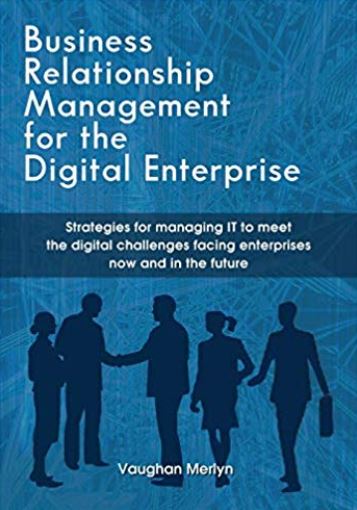
Vaughan Merlyn’s new book Business Relationship Management for the Digital Enterprise is a very important book for a strong BRM advocate, IT leader and practicing BRM like me.

I am honored to get an invitation from Vaughan Merlyn to review his new book because:

  • I admire Vaughan as a mentor and a good friend. I am one of the early followers of his blog – IT Organization Circa 2017. I met him through virtual collaboration in blog space. He eventually introduced me to Business Relationship Management. What I learned from Vaughan transformed my IT career and allowed me to transition to the IT leader that I am today from an IT manager.
  • I like that Vaughan is so humble and generous with his knowledge and wisdom. He willingly imparts them to a global audience through his blog and eventually through the BRM Institute as a co-founder and through this new book. I have benefited from learning from the master. If the content from his blog is any indication, this will truly be a remarkable book, full of insights to help BRMs, business and IT leaders navigate IT changing landscape.
  • This book is very timely. Digital transformation offers IT organizations the unique opportunity to create value by becoming digital change agents for the enterprise. I believe BRM is the key lever of strategic speed for IT organizations and business. BRMs are “the oil to the machine” that reduces organizational friction and allows new culture and digital enterprises to flourish.

Why behind BRM

What a way to open the book with an explanation behind how IT management approaches are shifting and requiring Business IT convergence. “The revolution in computing platforms inevitably leads to changes in approaches to IT management”. Vaughan has captured the reason for the shift by explaining how advancement in computing platform is driving the evolution of IT and IT management.

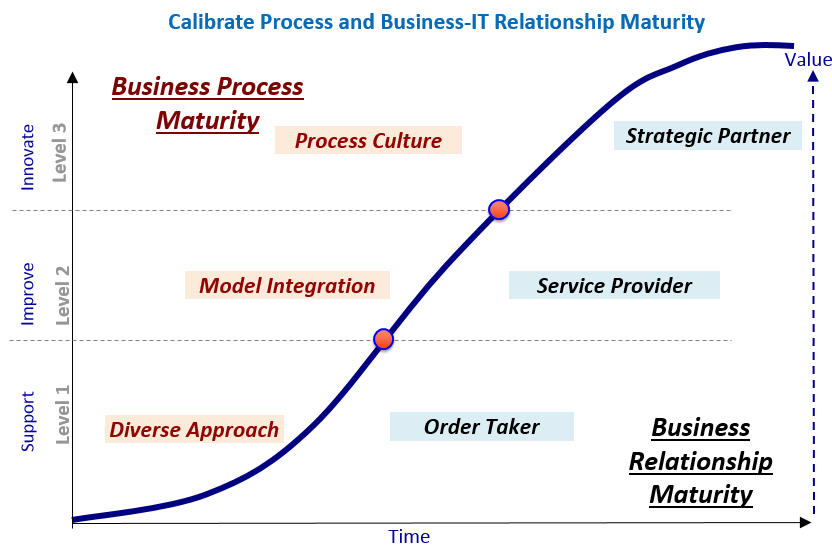
2019-10-07 22_51_22-Business Relationship Management for the Digital Enterprise_ Strategies for manaThe exponential development of technology has also made technology easier to use and more accessible. We have gone from an era where only a few people have access to technology, to one where it is virtually in everything we do. In business, this results in IT capabilities becoming more embedded into business capabilities. In the new digital landscape, IT is no longer just a service and a support function; it is a fundamental building block of the business. This is the reason why “Business-IT Maturity is essential for business to evolve”. This maturity model is one reason enough to get a hold of this book. I have seen the Business-IT maturity model many years ago from Vaughan’s blog and listened to him explain it on many occasions in webinars. It is one of the models that opened my eyes to BRM and how important it is to have BRM capability and discipline to advance value creation from IT. This model is essential to explaining the why behind BRM.
IT Leadership for the Digital Business

In his new book, Vaughan was able to present how technology has moved to the center of every business and a critical capability required to today’s competitive landscape. “As the nature of IT changes, roles that were formerly the domain of the IT professional are migrating into the business.” On the other hand, roles that were business focused are being assumed by IT groups: “Portfolio Management, Business Change Consultancy, Business Capability Roadmapping, Demand Management and Business Value Realization”.

Digital transformation offers IT organizations the unique opportunity to create value by becoming digital change agents for the enterprise. But first, we must understand that traditional operating models from the past will not be enough to reshape ways companies exploit technology for competitive advantage. What does it take to have an effective IT leadership for the digital business? In this book, Vaughan shares IT operating models that aim to achieve Business IT Alignment versus a Business-IT Convergence. I have seen no one in the IT management consulting space who has used operating models as brilliantly as Vaughan in providing leadership frameworks that support the ever-changing business landscape. He provides frameworks and practical advice on how to take on leadership role in digital enterprise.

BRMs Stepping into the Digital Leadership Void

Digital transformation is not just about technologies. Existing digital technologies are accessible to all companies. The key is using these technologies to find value at the new frontiers of business. Being digital means not being afraid to use emerging technologies to solve business problems. Being digital requires being innovative and pushing the boundaries even on areas where success is not guaranteed the first time. BRMs have the unique opportunity to step into the digital leadership void because they have a deep understanding of the business, its ecosystem, and the competitive landscape.

Digitization brings with it an important shift in IT leadership challenges, with the BRMs becoming more of a catalyst for digital transformation. This book provides BRMs with a guide to competencies needed to become an effective catalyst: Driving Value Realization, Understanding the Business Environment, Closing Gaps Between IT and its Key Stakeholders, Managing Relationships, Facilitating Organizational Change, Facilitating Major IT Programs, and Providing Financial Expertise. If the BRMs have these competencies, he/she can be an effective management consultant to the business applying different tools and techniques that Vaughan richly covers in his book.

My Conclusion

In this book, Business Relationship Management for the Digital Enterprise, Vaughan Merlyn is spot on about how BRM role and capability will be depended on by today’s emerging digital enterprise in order to demolish barriers and facilitate business IT convergence. This book is a must read for all BRMs, those aspiring for the role and organizations considering introduction of BRM. This is also a great book CIOs, Business executives and IT leaders. On a personal note, this is well worth the read for me as it gave me new perspectives of Vaughan as a musician and artist and how he has use it as inspiration in his work.

Vaughan Merlyn

Let’s Talk Business Process First! – How to Calibrate Business Relationship Maturity through Business Process Culture

Use of information technology. Is it creating value? Is it improving business processes and capabilities? Or merely creating new wants? Is it important, or only urgent? What is it for? Every Business and IT engagement around business requirements revolves around these questions but managing it isn’t always easy.

First, let’s talk about IT organization’s critical role in the company’s business processes. One of the consequences of Business Process Management is a large majority of these programs are initiated in the IT organization.  There are very good motives for this.  One of the most common: the IT organization is responsible for providing the technology that enables business processes. Take for example, ERP (Enterprise Resource Planning) systems like SAP, Oracle, etc.  This ERP solution is a suite of integrated applications that a company can use for many business processes. Most ERP systems incorporate best practices reflecting the vendor’s interpretation of the most effective way to perform each business process. Systems vary on how conveniently the customer can modify these practices. Talking about best practices, it is advisable not to over-customize because doing so will keep you from taking advantage of the expected improvements and innovations from the purchased ERP package.

How do you characterize the nature of your engagement with your business partners? Is it functional orientated? If it is, there is more tendency for having more solution-based discussion versus process- and value-based. Even worse, it could be possible that your internal customer is engaging you at the tail end of their decision cycle–when they have already determined what they want or need. There is lack of business-IT alignment and strategic partnership.

How do you then improve the level of your business relationship with the business? There are numerous paths towards that elusive business-IT strategic partnership. In this post, I will talk about Business Process Maturity as a path— so I would say – Let’s Talk Process First! This has worked for me in the past. One of the most effective ways to change the orientation and focus of business IT interactions is to start with business process. Calibrate  your organization’s business process maturity and you will take along with it to a great degree IT-business relationship maturity. What you need are experienced business process managers with business relationship management competencies. Below I will walk you through these 3 stages of Business Process and Business Relationship maturity and describe what it means.

Business Process and Business Relationship Maturity

Process Maturity

Level 1: Support

Business Process Maturity = Diverse and Business Relationship Maturity= Adhoc / Order Taker

When your organizational approach to business process is diverse, more often business-IT initiatives are managed with lack of integration. At this stage, most of the organization’s process knowledge is known only to a few individuals. For business process engagement facilitation, there is dependency on external consultancy. There is no standard process management discipline that leads to more functional orientation of IT requirements discussion. Consequently, IT as a provider organization is hardly seen as a strategic partner–at most, a service provider. In terms of business relationship maturity level, most of the time, IT is treated as an order taker. This type of business relationship is characterized by loudest in – first out tendency causing reactive course of actions. My advice is to embark on a business process maturity journey. Establish a discipline of managing business processes as the means for improving business performance outcomes and operational agility.  Leverage use of technology to improve business processes.

Level 2: Improve

Business Process Maturity = Model Integration and IT-Business Relationship Maturity = Service Provider

You want to become an organization that designs processes first and then goes on to implement the technology enablers. Your organization wants to keep pace with technology and maintain a competitive advantage. Companies at this level adapt a consolidated method to design and implement business models using standard processes and tools. Process ownership ultimately improves as management breaks silos and approaches process and technology implementation equally.  The common tendency is for companies to establish process governance and ownership. IT plays a key role in the process evolution of the company and starts to be seen as a service provider and some cases even a strategic partner.

Level 3: Innovate

Business Process Maturity = Process Culture and IT-Business Relationship Maturity = Strategic Partner

The final step to Process Culture Maturity occurs when innovation and change in business practices through process understanding are consistently promoted within the company. As executives passionately embrace process thinking, they are able to promote innovation more confidently when implementing new technologies. In many cases, companies with mature process culture has End-to-End orientation to process management and IT plays a key role as center of process excellence. IT starts to be regarded as trusted and strategic partner. Business–IT relationship is based on cooperation and mutual trust with shared goals to maximize value from business initiatives.

Technology will not automatically implement itself and run your organization’s processes the way you envision. IT has a unique opportunity to spearhead business process improvements in the company. Start by changing the orientation of your business interactions from functional to business process, from solutions to value. Do not shy away from this opportunity. Use business process management to create greater strategic value and by doing so advance business-IT relationship level to new heights.

A Complicated Way to Explain the Importance of a BRM Role in an IT Organization

Don’t tell me I did not warn you. The only thing I can promise is that you’ll learn a thing or two from this one, so please read on.

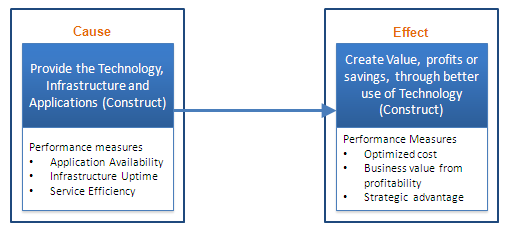
I came across a predictive validity framework called the “Libby boxes”, popularized by Cornell Accounting Professor Robert Libby. This framework is used to examine the distinction between underlying constructs of strategic objectives and their proxy measures to illustrate causal models related to some objectives in an organization.  Another definition of “strategy” is as a hypothesis about the cause and effect of your objectives. Predictive validity allows you to measure and analyze how well the execution of your objective (cause) predicts your desired performance (effect).

Simple Business-IT Strategy

Now, to illustrate the importance of a Business Relationship Management (BRM) function in an Information Technology (IT) organization, let’s start by picking a Business-IT strategy to dissect. Let’s call it “Strategy A”.

Strategy A: “Create business value through better use of technology.”

Let’s start it simple and take an approach to illustrate cause and effect depict Strategy A using the model. We are going to be taking a very logical approach. The strategy here is— you believe that if you use technology better, you create business value. Let’s assume that technology is comprised of infrastructure and applications that enable the business or enterprise.

Simple Business-IT Strategy

Observe that Strategy A is too simple—or maybe exceedingly simple. Can we really say that if IT provides better technology, we create business value, in the form of profits or savings? Yes, no, maybe. How about this – it is because of better use of technology, we improve business processes of the company and therefore we create business value. In this predictive validity framework, the middle action is called, mediating variable. It stands between two variables and it is an effect of one variable and the cause to another. This brings us to iteration to our business-IT strategy. Let’s refer to this improved business-IT strategy as “Strategy B”.

Strategy B:  “Create value by improving business processes through better use of technology”.

Business-IT Strategy

So how do you interpret this strategy? As an IT organization, your goal is to provide the business with the technology, infrastructure and applications to enable efficient business processes. This will result to business value creation through optimized cost, profitability and strategic advantage. Whew! Follow all that so far?

I think this business-IT strategy works. If you run this, you have a good chance of successful outcomes. But your aim is not to be just good. Your aim is to be great. Your goal is to differentiate your IT department and to support your enterprise to be the best performing company in its industry or to be the best performing company (period!).

The Missing Component to be great

So there is a missing component to your strategy, a moderating component—a component that will have a multiplying effect from certain causes and effects coming out from the collective work that you do. In this predictive validity framework, it is called the moderating variable.  The moderating variable is a variable that determines how big an effect you get from a certain cause.

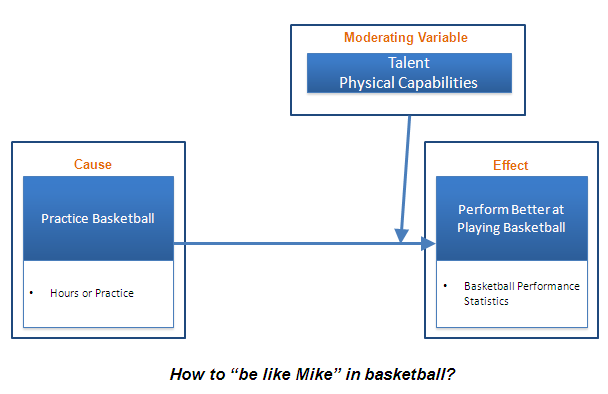
To illustrate, let’s say you want to improve your performance at playing basketball. By practicing basketball, doing drills and shooting, for sure it will improve your performance. This is a very simple causal model. You practice more and that, in effect, will improve your basketball performance. But think about this, is there a certain amount of practice that will allow you to be like Mike (Michael Jordan)? Most likely, no. Talent and perhaps physical capacities are the moderating variables here.  Sure, practice will improve your performance, but if you have a lot of talent, a little bit of practice goes a long way and will make you much better. If you don’t have that much talent, you’ll have to practice a lot to get just a little better. Talent in this case is a moderating variable.

Basketball Strategy

Now that you understand what a moderating variable is, let’s go back to our Business-IT strategy. Think about an organizational capability equivalent to talent that can potentially transition your IT organization from good to great—it is business relationship management (BRM).

Strategy with BRM

BRM in this case is a moderating variable. The BRM capabilities moderate the effect of improvement of business processes and enablement of new business capabilities on performance, making it bigger (due to converged business-IT strategy) or smaller (in cases where it is lacking). Improved business processes and enablement of new business capabilities doesn’t cause BRM capabilities, it just moderates the effect. How? BRMs (1) facilitate Business-Provider convergence, (2) ensure that use of Technology that drives maximize value and (3) facilitate productive and connections and mobilize business-IT projects and programs.

Value of BRM Role


For many years, IT organizations responsible for deploying technology systems to enable business capabilities have had one goal in mind – namely, to assure business-IT alignment. Today, however, as IT capabilities become more and more embedded in business capabilities, and given the pace of technological change and the pervasive nature of IT, alignment is no longer sufficient. The goal today, therefore, is “convergence”. This has given momentum to the growing emergence of the Business Relationship Management (BRM) role, which, according to the Business Relationship Management Institute (BRMI), is about “stimulating, surfacing and shaping business demand for a provider’s products and services, ensuring that the potential business value from those products and services is captured, optimized and communicated.”