Peter Drucker Centennial – his wisdom and perspectives

Peter Drucker (November 19, 1909–November 11, 2005) was a writer, management consultant, and self-described “social ecologist.” The Harvard Business Review honors Drucker’s contributions with a spread in its current November edition. The issue has a lot of interesting and insightful articles about the continuing relevance of his perspectives and wisdom in today’s turbulent times. 

Drucker’s Influence in Asia 

AsiaI remember my professor in the Asian Institute of Management who talked passionately about Peter Drucker’s perspective in business and management. Managers in Asia have described Drucker influence as essential in making their business successful and helping countries develop. Drucker frequently travelled to Asia, particularly Japan, throughout his life. He has profound influence there, not only as a management consultant to companies such as Toyota and retail giant Masatoshi Ito but also as a consultant to governments such as Japan, South Korea and China. 

Many influential and revolutionary ideas have run through Drucker’s career and writings. He preached about decentralization, simplification, impact of knowledge workers, management by objectives, customer service, corporate compensation, need for community, organizational business processes among others. I have chosen two out of Drucker’s many ideas to discuss: 

1. The Purpose of a Company Is to Create a Customer 

A company’s primary responsibility is to serve its customers. Profit is not the primary goal, but rather an essential condition for the company’s continued existence. There is only one valid definition of business purpose: to create a customer.”  – Peter Drucker

Profits come when customers continue to buy your products and services. That is the reason why Drucker’s perspective always pointed out the importance of putting customers first. A.G. Lafley, chairman of P&G board of directors, always sought out Drucker’s advice during his tenure as CEO of the company. He attributes their corporate principle to Drucker’s customer service principle that the consumer – not the CEO – is boss. P&G have made it their purpose to touch more consumers and improve more of each consumer’s life. By putting customers first, according to Lafley, they have nearly doubled the number served, from 2 billion to 3.8 billion; doubled sales and tripled P&G profits. 

2. Essential Condition for the Company’s Continued Existence 

“The need for planned abandonment – businesses have a natural human tendency to cling to “yesterday’s successes” rather than seeing when they are no longer useful.”  – Peter Drucker

Many companies focus on placing as many products and services as possible in the market and reap as much profits as possible. Their center of attention lies in what they have achieved in the past and what they are maximizing in the present. According Zhang Ruimin, CEO of the Haier Group based in China, sole focus on generating profits today could not ensure his company’s survival tomorrow. Early on, Haier’s profits were dwarfed by its competitors in China while Haier focused on quality. They could not compete with companies offering the same products in the market. But when supply-demand balance changed in China, according to Ruimin, lots of companies lost customers and went bankrupt overnight while Haier strengthened its position in the market. This is one of Drucker’s key principles – the assumptions on which the organization has been built and is being run no longer fits reality. Zhang Ruimin takes this to heart as a constant warning.  He wrote, “All decisions I make must be consistent with the ever-changing external environment. If they aren’t, the consequences may not emerge right away, but once the danger show up, it will be too late.” 

HBR Cover November 2009To read more about Peter Drucker’s perspectives and find out how his wisdom can help your company navigate these turbulent times, take a hold of the current November edition of Harvard Business Review with the headline: The Drucker Centennial – What Would Peter Do?

Photo courtesy of Harvard Business Review.

When Meetings Are Bad for the Company

I had a colleague in Germany who once told me, “If I didn’t have to go to a lot of these meetings, I’d enjoy my work more.” We probably had a lot of meetings – maybe too much – with them.

Internal discussion, status meetings, presentations, weekly update, checkpoints —you name it; they are all types of internal collaboration, otherwise called meetings. Internal collaboration is almost generally viewed as good for a company. Leaders regularly challenge us to collaborate, to talk to different departments, and chat with counterparts in different business units and work together in cross-unit teams. Where do we end up? Typically, swamped by information overload, spending more than 50% of our time in meetings and spending 20% preparing for it. Contrary to popular opinion, you indeed can have too much of a good thing. 

MeetingI am not saying meetings are bad.  Not at all.  It is a time-tested tool for communication and assistance for employees in aligning activities to desired goals. It is vital for projects and operations. In leading a team or department, I hold meetings periodically (and sometimes more than necessary). It is essential to functioning teams. There is simply no substitute for a good meeting. Meetings, working with teams and collaborating across organizational boundaries can create tremendous value. 

However, conventional wisdom rests on the false assumption that the more employees meet and collaborate, the better off the organization will be. The fact is, too many meetings can easily undermine productivity and performance. 

Knowing when (and when not) to meet 

There is an existing rule of thumb for this; I certainly don’t want to reinvent the wheel. Let me cite what effectivemeetings.com has to say on this subject. I got this from the article, Six Tips for more Effective Meetings. You will be surprised with tip number one: Don’t meet!.  

Avoid a meeting if the same information could be covered in a memo, e-mail or brief report. One of the keys to having more effective meetings is differentiating between the need for one-way information dissemination and two-way information sharing. To disseminate information you can use a variety of other communication media, such as sending an e-mail or posting the information on your company’s intranet. If you want to be certain you have delivered the right message, you can schedule a meeting to simply answer questions about the information you have sent. By remembering to ask yourself, “Is a meeting the best way to handle this?” you’ll cut down on wasted meeting time and restore your group’s belief that the meetings they attend are necessary. “

What’s a good meeting? 

You know when you’re attending one. There is a good reason to meet in the first place. The purpose, agenda and timeframe are clear. The participants are prepared and there is some degree of skilled facilitation. It is important to have someone who can keep participants focused on the goal in mind and can navigate issues so that the meeting can be effective. In good meetings you always leave with clear action items. 

Managers who emphasize the benefits of meeting are right. But they should temper those that do it excessively. It is a mistake to underestimate the equivalent time and cost the company spends in meetings. We should approach holding meetings as a group value-creating endeavor. Although getting together to collaborate is imperative to a working environment, the challenge is not to cultivate more and more meetings. Rather, it’s to develop the right meetings so we can achieve objectives and goals otherwise not possible when we work alone.

Photo courtesy of Ivy Remoreras Photography.

Innovation During a Recession

Innovation is bringing creative ideas to life. It occurs in the organizational context when individuals and teams work to spark new product development, to implement new technology and even to transform the organization. Innovation is always linked to performance and growth through incremental improvements in efficiency, productivity, quality and services. On the other hand, it is also associated with radical improvement like inventions, new products and radical changes in the business model. It is a balance of incremental improvements and radical innovations that keep the company competitive in a changing world.

NY StocksWe are on the brink of important change in the world— and it is economic in nature. We have seen massive job cuts, company bankruptcies, budget reductions, etc. We are in a period of profit-focused cost cutting. Innovation may be a low priority for many companies in this period of recession but I think it is a big mistake. Innovation ought to be a crucial element in a firm’s recession strategy. It will allow them to do more with less and to generate profit by exploiting existing resources.

Two kinds of Innovation that are especially valuable in a recession:

Internal and External Collaboration

Greater internal collaboration– between departments and business units, as well as external collaboration– with customers and suppliers, are essential if companies are to stay healthy during the recession. For example, internal collaboration could result to a Cross Selling strategy that could increase sales to the existing captured market while lowering cost of selling.  Collaboration can be a channel for transfer of best practices between operating units. Internal Collaboration can also result to inter-business-unit product innovation by creating new products and services from existing knowledge, technologies, products and brands.  External collaboration, specifically with key entities of your supply chain network — from suppliers to customer, is vital to staying in business during a recession. The big challenge to firms is to reduce cost while maintaining service levels. Businesses need to have open communication with suppliers and customers alike and ensure a more effective and efficient supply chain.

It is also important for firms to use new technology and cheaper options for collaboration. Leveraging Web 2.0 in the enterprise can be one option. Let me give you a clearer example. It is critical for companies to understand how customers reassess priorities, reallocate funds, switch brands and redefine value of products and services. Web 2.0 platforms can be both a source of information and a channel to facilitate this kind of collaboration in a cost effective way.

Leveraging Shared Services

If it’s all about cost reduction and economies of scale, it’s probably the best time to implement Shared Services. In these demanding times, companies are challenging themselves to discover business processes and business models that will open undiscovered synergies. Shared Services could be the answer to companies keenly looking for convergence and streamlining of an organization’s functions.

Shared Services has to ensure that they deliver the services required of them as effectively and efficiently as possible. In a recession, this convergence enables the appreciation of economies of scale within the function and can enable multi-function collaboration where there is the potential to create more synergies. A word of caution though, a Shared Services implementation involves a large scale cultural and process transformation; it must come with a well-planned organizational transformation and change management strategy.

In a nutshell

Shared Services has been around for years and companies have always strived to collaborate — internally and externally. I think the emphasis this time should be precision, timing, and bringing the best ideas forward. Forward looking and innovation-focused companies are seeing the light at the end of the tunnel. I strongly believe that this is the best time for innovation, for breakthrough value and for paradigm shifts. This is the best time to position your company ahead of the pack when the economy regains momentum again.

Incremental Change vs. Radical Improvement

Building an engine that generates a steady stream of innovations in processes, technology and product development is difficult, but companies that are able to do it, differentiate themselves from competitors. Innovation groups (other companies call it evolution committees or R&D groups) should focus their energy on: 

  • Incremental Improvements (streamlining, optimization, reengineering, cost reduction, reliability) 
  • Radical Periodic Improvement (New platform, new methods, new strategy, new philosophy, Enterprise 2.0, leap to Process Culture, etc)   

Examples of two companies who have mastered innovation are Toyota and Google. Both are leaders in their respective industries. Toyota’s success is tied up to its well-known business model– the Toyota Way that has been duplicated by other companies in different industries. The Toyota business model has been so successful that the company has relied on it for decades now to run its global business successfully. Toyota, for a long time, has a strong process culture and its continuous dominance is driven by its focus on incremental process improvement that is tied up to its quality operations and production management. 

Google, on the other hand, grew rapidly because of the radical rules they initiated that redefined the use of the Internet. Roberto Verganti in his book Design-Driven innovation compares this radical change to having a vision, and taking that vision to the heart of the customers.   In the case of Google, this means the Web users. Think about it.  This company has overturned our understanding of the use of information and networking. Jeff Jarvis in his book What Would Goggle Do?, talked about Google differentiating itself from the likes of Yahoo and AOL. Unlike the previous search giants, Google is not a portal; it is a network of platforms. Google, in a way, empowered the users of the internet, changed media and redefined the advertising rules. We as users have not asked for these new necessities, but when we experienced them, it was love at first sight. 

Radical vs Incremental Change

It’s hard to imagine how already huge companies such as Toyota and Google can continue to improve and sustain growth well into the future. They have perfected the fuel that keep them competitive and well ahead of everyone else. They rely on the combination of continuous incremental changes and periodic radical innovations. I think it is mandatory for companies who aim for sustainable growth and continued primary industry position in the future to push for visionary innovation. There is no single scheme to follow. It is a transversal process that depends on combining industry experience and strong innovation methodologies that create new ideas, new technologies, new products and new processes. 

Design-Driven Innovation- Book Recommendation 

Last weekend, I came across a book entitled “Design Driven Innovation: Changing the Rules of Competition by Radically Innovating What Things Mean”.  This recently-published book is written by Roberto Verganti — a professor of Management of Innovation at Politecnico di Milano. He is the founder of PROject Science, a consulting institute that provides consulting services on management strategic innovation. 

Design-Driven InnovationThe book caught my attention initially because of its title. I have a close affinity for design initiatives, having moved early last year across the Pacific from Asia to the company headquarters to join a Global Design Team. I have always believed that innovation from a well-thought out design initiative can radically improve a company and change the rules of competition in its industry — be it product innovation, organizational, technological, process and company philosophy. 
From the front flap of his book, Professor Verganti presented his vision of a bold new way of competing. He wrote, “Until now, innovation studies have focused either on radical innovation or incremental innovation pulled by the market.” He explains that “…design-driven innovations do not come from new markets; they create new markets. They don’t push new technologies; they push radically new meanings.” His book talked about innovative products like Swatch in the 80s and as well as Nintendo’s Wii and Apple’s iPod – both of which are currently dominating their respective markets.   In the fourth chapter of his book, Professor Verganti provided a comparison between the innovation strategies of Nintendo, Sony and Microsoft in the US$30 billion game console industry. Nintendo, after dominating the game market in the 80s, was experiencing a downturn, until they released their revolutionary Nintendo Wii. Meanwhile, Microsoft and Sony were focused on incremental improvements on their Xbox and Playstation products through better speed and graphics.  Nintendo, on the other hand, introduced the radical idea of using game consoles as an active physical entertaining medium. It generated new meaning to game consoles and appealed to different consumers worldwide. 

I think managers who are interested in innovation should get a hold of this book. This can be used as essential reference for all those interested in design and determined to make innovation the driving factor in their business and profession. In my case, the reason I bought this book is because I am interested in Processes and IT innovations. I believe this book will definitely provide me insights on methodologies that can drive process innovation initiatives. It is something that I want to write about and explore.

Book Cover Image Courtesy of Harvard Business Press.

Achieving the Highest Level of Process Culture Maturity

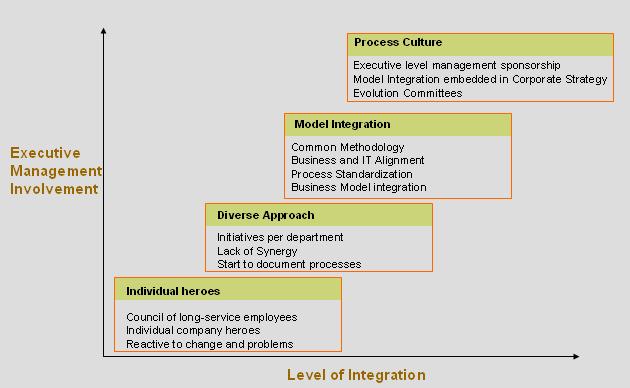
Last August 13, I published an article entitled “Accelerating Process Culture” which talked about the four different levels of process culture maturity in a company. There are two underlying criteria used to qualify the different levels of process culture maturity– level executive management involvement and level of business process integration. 

When executives exhibit a strong commitment to the process and technology evolution of the company, they always bring everyone on board. Executive management has the authority to push company-wide change as well as fund processes and IT initiatives. They are responsible for aligning the company’s structure to the business integration strategy; therefore, they enable the organization to advance to a higher process culture maturity. Let’s revisit the four levels of process culture maturity:

  • Level 1: Individual heroes – dependence on individuals or a few company experts
  • Level 2: Diverse Approach – initiatives per department but lacking in integration
  • Level 3: Model Integration – business and IT align and model integration is achieved
  • Level 4: Process Culture – executive passionately participates in process initiatives

 Process Maturity Levels

This time, let’s examine closely the highest level of process maturity—The Process Culture. The final step of process culture maturity is when the organization achieves a high level of model integration by leveraging the consistent involvement of executive management as sponsors and facilitators of change.

There are three factors that determine the right approach towards process culture maturity.  Let’s call it the “SIB factors”. S stands for senior management involvement, I for innovation and B for business model integration.

Senior managers and managers alike are the critical success factors in your organization’s process culture journey. They lead the way in building process culture and defining the operating model. Innovation in information technology is also a key component. Successful companies nowadays rely on an integrated set of electronic business processes, tools, information, and technologies. With proper support and funding, an IT organization should be able to provide the right platform and technology in which to build the foundation.

The next thing that the company needs to do is to make sure that they select the right business process model from among the many tested disciplines and existing operating models. The underlying logic here is that a company’s business model is limited by the environment. In other words, it depends on several factors, such as the industry it operates, the products and services it sells, its size and geographical diversity. Using all these factors, you determine the level of business process standardization and the level of integration of the company’s different businesses — with profitability and competitiveness requirements in mind. Shared services, outsourcing, diversification, standardization, model replication are some of the most prevalent business models multinational companies have implemented. 

The real question is: how close are you and your company to getting to the highest level of process culture? This is a guide on how to assess the level of process culture maturity of an organization. Again, the examples are outlined using the “SIB factors”. Observe the following points and evaluate how your company is doing right now.

Senior management involvement

  • Top executives participate in the IT and Processes evolution committee.
  • Requires thoroughly analyzed business cases and encourages measurement of acquired benefits.
  • Pushes for post-implementation audit to evaluate project output and acquire lessons learned.
  • Encourages collaboration across business lines and functional teams.
  • Funds IT and Process initiatives and actively support training in the use of IT.

Innovation:

  • Exhibits a strong sense of innovation, feelings of shared interest to continue to improve and be ahead of competitors
  • Holds regular management briefings on the impact of new technology developments and process innovations in the industry.
  • Establishes a consolidated IT operation that manages a standard IT platform to sustain day-to-day support functions to business areas.
  • Encourages use of IT in the business. Users possess a feeling of empowerment and confidence in the effectiveness and reliability of the processes and systems. 
  • Strives to leverage new technology, platform and methodology with sufficient effort in research and development in the area of processes and IT. 

Business Integration:

  • Defines a clear vision of model integration and process standardization.
  • Uses a best-in-class enterprise resource planning software to run an integrated set of business processes
  • Promotes implementation of end-to-end processes to ensure the efficient flow of activities and effective allocation of decision rights and accountabilities.
  • Captures business information in one area and shares it to another business area. Possesses the willingness to share and use information to measure and improve key performance.
  • Maximizes reuse of business processes and platform across different business lines.

Achieving a high level of process culture maturity presents a host of challenges to an organization. The SIB factors provide a structured framework where initiatives can be drawn and strategies derived. This will propel your company forward through its process culture maturity journey.  Achieving the highest level of process culture maturity requires strong executive sponsorship and IT leadership in order to support the company through a change process. When achieved, the company is in a good position to leverage IT for profitable growth and gain competitive advantage in a global market that knows no boundaries. This leap begins with you and your company’s senior managers.

Accelerating Process Culture

It seems like distant past when big companies rely on individual heroes to facilitate process initiatives. They are long-service employees who became the experts of how things and processes work in the company. They are always consulted because of their inherent authority– business owners and managers listen to them. Think about them as company elders and gurus whom we seek advice from when things go wrong and consulted whenever changes are planned.  

When a company relies and is solely dependent on its individual heroes for change and process enhancement, it is on its 1st level of process culture maturity.

Process Maturity Levels

The second stage of process culture maturity is the Diverse Approach.  This is when the company starts to utilize standard methods and best practices to drive process design and innovation. Oftentimes at this stage, different areas in the organization implore varying approaches and therefore, less synergy is achieved. Standard operating procedures (SOP) start to shape in each department and documentation becomes an integral part of process implementation. In many cases, at this point, IT and business approaches tend to clash and technology becomes the focus of project implementation.

Companies move up to the Model Integration stage when it builds more synergies throughout the organization. Very successful multinational companies such as P&G, CEMEX, and ING DIRECT take advantage of Model Integration by consolidating functions and developing its shared services. P&G, for example, has established Global Business Services (GBS) — a shared service organization that provides the company a platform for continuous global growth while maintaining values of innovation, service, customer responsiveness and business efficiency. Companies at this level adapt a consolidated method to design and implement business models using standard processes and tools. The project team discipline ultimately improves as management breaks silos and approaches process and technology implementation equally.  The common tendency is for companies to establish global standards and to consolidate both IT infrastructure and human resources, thereby reducing cost of operations.

The final step to Process Culture Maturity occurs when innovation and change in business practices through process understanding are consistently promoted within the company. When executives passionately embrace process thinking, they are able to promote innovation more confidently when implementing new technologies.

Many organizations have gone a long way from the days when company individual heroes were the sole initiators of change and process innovation.  Yet it’s difficult to predict what comes next — as technology evolves, industries consolidate, and Web 2.0 quickly becoming the new platform.