Build Value Proposition That Improves IT Customer Experience In and Out

Refine Your Service Value Proposition

IT organizations are service organizations. They don’t become service leaders through sightless evolution. IT leaders must engage their counterpart business unit leaders (i.e., the heads of logistics, purchasing, etc.) to have a good grasp of their own departmental goals, plans and objectives. Understanding the strategy and goals of the business it serves is critical to the alignment of objectives. The IT organization can provide better service if it understands the objectives of internal customers.

Revisiting the IT value proposition during annual planning sessions is an important exercise for IT managers. This will help IT managers understand the real and softer elements that are the differentiators of IT services. For internal customers, Value Proposition is the collective services they receive upon investing in IT capabilities and services. We have to understand that it includes more than just the core IT services (equipments, applications, and connectivity), and even more than just quality— it also involves several softer variables that will differentiate the total service offering such as responsiveness, innovation, collaboration and commitment.

These are two perspectives representing the two words of the terminology “Value Proposition” itself— “Value” and “Proposition”. This is broken down into: 

  • Value (Internal Customer’s Perspective) = The benefits received by the business upon investment on IT capabilities and services. 
  • Proposition (IT’s Perspective as Service Provider) = The total offering to the customer in exchange for their investment. 

IT best practices such as Information Technology Infrastructure Library (ITIL) and IT Services Management (ITSM) ensure that IT is aligned with the goals of the business organization. IT’s challenge is beyond technology. Its challenge is to deliver services that enable the business to balance performance, quality, risk and cost. IT’s attention is shifting from discrete technology initiatives to optimizing the value of business services delivered by IT, driving positive business outcomes and improving customer experience. 

Commitment to the business’ end-customer

Although the IT organization’s direct customers are typically internal (the business units), IT is expected to play an important part in the ultimate value proposition— the value proposition to the customers of the business units (the end-customers). When I was an IT business process manager in the Philippines, we used to program appointments that will require IT personnel and managers to accompany Area Sales Managers on their sales visits with customers. These visits allowed us to experience the action from the frontline and engage our end-customers. At the time, we were implementing Internet and mobile applications to enhance customer service management. These personal meetings with end-customers allowed me to hear first-hand the affirmations, complaints and suggestions. That experience enriched our perspective and allowed us to improve and design better customer solutions for our commercial organization to sell and serve to our end-customer.

Do your information technology (IT) capabilities enhance the experience of your internal customers (business users) and external customers (customers of your internal customers)? Do IT managers throughout your organization recognize their responsibilities for effective customer relationship and business alignment? What’s it like to actually walk in your customers’ shoes?  Do you know what your customers actually experience? Simply put, do your IT capabilities achieve meaningful differentiation by enhancing customer experience, in and out? 

Photo courtesy of Ivy Remoreras Photography.

Follow Glenn Remoreras on Twitter.

What Prioritization and Planning Can Do for You

Prioritization and planning are two sides of the same coin. Planning is thinking about the tasks required to achieve the desired goal on some scale . Prioritization is ensuring you are doing the right tasks. Planning and prioritization are two of the best skills a manager can have. They ensure good use of your own efforts and those of your team. 

Prioritization is making the best use of your limited time and resources when demands are seemingly limitless. Every single day a manager is bombarded with demands with “ASAP” written all over it. Unending meeting requests, continuous daily reports, pressing operative issues and urgent project tasks — you name it—the list goes on and on and on! If you get into that vicious cycle of trying to do everything, you’ll end up burned out, frustrated and unhappy.   

Prioritization in principle means doing “first things first;” as a process it means evaluating a group of items and ranking them in order of importance and urgency.    – Business Dictionary

Your day only has a limited number of hours, this is the same for your week, your month, your year etc. There is a maximum number of things that you can possibly do (with good quality) in a period of time— therefore you need to prioritize.

If everything is important then nothing is important. If you qualify the “not-so-important-tasks” as very important it devalues any other “more-important-tasks”. 

Start your day by devoting a fair amount of your creative energy to planing your day. This will jump start your day on the right track. You will know your action items (things that matter) and backburners (tasks that can wait).

Perhaps a year is a much longer period but even though, there is a maximum number of things you can do in a year—therefore, you still need to prioritize. Annual planning sessions are important endeavors for companies wanting to set priorities right for the year and align objectives with strategic goals. Nothing beats starting the year in the right direction; you have a game plan and you understand what needs to be done to accomplish your goals.

By planning ahead you are in the best position to adjust priorities. Proper planning is building enough room into your plans for additional demands. New demands pop-up and they may also be important. Adjusting priorities is commonplace; you should always assume that there will be unexpected requests. Set aside time for them. As long as they are important tasks that bring you closer to you goal, they must be done!

Photo courtesy of Ivy Remoreras Photography.

Building an Excellent IT Services Culture

Why do your employees feel uncomfortable about being empowered? Why don’t they follow the instituted risk and change management processes? Why don’t they put customers first? The answers may lie in your control systems — and the fact that mediocrity is too easily accepted.

Whenever an IT organization excels in providing services to its customers, its customer service orientation is guaranteed to be deeply embedded into its culture.

Culture is one of the softer elements of an organization’s identity but it’s extremely important when you want your organization to improve its service delivery system.

Culture offers answers to some really difficult issues in IT services delivery, such as:

  • Why employees feel uncomfortable and somehow do not want to be empowered (Review your control systems — your controls might be too tight to encourage empowerment. You might also be surprised to find that making mistakes is severely punished.)
  • Why employees don’t follow the instituted risk and change management processes. (Check the extent to which anyone actually follows protocol.)
  • Why getting employees to put customers first is so complicated and why there are so many complaints about poor service. (Review what happens when employees fail repeatedly in tasks and have so many complaints against them—most likely nothing! Mediocrity is tolerated!)
  • Why critical IT problems are recurring. (Check approach to problem management. Most likely you are reactive in terms of issues resolution. You do not address the root causes of the problems. Do you have a culture of preparedness, contingency and proactive problem management?)
  • Why employee turnover is so high even though they are paid competitively well relative to market standards. (Check the extent of camaraderie, teamwork and cooperation. Review learning practices. Are employees mentored or coached by managers and leaders of the organizations?)

If you want to improve the IT service culture of your organization, you have to understand that it is not an overnight endeavor.

Organizations don’t create culture overnight. Culture develops. There is no instant formula for creating culture or else you will end up with an artificial one with a weak foundation. Such type of culture is not sustainable. You don’t create culture by merely creating or declaring mission statements and rules. You don’t create culture by simply implementing new applications and best practices copied from other successful IT organizations. Culture happens through consistent behavior over time embedded and encouraged by leaders.

What does an excellent IT services culture look like? Like any culture, it is a collection of service traits, and behaviors that get repeated over time and embedded in the organization’s subconsciousness. The values, behaviors or traits you need to nurture and develop in your team to improve your IT services culture are as follows:

1. Customer First – Internally and Externally. 

Fostering a “customer first” attitude means creating a work culture that values the customers. It needs to be applied internally and externally. Customer-friendly behavior should be encouraged. It is important for IT, at every level of the organization, to build a meaningful relationship with its customers. This practice will help IT to understand the requirements and needs of the business and allow them to align their services accordingly. Every interaction point — from frontline service desk personnel to managers handling customer engagements — should provide a consistent level of customer service.

This “customer first” focus must also be practiced at every unit of the group — and even between themselves. Customer service behavior should not only apply to the external customers of the organization. Each individual, department or function is interdependent. At any point in time, one could either be a supplier or a customer to the other. It is simple logic. If one part is a weak link, it will impact the service of the whole. If customer service behavior is practiced on a consistent basis, externally and internally, it becomes part of the IT group culture.

2. Collaboration and Teamwork

The best teams have a commitment to help each other. The culture of shared responsibility is all about teamwork and collaboration. Developing teamwork is about creating a group culture that values collaboration. With teamwork, no one completely owns an area of work or responsibility. It is shared by members of the team. Each member is encouraged to be involved and contribute to the attainment of the group objectives. In a group that has teamwork, members believe that working, planning and deciding is better done collaboratively.

3. Proactive Approach, Not Reactive

It is important to find or identify patterns and get to root causes of recurring issues. There has to be a strong drive to solve problems and stop recurring critical issues. In addition, teams need to prepare for critical incidents because these will happen. Problem management and disaster preparedness should be built into the IT culture. This is not an individual task. It should be managed collectively and involve all areas of IT.

4. Learning Organization 

Learning is the best way to create culture and transmit culture. IT must have a culture of continuous learning. Employees who are well trained take more ownership and have an active role in operations. Attitudes become more positive and people aim to do things better. Learning in an organization should start early. This means starting the moment you hire an employee. An on-boarding program is one of the best ways to prepare employees and cultivate the kind of traits and behaviors you expect from them. In organizations with a strong service culture, new hires — who are selected in part for their service skills — quickly find out that the organization is serious about customer service.

5. Creativity and Empowerment 

Creative people don’t accept standards as a given. They are obsessed with innovation and change. They are impatient for progress and will always look for ways and means to improve how things are done. For IT organizations to embed creativity and empowerment into their culture, IT leaders must learn to value negative results as well as positive ones. When you create something new, you don’t always succeed. The culture of encouraging creativity and empowerment will lead employees to be more collaborative, effective and innovative.

Being service oriented, or more specifically, being successful and excellent with providing services can’t be achieved swiftly. A service culture has many attributes that may be difficult to achieve. If you are trying to make your organization more customer-oriented, you need to assess what customer service traits are more prevalent and what needs more work. Creating a culture of service requires that you practice the service traits we covered earlier consistently in order to develop the attitudes and norms that will govern the behavior of all the members of the organization.

Photo courtesy of Ivy Remoreras Photography.

Follow Glenn Remoreras on Twitter.

2010 in review

The stats helper monkeys at WordPress.com mulled over how this blog did in 2010, and here’s a high level summary of its overall blog health: The Blog-Health-o-Meter™ reads Wow! 

Crunchy numbers


Healthy blog!

The average container ship can carry about 4,500 containers. This blog was viewed about 16,000 times in 2010. If each view were a shipping container, your blog would have filled about 4 fully loaded ships.

In 2010, there were 29 new posts, growing the total archive of this blog to 45 posts. There were 103 pictures uploaded, taking up a total of 21mb. That’s about 2 pictures per week.

The busiest day of the year was September 5th with 232 views. The most popular post that day was Social Shared Services.

Where did they come from?

The top referring sites in 2010 were facebook.com, twitter.com, ssonetwork.com, shift.cemex.com, and itsmportal.com.

Some visitors came searching, mostly for shared services, support, monterrey mexico flooding, monterrey, and services.

Attractions in 2010

These are the posts and pages that got the most views in 2010.

1

Social Shared Services September 2010

2

Monterrey Mexico – Beyond Recognition! July 2010

3

Three Reasons Why You Need a Project Management Office (PMO) May 2010

4

Forecast 2020: Web 3.0+ and Collective Intelligence July 2010

Values My Parents Taught Me

When I reflect on where I am today, I remember the journey that I have been through — my childhood in the humble hometown of Catbalogan (in the Philippines) where our parents raised us three boys.  I see how the daring dream of parents, nurturing love, and early childhood lessons can shape a wonderful life. I know that by truly knowing who you are, your strengths and core values, you can relate to others better, gain more friends and be successful in life.

This is the time of the year when you reflect on what happened during the year and the years that have gone by. Christmas is always filled with emotions and longing to be with your family and loved ones. I have spent 31 out of 33 Christmases in my life with my family in Catbalogan. Last year, I was there too. This Christmas is the second one that I won’t be spending at home. We are pregnant with twin boys and obviously, the doctor won’t allow my wife to travel. So we are spending this holiday season in Florida for the first time. 

I would like to dedicate this post to my parents, Ignacio and Leonita Remoreras. They are the best parents in the world and I attribute most of what I am and what I have become to them. These are the values and lessons they have taught me and my two other brothers, Lemuel and Ryan, when we were growing up. 

Hardwork 

The importance of hardwork was a lesson I learned early in life. Leading to Christmas, at this time of the year, I remember my brothers and I would be busy helping our parents operate the store. My parents own a small store in our hometown in the Philippines. We initially sold mostly school and office supplies but eventually offered more and more gift items, especially in the months leading to Christmas.  December had always been a special month for the family — a month of lots of preparation and work. After school breaks for Christmas, my classmates looked forward to vacation while my brothers and I looked forward to working everyday during the Christmas break. Our parents instilled in us the culture of shared responsibility. They did not hire store helpers early on and they expected us to help in every aspect of the business. 

About 30% of our store’s annual gross sales come from the month of December. That’s how important the month is for our livelihood. You can just imagine the amount of work that it represented to us. It was a family affair to help out, and it was a tradition admired even by other friends of the family. My parents tasked us to help in the store in different ways — wrap gifts, man the cashier, assist customers and move stocks around. It was just the five of us operating the store. When I was in high-school, my parents began to entrust me with managing the store during the summer when they both travelled to Manila to buy inventory for the school opening. When I went to university in Manila, my younger brother Lemuel took over this role. (I think he was better at it than I was.) When my brothers and I moved to Manila to go to university, my parents started hiring people to help in the store.

“Cenintavo” and Malasakit (Deep Caring and Empathy) 

During the store’s off season, the business mostly concentrated on retail of school and office supplies. We sold ballpens, pencils, scissors, crayon, and many others. We even sold paper (typewriting paper, yellow pad paper and the like) by piece to customers — mostly to students of Samar College (located across the street from our store). I wondered why we sold paper by piece. My father explained that it’s about earning “cenintavo” (meaning — earning by centavo or the cent) and centavos put together make a good sum. That’s how we earn a living — “cenintavo”. That’s how my father taught me the value of working hard for small things. My parents were raising us to be responsible and self-motivated, to understand the value of initiative and caring, to appreciate the value of money and earning a living the hard way. Filipino values were inculcated in our upbringing. Values such as “pagmamalasakit” (deep caring and empathy) and “kusang loob” (initiative).

Again, when I reflect where I am today, knowng the journey is far from over,  I see that my next step is daring to dream big for my children, pursuing the same lessons and discipline, and passing on the same core family values my parents taught me.

I am citing a very old poem that I wrote during my childhood (this one is from 1992, when I was 15 yrs old).  I will leave you this year, with this poem about me, my parents and my hometown. Merry Christmas and Happy New Year!!!

My mother lives by the sea,
eats fish, crabs, shrimps for her everyday meals
She wanders the Samar island.
Walks with bare emptiness.
Crying with droplet tears of pearls.

My father braves the bridges and the soars.
He leaves home through a nightingale cast
and reaches the island of dreams,
searching pearls from oysters undersea.

Then came…
the last day of the first month known,
the mild brook begins singing songs.
The billowing wind excites
the crystal water to fall downstream.
No mural drawn, no trumpet sung
no fuming incense and amber cunning.
My rapture to the gates of the world
bears no wonder and warmth.

The firmament where I seek residence
is a town of willow and grass.
Treat and retreat come the waves
ashore to the town of wedge.
Strait of San Bernardino to the north,
the great Pacific to the east,
Strait of San Juanico to the south
the Maqueda Bay to the west.
Waters I see in every point I trudge.
Water I see in every edge.
I can go nowhere without the sea I see,
I can’t live without the sea.

Perspective view of Catbalogan with Maqueda Bay at the background

I print the map of my hometown,
roaring through, the pins print
the old town’s map.
Printing pins, printing pins,
It prints the narrow street of Rizal,
Del Rosario, San Francisco and San Roque.
It prints the narrow street of Mabini,
where I live and grow.
I print the map of Catbalogan
its schools, churches, halls and parks.
The pins go tired and weary-
they print for years now,
ever printing the changes of the town.

Photo Courtesy of http://catbalogan.lgu-ph.com/

Learning IT Organizations

We’ve all heard the saying that leading by example is one of the most powerful ways of leadership. But ironically, it’s often the most overlooked. “You must be the change you wish to see in the world,” Gandhi once said.

The best way to create culture is to transmit culture. The most obvious ways to transmit culture is through teaching and coaching. IT managers and staff look up to their senior leaders for directions.  IT leaders should not limit their engagement with their employees with discussions about operation work. They should engage their subordinates in other meaningful ways so as to help them develop themselves.

The best IT teams must have a culture of continuous learning.  In IT organizations, developing employees is not optional, it is a necessity. Development is necessary to acquire the skills and learn the knowledge needed to keep up with new technology and processes in order to achieve business goals. Additionally, development programs in volatile and competitive organizations like IT are important in attracting and retaining employees. 

Information Technology needs future-oriented leaders. Arguably, it is the most unpredictable and most innovative area of the company. If the CIO is not forward-looking, IT will most likely neither be as competitive nor at par with competitors who are relentlessly pursuing innovation. IT leaders are fascinated about the future. They are relentless about change and impatient for progress. CIOs should always be looking forward to new technology and practices that are developing, searching for new processes, tools and methodologies and experimenting how it will make sense in business in the future.  

  • How many types of developmental conversations occur in your organization?
  • How can you create a culture of learning that goes beyond traditional classroom training?
  • In what ways do your communication tools and practices help build your team’s skills for participating in conversations about goals, changes, and barriers they face?

Photo coutesy of Ivy Remoreras Photography.

Transforming the IT Customer Experience: Helpdesk and Field Support (a story…)

Imagine crashing your PC after having a virus issue. You need to call the IT helpdesk. You pick up the phone and call the 1-800 hotline number. Your expectations of the quality of IT’s response time is so low that you’ll settle for a day or two without a workstation. You imagine that perhaps you lost all your files and important documents in your computer. Service? Forget it.  Your previous experiences with the IT helpdesk were terrible, if a service agent answers your call after 5 minutes waiting on call queue, it would be a small miracle. 

IT Helpdesk

Instead— you must be dreaming— your call gets picked up after two rings and a friendly service agent greets you with, “Good morning ,sir.  My name is Kyra, how are you? How can I be of service to you today?” You are surprised but refreshed with the friendliness of the agent’s greeting. It’s unusual and has never been the case before — even during the last time you called them a month ago. You reply, “I’m good, thank you. I have a problem with my desktop. When I started it this morning, I got a blue screen after a couple of minutes. I don’t know what’s wrong. I think it might be a virus or something. It was working last Friday when I left.”  The agent quickly and confidently replies, “Actually sir, we have a virus alert this morning that affected several users. We already sent a notice by email, and of course you didn’t receive it. We were about to call you but you beat us to that. We know the root cause of the problem for certain because of the new proactive monitoring tool that we recently implemented. Your desktop is one of those affected because you run one of our old desktop models with an older OS version on it. That made your computer more vulnerable to this new virus attack.” You are astonished with the level of information the service agent has already but still you have reservations as to whether this will impact the resolution time. Sure, she is friendly and she knows what’s going on but can she solve it?

Then you ask, “Then what should we do? It sounds like I won’t be able to use my computer today or for a couple of days perhaps?”  Kyra replies confidently, “No sir, definitely not. We won’t allow that. As a matter of fact, our field-support team members are on their way to the offices of the users affected. They are making rounds as we speak.  The person assigned to assist you is scheduled to arrive at 10:00 am. I think he’ll be there in minutes.”

Communication of the Service Deal

Kyra continues, “In the meantime, if you have a minute of your time to spare, I would be glad to tell you our new service mission statement. Do you have some time, sir?” You don’t have a workstation anyway so surely you have time and this wonderful service agent deserves a few extra minutes. You reply willingly, “Yes of course. I noticed a big difference in your over-all service today so far and I am pleasantly surprised. I’d be glad to hear about your new mission statement.” Kyra continued, “Thank you, sir. I am proud to say that our management and the whole IT organization came up with a common objective of improving our overall service delivery. Particularly, our technical support department which includes first level support agents, field-support service personnel and second level specialists, have the objective of providing our customers the fastest, high quality, friendly and effective IT support.”

“Sir, do you have any questions about our new mission?”  You decide that it is good for IT to communicate its service offer and you feel special to be treated an important customer. You say, “No questions, Kyra, and congratulations. I’m really happy about your service.  This is not what I expected. You guys really improved your service in such a short time. I’m impressed. Oh wait, I think the field support is here already. I have to go.” Kyra concludes, “Okay, sir, I will call you back after the service call to check if everything is fine. I know JB will take good care of you. Thank you and please don’t hesitate to call us again if you need anything.”

IT Field Support

Then as the field support agent comes into you office, he greets you warmly, “Good morning, sir. My name is John Bryan but you can call me JB. I am here to help you with your Desktop and I want to tell you about the two choices.” “Choices?”, you wonder incredulously. Now he is going to tell you the bad news that he needs to pull out your desktop for one day. Or maybe you get a loaner — something you’ve experienced before. At that time, you were given an incredibly old PC that was so slow you couldn’t even use it. You brace yourself for the bad news but instead he says.” I brought you a new computer. It’s a laptop. I need two hours to set it up fully with all your programs and files in it, or I can try fixing your virus problem for 30 minutes so you can work and then I can set up your new laptop for delivery next week.  What do you think? ” Already impressed with the customer experience so far, you think that two hours doesn’t seem so bad. Plus, you are getting a new laptop when you were expecting at least a day of no computer.  You reply, “OK, get on with the setup of the new one. I’ll wait here.” John Bryan says, “Good choice, sir. I’m sure you’ll be pleased with this new one. And finally sir, I can give you a general overview of the many capabilities of your new laptop and programs while we wait for the installations and file transfer to finish, or I could keep my mouth shut. What would you prefer?” 

After everything was done, you realize that not only has the IT support services improved but you also just had a transforming experience. Talk about exceeding expectations! 

I believe IT leaders have the power to embed a strong customer service culture through their influence…but culture embedding is not easy…organizations don’t create culture, it is an outcome of consistent behavior (demanded or influenced by leadership). If you provide the best customer service always, it becomes your culture. We try to make positive stories like these everyday… not always the case of course, what I am painting is the perfect world of IT support services, but this is what we aspire for.

Photo courtesy of Ivy Remoreras Photography.

Follow Glenn Remoreras on Twitter.

Collaborative Research: Smart Use of Peer Networks to Improve Efficiency and Spur Innovation

On my article about Social Shared Services, I examined the possibilities of adopting social media practices and social collaboration toolsets as part of the shared services offering and communication channel. The “social media adoption model” I referred to does not apply only to shared services organizations but also to any other services organizations looking to harness social media.

If you read my article on Social Shared Services, I cited  “external collaborative research” as one of the six components of the social shared services model. It refers to the interaction of organization’s members with peers in other companies through “social” media and collaborative channels. This interaction results in collaborative research, benchmarking, enriched studies and shared best practices. This artcle aims to give a concrete example of how organizations can participate in forums and collaborate with external parties.

Peeriosity, an Example and Success Story

There are existing platforms in the internet that allows “social” or collaborative engagement using advanced Web 2.0 toolsets. Take for example, the website Peeriosity. It is already used by many shared services organizations and companies worldwide. Peeriosity uses innovative platforms to enable collaborative communities and facilitates the sharing of experiences and best practices. This type of collaboration brings together a broad number of individuals with different areas and levels of expertise. When collaborating with peers, you want a wide selection of qualified individuals to work with. This platform allows organizations to engage peers beyond their internal ecosystem and to participate in forums, webcasts and research. Each research area includes live webcasts featuring leading experts and recognized peers on key topics. Participants can actively ask questions and share their perspectives and experiences.

The tool in Peeriosity that I best like is  iPolling. If you have an idea or a problem in your office environment, you typically look for co-workers within the company to discuss it. It is the same with iPolling except that you can confer not only with your co-workers but also your peers in other companies. With iPolling you can create your own poll in just a few minutes. Peeriosity then professional reviews it and distributes it to peers who have the most interest and experience in your specific topic. Poll results include a summary chart and the underlying detailed results. I think it’s a great way to get feedback from your peers about topics you care about and engage them in direct poll discussion and comments.

Benefits of Peer Networking and Collaboration:

Here are some benefits that I see for companies participating in cross-company and cross industry collaboration:

  1. Organizations can construct and enrich innovative ideas by leveraging the diverse and expansive expertise of the collaborative network.
  2. Attain benefits of scale through effective collaboration with peers across geographies and across industries concerning a topic of interest.
  3. Drive continuous learning in the organization by allowing its members to participate in webcasts and online forums.
  4. Maximize collaborative research efficiencies and reduce consulting costs.
  5. Drive employee engagement and performance by optimizing flow of good ideas.

Interaction with an “extended” peer network can have a profound impact on creating a learning organization that can adapt, collaborate and innovate. I view new collaborative platforms like Peeriosity and other similar services online as an extension to collaborative channels already available to you. This is the same type of engagement you would experience when attending annual industry conventons and personally meet professionals in the same industry or practice. I personally don’t believe these types of platforms are possible replacements for traditional conventions, forums and training programs but instead, it allows you to continue the same level of meaningful interaction with your peers long after the event.

I will leave you with the following questions: Is it time for your organization to adopt social networking practices and tools? How can you build a more collaborative and innovative organization? How can you promote patterns of collaborations that will allow your organization to become more efficient, innovative and engaging?

Image courtesy of www.peeriosity.com

Architecture of Performance Measures – When Are There Enough Performance Indicators?

If you are running a business, having a big set of performance measures is a good thing. But a set of measures by itself isn’t enough. Having performance measures is one side of the coin.  The other side (and what counts) is the application of those measures for its fundamental purpose — that is, to improve business performance. 

Technological advancements in business analytics makes it much easier to collect and report data. This causes a tendency for business users to demand excessive numbers of performance indicators— in some cases, even more than needed to monitor, control and manage their business. Performance measures are worthless and counter productive unless used for a specific purpose such as to track work and achieve better results. 

When are there enough performance measures?

This question can be answered only by you as users of information. Review what you have and analyze each performance measure. You’ll never know.  You might have in excess of some types of measures and lacking others. Let’s understand the different types of performance measures. 

Performance measurement is the regular collection and reporting of data to track work produced and results achieved. Performance measures can be applied in any organization, regardless of size, type and structure.

To illustrate the different types of performance measures and how they are used in different levels of the organization, please refer to the figure below. 

Architecture of Performance Measures

I like to use the Deming circle based on the principles of W. Edwards Deming, an American statistician who argued that supplying products or services require activities, and the quality of a service depends upon the way activities are organized. The Deming circle demonstrates a system of continuous improvement, with the appropriate levels of quality delivered by adhering to the following steps: 

  • PLAN: Design or revise components to improve results.
  • DO: Ensure the plan is implemented
  • CHECK: Determine if the activities achieved the expected results
  • ACT: Adjust the plan based on results gathered during the check phase. 

When you talk about performance measurement, the most important element of the Deming circle is the “check” element. That’s where you apply performance measures,  “check” or measure in order to “act” and change the “plan”.  Consequently, you adjust what you “do” in execution. 

The nested Deming circles represent the levels of the organization and the different types of measures used at every level. The first circle denotes the corporate or strategic cycle. The performance measures in the “check” component in the strategic cycle are composed of strategic performance indicators. They are usually a high level aggregate of data consolidated in summary, graphs and dashboards. Performance measures at this level are usually a small set of key performance indicators selected by top management.

The second circle represents the business unit or tactical cycle. The measures in the “check’ component of the tactical cycle are composed of tactical performance indicators. They are usually a drill-down of the strategic measures and used to manage and control the business operations. Performance measures at this level are usually a small set of key performance indicators selected by business unit management. Tactical measures are an important link to strategic and operative measures.   

The last level is made of the process indicators or operative measures. They are measures that are embedded in each of the end-to-end processes, within or across departmental boundaries. These are the lowest level measure use to track work on a daily basis to improve process efficiency and performance. 

Now that you know the different types of performance measures depending on different levels of the organization, examine your existing metrics.  Do you think you have the right quantity and quality of performance measures at every level?  

Follow Glenn Remoreras on Twitter.

Social Shared Services – Implementing Social Media in Shared Services Organizations

Traditionally, the development of a shared services group within an organization was a result of the need to achieve cost reduction through economies of scale, centralization and process standardization. Starting in the late 1980s, large, decentralized companies consolidated basic transactional processes — such as accounting, payroll, accounts payable and purchasing — and charged business units back at cost. As business units increasingly recognized the benefits of bringing together services in an internal service provider, the functions of shared services grew over time. Advancements in technology and Enterprise Resource Planning (ERP) platforms enabled the shared services to link remote businesses and develop its end-to-end processes.

Businesses today drive even more value creation from shared services, through functions like process management, knowledge management, product and service innovation, project and portfolio management, and business performance solutions. This allows the business to focus on its core activities. Organizations that have a mature shared services group continually evaluate other services as to whether they fit a shared services model. The objective of this article is to examine the possibilities of adopting social media practices and social collaboration toolsets as part of the shared services offering and communication channel.

The exponential growth of social media has had a profound impact on the world’s businesses. Companies can no longer ignore the persistence and expansion of social media platforms. The growth of social networks and tools such as LinkedIn, Facebook, Twitter and others, has revolutionized the way we interact with our customers, peers and providers. But the question of value is often brought to the table when looking at these same social tools from the executive level — i.e. how can social tools be leveraged in a shared services organization?

Forward-looking companies have started to embrace Web 2.0 practices and technology to encourage innovation initiatives. Can organizations like shared services take advantage of similar developments so as to enable and improve their function as an internal service provider to the business? How can shared services leverage new collaboration tools and Web 2.0?

Shared Services — Four Adoption Points

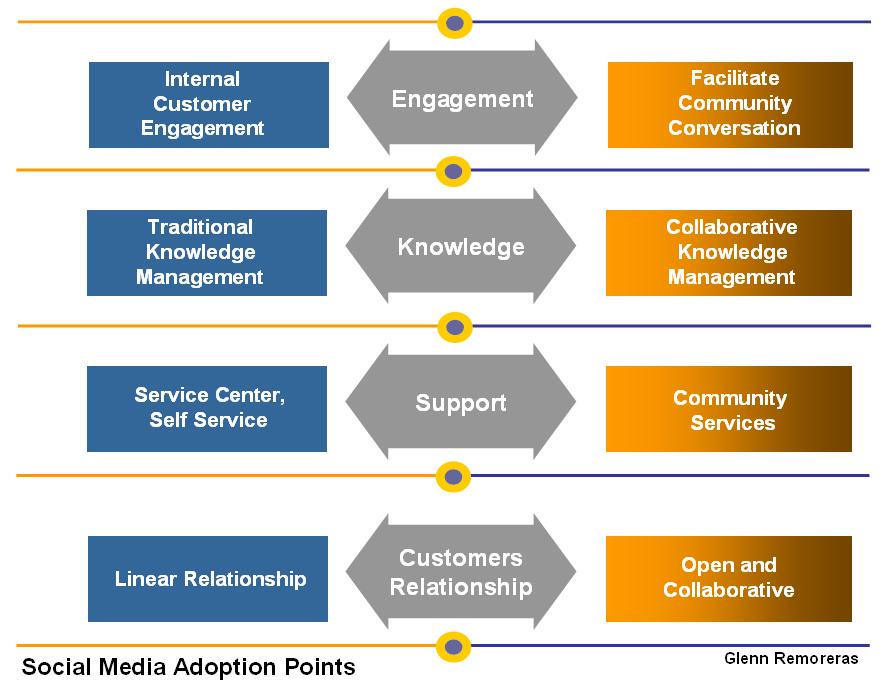
I see four areas where shared services can utilize social media: (1) Engagement, (2) Knowledge Management, (3) Support, and (4) Internal Customer Relationship. If you are already thinking of implementing Web 2.0 practices in your organizations, here are possible adoption points:

  1. Engagement — Engagement means enabling a community for your internal customers where they can freely interact with you and with each other. We are used to linear and traditional engagement with our internal customers. We communicate with them through traditional media like email, phone or personal visits. Think about the advantages of being able to talk to your internal customers in community groups where the best way to engage them is to communicate with them openly. Your role becomes that of a facilitator, leading the community engagement, which, in turn, results in value-creating collaborative outputs.
  2. Knowledge Management — As shared services, we keep track of process documentation, how-to’s and training materials. We keep these documents in certain locations for easy deployment to our internal users.  Sometimes we enable portals to publish them and they become directly accessible to internal customers. Knowledge Management, the “social” shared services approach, is ceding control of this documentation to power users and the users’ communities — much like Wikipedia allows us to change its content collectively. The role of shared services now is to ensure the quality of the updates, edit content when necessary, and provide feedback to the community.
  3. Support — This is not intended to replace existing support groups. ‘Social’ support is just opening up a collaborative support channel — the ‘community support services.’ When end-users have questions, they can post these in a community and anybody can answer. Additionally, shared services support personnel can engage these end-users directly. Expert users and even regular users who are members of the community can also assist by providing links to how-to’s and wikis already available in Knowledge Management. If the questions and the answers are worth documenting, someone will update the how-to’s and wikis so everyone can have access to the latest version.
  4. Customer Relationship — With social media, customer relationship management (CRM) becomes open and collaborative. Social CRM extends beyond traditional CRM by focusing on people and collaboration. Processes covered by traditional CRM and will not be replaced — social CRM in a way supports CRM by focusing on meaningful engagement, on content and conversations. For shared services, going social on CRM is equivalent to interacting with customers through communities, wikis and blogs; enabling customers to critique the services; encouraging customers to share ideas and creating platforms in partnership to improve value creation.

‘Social’ Shared Services Model — Six Components

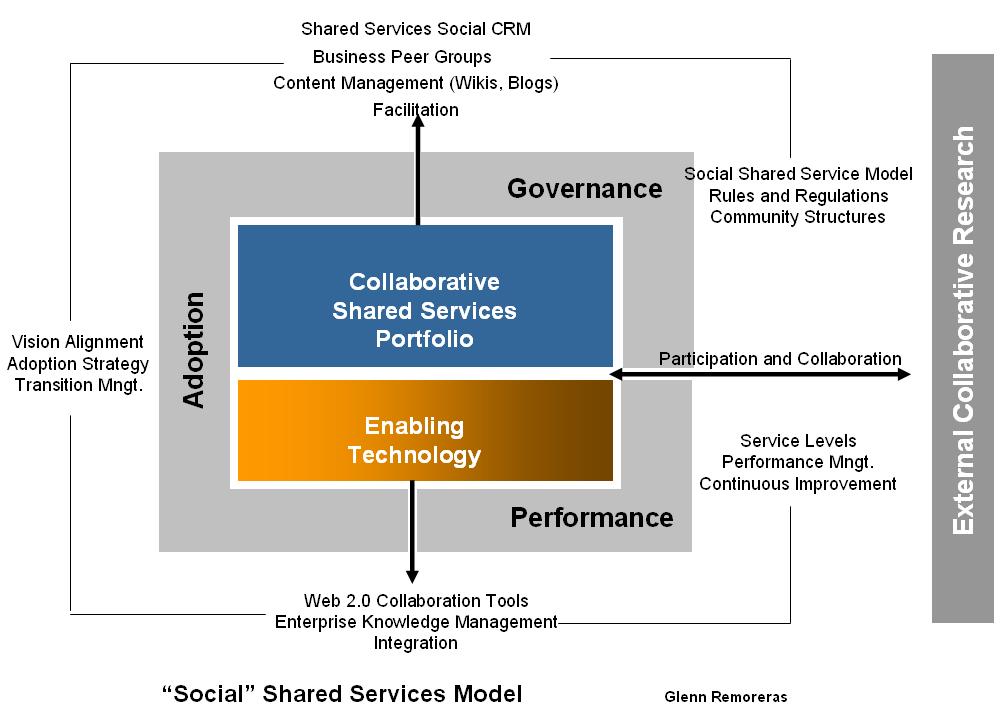
‘Social’ shared services are existing shared services organizations that embrace social media practices and the Web 2.0 platform to increase the efficiency of the network’s value. An added principle of ‘social’ shared services is enabling the power of ‘participation’ and ‘people.’ The core function of shared services that go ‘social’ remains the same — to deliver transactional and other non-core services to the business units. The main differentiation is the culture and practice of open collaboration with internal and external entities using new collaborative Web 2.0 tools. ‘Social’ shared services enable the communities and facilitate conversations with business users, thereby creating new ‘interaction points.’

Six Components of the ‘Social’ Shared Services Model

Collaborative Shared Services Portfolio — New channels enabled during the implementation of the ‘social’ shared services model. In a way, these new channels facilitate new forms of service offerings —these are the shared services social CRM, business peer groups, knowledge and content management and facilitation services.

Enabling Technology — These are the Web 2.0 platform and applications available in the market that support collaboration, enterprise knowledge management and integration. Web 2.0 toolsets, including collaboration and productivity tools, use these technologies to help businesses deliver applications more flexibly and cost effectively.

Adoption Strategy — Implementing the Web 2.0 toolset is the easy part. The main challenge is the adoption process. Adopting social media in a business setting is a cultural change process. Not everyone is used to this way of working and the implied new collaboration practices. There should be a strong strategic principle that guides shared services through social media adoption and thereby ensures the chances of success. This adoption process does not have shortcuts; it can’t be forced upon employees.

Governance — Web 2.0 tools are equipped with powerful communication and dissemination technologies that may be difficult to control. To mitigate risk, the first thing that the organization should establish in this initiative is the governance strategy. Governance strives to bring order and sustainability to what would otherwise be a chaotic environment of ad hoc communication and information dissemination. This governance will include community policies, rules and regulations and community structures.

Performance — Similar to shared services’ traditional service offerings, ‘social’ services portfolios also need service level definitions. Examples include how a shared services staff member is expected to answer a support question in a community blog, the performance of shared services in community facilitation, etc. The objective is to measure the effectiveness of the new set of services. Part of the goal in performance monitoring is to draw up continuous improvement initiatives.

External Collaborative Research — Why do it alone when you can participate and collaborate with peers? Innovative platforms and collaborative communities leverage technology and facilitate sharing of experiences and best practices. This type of collaboration brings together a broad pool of individuals with different areas and levels of expertise. This is the component of the ‘social’ services model that branches out beyond the internal ecosystem of the service organization and the company. 

Conclusion

The ‘human network’ is an adaptive entity and it is constantly learning. It is happening already in consumer communities — why can’t it work internally, in service organizations? Today’s service organizations are under pressure to give business users access to information on-demand. Internal customers are more fickle and demand a different kind of response: more flexibility, greater innovation, more attention, etc.

Social media and technology are rapidly changing today’s businesses. This creates pressure on organizations and on the people in them to constantly adopt. Is it time for shared services organizations to adopt social networking practices and tools? I think you can best answer that question. Some businesses have already started looking into Web 2.0 adoptions. I think it’s just a matter of time before social media practices and the Web 2.0 toolset becomes more prevalent in organizations globally. ‘Social’ shared services will be able to support and promote a globally integrated virtual enterprise and extend the discovery and use of expertise across an entire ecosystem. Web 2.0 technology will help shared services bring together interaction among people, information and data to drive new opportunities and to foster communities.

View full PDF version published in Shared Services and Outsourcing Network >> Social Shared Services.

Follow Glenn Remoreras on Twitter.