Across industries, leaders are facing a perfect storm: softening markets, mounting technology debt, and unprecedented pressure to scale with AI. Gartner estimates that by 2027, more than 70% of enterprises will adopt AI in at least one business domain, yet fewer than half will achieve measurable business outcomes without modernizing their foundations.
For many organizations, the reality is stark: technology landscapes remain fragmented, low in data maturity, and limited in scalability. This creates barriers to growth, stifles innovation, and leaves gaps in automation and security.
The Opportunity
Yet, moments of pressure also create opportunity. We are at a true inflection point—a convergence of technology advancement, business need, and the acceleration of AI.
For CIOs and business leaders, this moment calls for a deliberate shift: building integrated, intelligent, and scalable enterprise architecture.
The AI Flywheel
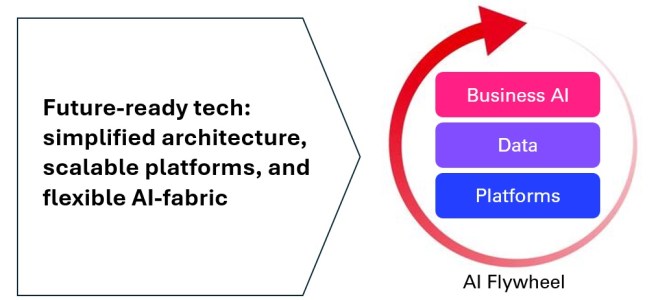
Traditional enterprise architecture often emphasizes layers, roadmaps, and governance. While these are essential, they can feel cumbersome in today’s world of constant change. The AI Flywheel reframes architecture as a dynamic, reinforcing system—where applications, data, and AI continuously accelerate one another.
Instead of a top-down blueprint, the flywheel emphasizes motion, momentum, and compounding value. A powerful way to think about this transformation is through the lens of the AI Flywheel.
- At the base are applications (Apps)—the systems and platforms that run the business, from ERP to CRM, Supply Chain and Human Capital systems. These generate the transactions and interactions that fuel the enterprise.
- At the center is data—the connective tissue that transforms raw transactions into insights. When properly governed, integrated, and matured, data becomes the engine of enterprise intelligence.
- At the top sits Business AI—the layer that turns applications and data beyond predictive models and task automation, agentic AI systems reason, plan, and act with a degree of autonomy.
As the flywheel turns, each layer reinforces the others: modern applications create higher-quality data, which in turn powers more advanced AI use cases. Those AI insights then feed back into the apps, driving efficiency, better decisions, and continuous innovation.
While the AI Flywheel offers a powerful framework, it’s important to recognize that the layers themselves—applications, data, and AI—are still evolving rapidly. AI architectures, in particular, are far from settled, with breakthroughs in agentic systems, reasoning models, and orchestration frameworks emerging almost monthly. This uncertainty makes it critical for enterprise architecture to remain modular and flexible, allowing organizations to adapt as the AI stack matures. By designing for adaptability rather than permanence, enterprises ensure they can integrate new capabilities, swap out components, and scale with the technology’s trajectory—without being locked into outdated choices.
When designed intentionally, the AI Flywheel creates a self-reinforcing cycle of optionality, growth and capability.
From Fragmented to Future-Ready
This shift mirrors what many industries are grappling with:
- From fragmented → to integrated
- From reactive → to intelligent
- From rigid → to scalable
According to McKinsey, companies that modernize their tech foundations before scaling AI achieve 30–50% faster adoption rates and significantly higher returns on digital investments. The implication is clear: AI maturity is only possible on modern foundations.
One of the key learnings from transformation programs is that this work requires co-leadership between IT and the business. Enterprise architecture is not just an IT blueprint—it is a business design challenge. When both sides co-create the future, organizations move faster, align stronger, and unlock more value. For leaders, the critical questions to ask are:
- How can we architect the AI layer effectively on top of the enterprise stack?
- What lessons can we draw from modernization journeys in other industries?
- How do we balance speed of innovation with long-term resilience?
We stand at a crossroads where business necessity and technological possibility converge. The organizations that act now—investing in integrated, intelligent, and scalable technology—will be the ones best positioned to thrive in the age of AI. The call to action is clear: be future-ready by design—and set the AI Flywheel in motion.
 #Perspectives