I have written extensively about the technology architecture required to power an organization’s AI ambitions. For many companies, the starting point is not AI. It is technical debt, or solving for the underlying technology foundation that is often fragmented, rigid, or outdated. Adding more AI tools into it only takes you so far as interesting pilots and pockets of productivity, but you will struggle to build the capability, optionality, and speed required to scale AI across the enterprise.
I describe the technology architecture as a three-layer cake (1,2). Platforms at the foundation. Data in the middle. AI on top. Each layer enables the next. Modern platforms create flexibility and connectivity. A strong data foundation makes enterprise information accessible, governed, and usable. AI then turns that data and capability into intelligence, automation, and increasingly, autonomous action. This architecture creates the AI flywheel effect in terms of value for companies who do this right.
The Technology Trap: Why Technology Alone Cannot Scale AI
Companies are starting to figure out the technology side of the AI equation, and yet with 94% of companies reporting no significant value from AI deployments and only 7% achieving enterprise-wide AI scale (3, McKinsey), it is clear that technology architecture alone is not enough. BCG captured it well with the 10-20-70 rule: 10% algorithms, 20% technology and data, and 70% people, process, culture, and change (4, Boston Consulting Group). Most organizations invert that ratio. They overinvest in technology, underinvest in adoption, and then wonder why their AI transformation never escapes the pilot phase.
It turns out the three-layer cake is just one piece of the puzzle ultimately required to achieve enterprise-scale transformation. AI, like “digital transformation” before it, is a reimagining of the business as a logical consequence of emerging AI technologies. When people used to ask me what digital transformation really meant, my answer often surprised them. Digital is never the technology. It is not a program, a role, or a roadmap. Digital is a way of doing business (5). The technology matters, but only as a consequence of rethinking how decisions are made, how work flows, and how value is created. In practice, this means examining every role as a mix of tasks requiring human judgment and tasks that are routine and repetitive. As world-leading AI strategist Sol Rashidi puts it, AI is “unbundling” every job: agentic AI handles the routine, humans handle the judgment, and the winners rebundle human effort toward higher-order problem solving.
The world needs a resurgence of the business process reengineering focus reminiscent of the 1990s, this time aimed at broader organizational transformation through artificial intelligence. In 1993, Michael Hammer and James Champy had a radical premise: stop automating broken processes and start obliterating them. Three decades later, enterprises face a strikingly similar inflection point.
The Missing Layer: Business Architecture
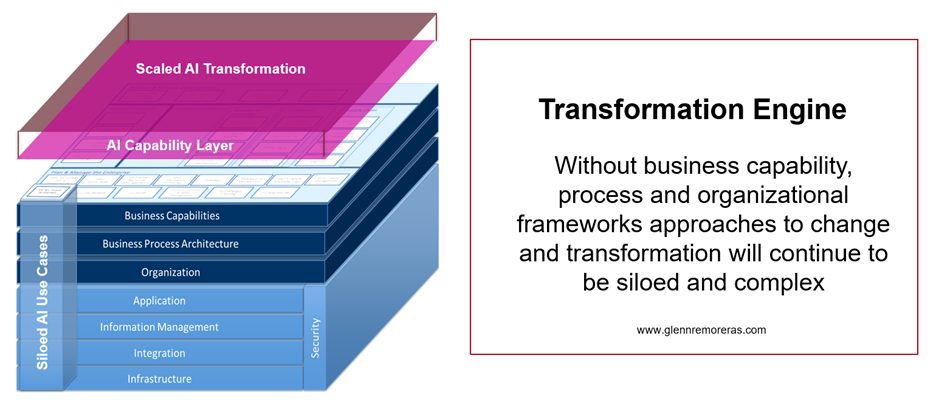
Here is what most organizations miss. The AI flywheel (the three-layer technology cake), as essential as it is, only represents half of the enterprise architecture required to scale AI. Sitting on top of the technology architecture is another three-layer structure: the Business Architecture. It consists of:
- Business Capabilities that define what the organization does and where it creates value
- Business Process Architecture that defines how work flows end-to-end across the enterprise
- Organization that aligns people, roles, and governance to those processes

Without this layer, technology has no strategic direction and organizing principle. You can have the most modern platforms, the cleanest data, and the most advanced AI models, but if you have not defined your business capabilities, mapped your end-to-end processes, and aligned your organization to them, AI will remain confined to functional silos. It will optimize fragments rather than transform the whole.
When you see it this way, the reason most AI initiatives fail to scale becomes obvious. Organizations are deploying AI into the technology layers without first establishing clarity in the business layers above them. They are automating tasks without understanding the processes those tasks belong to. They are building intelligent applications without mapping the capabilities those applications serve. They are introducing AI agents without redesigning the organizational model that governs who does what.
The technology architecture (three-layer cake) gives you the foundation. The three-layer business architecture gives you the steering wheel. You need both. And critically, the business architecture must come first, because it determines where AI creates the most value, how processes should be redesigned for human-agent collaboration, and which organizational changes are required to sustain transformation at scale.
Executing business transformation with AI
Recognizing the need for business architecture is one thing. Executing it is another.
In Part Two of this series, I will explore how to put this into practice. Successful enterprise transformation requires four strategic phases that connect strategy to execution:
- Deliberately define how you operate our business through a clear operating model that establishes the necessary level of standardization and integration across markets and operating units
- Choose where you will differentiate by selecting a competitive advantage lane that defines how the organization wins
- Translate strategy into process execution playbooks through business capabilities and process redesign, enabled by data and technology
- Execute with discipline through a deliberate multi-year roadmap that prioritizes initiatives, aligns investment to value, and ensures disciplined execution at scale
These four elements form the bridge between knowing what needs to change and actually changing it. They answer the question that every leadership team eventually confronts: we understand the architecture, we see the opportunity, but how do we sequence and sustain transformation across a complex, multi-market enterprise?
The 90s provided us with the necessary discipline. Modern tools offer optionality and speed. With agentic AI, we may finally achieve the transformation pace that today’s business environment demands. But pace without structure is chaos. In Part Two, I will show how these four elements create the structure that makes speed sustainable.
(1) https://adastracorp.com/podcast/think-of-it-as-a-three-layer-cake-platform-data-ai-says-glenn-remoreras-cio-breakthru-beverage-group/
(2) https://www.linkedin.com/pulse/ai-flywheel-building-technology-architecture-age-glenn-remoreras-y16gc/
(3) https://www.mckinsey.com/capabilities/strategy-and-corporate-finance/our-insights/where-ai-will-create-value-and-where-it-wont
(4) https://www.bcg.com/publications/2026/scaling-ai-requires-new-processes-not-just-new-tools
(5) https://glennremoreras.com/2018/08/22/digital-is-a-way-of-doing-business-2/

