Facets of High Quality IT Services (Branding IT Organization Part 3)

In Part 1 of this series I talked about branding in general and how IT branding is linked to the Process Culture maturity of an IT organization. In Part 2, I listed the different rewards IT organizations can derive directly or indirectly from having a strong IT brand. I also defined the concept of IT Brand Identity and IT Branding. 

  • IT Brand Identity marks the tangible representation of your IT brand. This representation can be in different forms – your mission and vision, your service offers, culture and style.
  • IT Branding is the process of building and improving IT brand identity.  This identity or culture is shared by employees and groups that control the way you interact with each other and with stakeholders outside of t he company.  

I derived the idea of associating quality of IT service delivery and IT branding from the opinion shared to me by William Gearhart. Bill is the VP of Information Technology of the organization I work with. Bill’s comment was as follows: 

“Critical to the success of any company or its branding is the business model and the success of delivering it hourly, daily, weekly, etc. You can brand any identity but it is the delivery and focus of the team that moves you up the ladder of respect within an organization.” 

Bill goes on to say: 

“I believe you establish the partnership and respect, apply your brand and then focus on assuring your service delivery and processes move forward with the organization(s) you are supporting and enabling.” 

The relentless pursuit of high quality IT services is central to IT branding. It is the factory that creates meaningful stories in the hearts and minds of our internal customers. These stories ultimately shape the perception of your internal customers – thus, strengthening your IT brand identity. High quality IT service is the best IT brand identity. For a service organization like IT, the surest way to create trust is consistency in the delivery of services. 

Facets of Quality in IT Services 

Quality is the best problem solver. IT organizations that consciously pursue quality in all its services take a proactive approach in problem management. This pursuit guides IT organizations on which problems to solve first and which opportunity to seize. Problem management practices are essential in this effort. First of all, problem management should be proactive. It should be focused on studying trends in order to reduce recurring issues and ensure long-term solutions by addressing root causes. Reducing IT incidents directly helps in improving customer or end-user experience in using IT services.   

Quality is the best customer relationship. High quality in IT services is the silent salesman. Consistency in IT service delivery will create good perceptions and a positive experience for internal customers. I think that a high level of quality enables IT to function as a business partner of its customers. Somehow it is the same as selling a product in the market. No matter how much you spend in advertising and promotions, if the product is questionable and does not have good quality, it will be difficult to sell. It is important for IT to focus on delivering high quality products and services right the first time. This is done through effective change management and high quality implementations. 

Quality is your best identity. IT branding and quality of IT services delivery are two sides of the same coin, in that high quality IT services creates a good IT brand identity. The level of quality in your company’s IT services determines how your organization is perceived by your partners and internal customers. It is important for IT managers to understand that the organization establishes its brand by building trust. The best way to create trust is consistency in providing high quality services.   

A Final Note: 

One can define quality in many different ways depending on the point of view. However, quality in the perspective of a service organization such as IT is defined entirely by the customers. The customers’ perception is reality. Quality is based on the customer’s assessment of his or her entire customer experience which is the consolidated evaluation of the organization’s different touch points. Again, I believe that the persistent pursuit of high quality IT services is central to IT branding. High quality IT service is the best IT brand identity. For a service organization like IT, the surest way to create trust is consistency in the delivery of services.

Photo courtesy of  www.zebratranslations.co.uk

IT Team Culture and Branding (Branding IT Organization Part II)

Branding IT Organization Part I talked about branding in general and how IT branding is linked to the Process Culture maturity of an IT organization. This time, I will further define the concept of IT branding and how it relates to team culture. Jose Rivas, a colleague of mine, posted this as a comment in my last article:


“Branding is something that everyone in IT does every day– it is how the user community perceives you. I believe that branding is a reflection of the culture that drives the IT organization, or any other group for that matter. Purposely branding IT takes a lot of thought and effort. It requires a clear vision, effective communications within as well as outside IT, strong executive sponsorship and a well-motivated organization.” 

I couldn’t agree more with this opinion of Jose Rivas on IT branding as a reflection of the team’s culture. Branding has a lot to do with human perspective and the forces that are created in social and organizational interactions. It has a lot to do with your group’s identity and culture.

IT Brand Identity and IT Branding

IT Brand Identity marks the tangible representation of your IT brand. This representation can be in different forms – your mission and vision, your service offers, culture and style. It is what you stand for. IT brand identify is the set of values that exists in your customers and employees’ mind as a result of interaction and associations with your IT organization.

IT Branding is the process of building and improving IT brand identity.  This identity or culture is shared by employees and groups that control the way you interact with each other and with stakeholders outside of t he company. It is the value you create that gets reinforced every time your internal customers interact with anyone in your team and any facet of your service.

Improving your IT brand: Why bother?

Below are just some of the rewards IT organizations can derive directly or indirectly from having a strong IT brand.

  • IT will run more efficient operations because they align all decisions with the mission, vision and values that underpin their promise.
  • Internal customers (business) are willing to invest more in IT because they believe it will deliver outstanding benefits.
  • Quality of IT services concretes internal customer loyalty.
  • Business supports IT projects because they know that IT creates value in the company.  
  • It is easier for IT to communicate new service offers.
  • IT will find it easier to attract and retain good employees because applicants believe in the quality of the workplace based on the advance knowledge of the caliber of the brand.
  • IT will increase its value and management support

The bottom line for IT managers and employees is that if they do not become conscious of the team culture in which they are embedded – those cultures will control them. This process is complex and multifaceted. Every IT team must learn how to become a team. They have to find their identity and use it to their advantage. 

Photo courtesy of advanceweb.com.

Branding IT Organizations

Recently, I was involved with the redesign of a newsletter for our organization. I have always believed that communication is an integral part of any service organization – including IT. What we communicate is our story and our promise. This creates a perception to our internal customer about who we are and what we are about. At first glance, IT organizations and branding seem to be mutually exclusive.  However, I disagree. 

Branding in General

First, let’s talk about branding in general. Many professionals confuse the term “branding” as synonymous to “advertising”, “communications”, and “marketing”. They use it interchangeably. This confusion is costing companies a lot of money. Companies that market their products or services without first establishing their brand identities are not likely to achieve their objectives. Branding is about the customer’s perception of your product. It is the image of your products and services in relation to your organization.

Now how about branding in an IT perspective? This goes in line with the general concept of branding. IT branding is finding and knowing your IT organization’s identity. In many small- to medium-sized companies, internal customers only interact with IT when they have computer and IT application issues. This shapes their understanding and perception of the kind of IT organization they have. Branding for these IT organizations is getting their users to think that they are the sole solution to their IT-related problems. Once your IT is perceived as “only”, there is no place else to call.

How to Grow your IT Brand

The IT organization’s brand grows as the company expands. The IT organization’s brand evolves as the enterprise matures through the different levels of Process Culture maturity. Take time to revisit the article that I posted last year on Process Culture. As your organization’s Process Culture evolves and IT takes on a more important role, your IT brand grows with it. The IT organization’s identity is linked to this Process Culture maturity. 

Just like the most popular ones in the market today—Apple, Coke, Marlboro, Google, the business has to strive to grow and improve its IT organization’s brand. It is important that the IT organization must have a good understanding of the internal customer segments in order to position its services appropriately. In small IT organizations, this means positioning support so as to solve more IT computer issues and improve internal customer service. In more mature organizations, IT can position services to create more business value. IT branding will help your organization become the partner of choice internally.

I like the article Russ Aebig wrote about branding for IT organizations, entitled “Attraction of Identity”. He started with some very good questions and I am sharing it here because I want to end this article with the same questions: “As an organization, who are you? What is your internal and external story? If you cannot crisply define yourself in a few words you likely have a problem on your hands.”

Photo courtesy of ignitionblog.

Climate Change— is your IT Department going Green to help the environment?

I had the opportunity to meet with some good friends and colleagues while vacationing in the Philippines last month. A colleague of mine, Roland Vera Cruz, who leads Alternative Fuel projects in CEMEX Philippines, encouraged me to write about Green IT Initiatives. We talked extensively about his enthusiasm for energy efficiency and green initiatives. Is your IT department going green? Desktops, laptops, printers and all other IT equipment account for 9 percent of all energy consumed by businesses. Did you know that a typical computer (CPU and Monitor) sends 1,000 pounds of CO2 into the atmosphere every year? To put that into perspective, 20 computers will equal CO2 emission of a midsize car.  There are a lot of opportunity areas for IT to contribute in Green initiatives, starting with improving energy efficiency of the IT infrastructure. 

Based on a McKinsey report, 60 percent of global executives view climate change as important to consider within their companies’ overall strategy and nearly 70 percent see it as an important consideration in managing corporate reputation and brands. No wonder there is a lot of buzz about green strategy. I hope this translates to the importance company leaders place on the environment and not merely a gimmick for corporate image building. 

Climate Change 

In nearly all the places I have been this past 5 years, I have personally experienced serious evidences of the shifting global climate. While in Germany during the winter of 2005, I remember Germans being anxious about a particularly unusual winter. The temperature wasn’t going down like previous years. They worried that insects that normally perish during the long winter chill will survive and propagate, impacting ecological balance. Another example is the great flood in Manila just last year — I talked about it in one of my articles. The rainfall was unprecedented and some low-lying areas were reclaimed by growing lakes. Lastly, just arriving in Florida this month, I was greeted by an unusual winter chill (which turned out to be record low temperatures across the state and, in some areas, it even snowed in sunny Florida). It troubled farmers that the famous Florida orange crops might be freezing. The signs are obvious everywhere. What can we do to help in each of our industries? 

Challenge for IT 

CIOs and IT managers in many multinational companies now face growing pressures to become more sensitive to their companies’ energy consumption and environmental impact. It is evident with the rising trend. More major companies are implementing comprehensive plans for green IT practices and technologies. According to the new study by Forrester Research Inc., about 28 percent of companies are into Green IT initiatives. That’s up from 20 percent in April of 2008. 

One of the primary ways to pursue IT Green initiatives is through energy efficiency. The challenge for IT innovators and industry leaders is to continue to come up with ways to support the constant need for increasing computing performance without increasing power consumption.  I think a thorough understanding of IT energy consumption and operations is the groundwork of this initiative. From this foundation, IT leaders can work out strategies to help them improve IT efficiency, address emissions and reduce energy costs. Results of these initiatives must be measured against business goals. Many organizations have demonstrated that significant return on investment can be achieved from pursuing green initiatives through energy savings.

IT can also take advantage of business process initiatives. Some business process projects can be Green initiatives if some specific objectives are integrated into the overall vision— whether the goal is reducing the company’s carbon footprint, decreasing overall transportation and distribution costs, finding alternative fuels, improving operational efficiency and optimizing supply chain.

The following are questions that IT leaders must consider in their quest for Green initiatives: 

  • Are we looking for ways to improve IT operations and generate more computing performance without increasing power consumption? 
  • Are we looking to assist the business in transforming processes so as to reduce environmental impact for operations end-to-end? 
  • Do we have a strategy to educate our employees, contractors and partners about means to contribute to green initiatives and help the environment?

These questions summarize the challenges for IT managers to develop IT practices, policies and technologies that are both good for the planet and good for business. Going green is really about using IT and industry best practices to create more efficient processes which benefit both the company and the environment.

Keep it Simple- Build a Little, Benefit a Lot

Typically, big companies invest one percent to four percent of revenue in IT. This investment is usually spent on integrated business model implementations, continuous innovations, and day-to-day IT operations. There must be a way to assess and take full advantage on the return of these investments; otherwise, IT organizations cannot move from being cost centers to value centers. Optimizing the value of IT is a top priority in today’s tough economy. Companies rush to reduce IT operating cost and IT capital expenditures mainly because of falling revenue sources. 

Many companies are so focused on evolution in order to always be steps ahead of competitors. They, at times, push themselves hard through IT implementations and afterwards, fail to take advantage of the benefits. They resort to old habits, making change process difficult to achieve. 

Keep it simpleOnce you implement new systems and processes, you need to aggressively drive value creation from it. Peter Weill, in his book IT Savvy wrote, “The firms that are best at this start driving value early. If you start driving value early as you take the first small steps towards building it, you will reduce the disruptions of major transformation. The goal should be—build a little, benefit a lot; build some more, benefit some more; and so on.” 1 In other words, keep it simple! Now is probably the best time to resort to this time-tested principle where investment is placed only on IT solutions that are cost effective and that deliver better value and greater performance for the business. Below are just some key initiatives that can help organizations maximize value of IT in a company. 

Define Clear Strategic Vision 

The first step is to have clarity of strategic vision for each of your IT portfolios. Executive managers in Steering Committees have the responsibility to clearly define the main business objectives of projects and portfolio of projects. They are the ultimate architects for the organizational transformation that will happen. The objectives that they define will guide IT project leaders in their decision making and will help them prioritize business requirements. 

Maximize ERP systems 

Most big firms implement a digitized platform anchored on a major piece of purchased enterprise resource planning software such as SAP and Oracle. Implementation should be kept within the standard configuration as much as possible. This is a difficult challenge though. Of course, some business requirements cannot be addressed by standard functionalities. They will have to be developed or coded to change standard functionalities of the application to suit business needs. The challenge is to keep the balance between benefits and costs of these developments. Keeping solution within the platform configuration standards will reduce consulting cost, configuration and development effort. In the long run it will reduce cost of IT operation and application support. Additionally, companies can leverage on continuous evolution of those ERP platforms whenever new releases and versions become available. They can change to the new version without lengthy and costly upgrade process. 

IT Infrastructure Consolidation 

Data center consolidation is a major focus of many organizations today. According to Computer Economics, in 2008, 76% of organizations had some level of activity in the area of data center consolidation.  It is one of the most essential ways to lower the cost of IT operations. Bigger data centers are simply more cost-effective on a per unit basis. Therefore, for many organizations, consolidating multiple data centers into a single facility should be a primary strategy for cutting cost. Additionally, this consolidation effort can also result to mitigating risk and improving service levels. Concentrating computing resources into one or a small number of physical locations can boost the productivity of IT assets and personnel. It will also simplify IT operations management. Most organizations will realize quantifiable returns from such efforts. 

1 Weill, Peter. IT Savvy: What Top Executives Must Know to Go from Pain to Gain. 2009.

 Simple Processes

Achieving the Highest Level of Process Culture Maturity

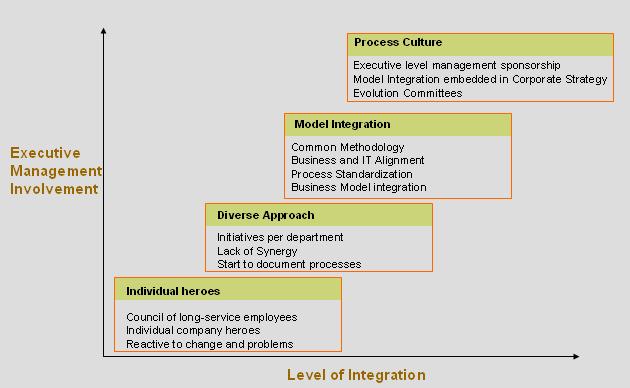
Last August 13, I published an article entitled “Accelerating Process Culture” which talked about the four different levels of process culture maturity in a company. There are two underlying criteria used to qualify the different levels of process culture maturity– level executive management involvement and level of business process integration. 

When executives exhibit a strong commitment to the process and technology evolution of the company, they always bring everyone on board. Executive management has the authority to push company-wide change as well as fund processes and IT initiatives. They are responsible for aligning the company’s structure to the business integration strategy; therefore, they enable the organization to advance to a higher process culture maturity. Let’s revisit the four levels of process culture maturity:

  • Level 1: Individual heroes – dependence on individuals or a few company experts
  • Level 2: Diverse Approach – initiatives per department but lacking in integration
  • Level 3: Model Integration – business and IT align and model integration is achieved
  • Level 4: Process Culture – executive passionately participates in process initiatives

 Process Maturity Levels

This time, let’s examine closely the highest level of process maturity—The Process Culture. The final step of process culture maturity is when the organization achieves a high level of model integration by leveraging the consistent involvement of executive management as sponsors and facilitators of change.

There are three factors that determine the right approach towards process culture maturity.  Let’s call it the “SIB factors”. S stands for senior management involvement, I for innovation and B for business model integration.

Senior managers and managers alike are the critical success factors in your organization’s process culture journey. They lead the way in building process culture and defining the operating model. Innovation in information technology is also a key component. Successful companies nowadays rely on an integrated set of electronic business processes, tools, information, and technologies. With proper support and funding, an IT organization should be able to provide the right platform and technology in which to build the foundation.

The next thing that the company needs to do is to make sure that they select the right business process model from among the many tested disciplines and existing operating models. The underlying logic here is that a company’s business model is limited by the environment. In other words, it depends on several factors, such as the industry it operates, the products and services it sells, its size and geographical diversity. Using all these factors, you determine the level of business process standardization and the level of integration of the company’s different businesses — with profitability and competitiveness requirements in mind. Shared services, outsourcing, diversification, standardization, model replication are some of the most prevalent business models multinational companies have implemented. 

The real question is: how close are you and your company to getting to the highest level of process culture? This is a guide on how to assess the level of process culture maturity of an organization. Again, the examples are outlined using the “SIB factors”. Observe the following points and evaluate how your company is doing right now.

Senior management involvement

  • Top executives participate in the IT and Processes evolution committee.
  • Requires thoroughly analyzed business cases and encourages measurement of acquired benefits.
  • Pushes for post-implementation audit to evaluate project output and acquire lessons learned.
  • Encourages collaboration across business lines and functional teams.
  • Funds IT and Process initiatives and actively support training in the use of IT.

Innovation:

  • Exhibits a strong sense of innovation, feelings of shared interest to continue to improve and be ahead of competitors
  • Holds regular management briefings on the impact of new technology developments and process innovations in the industry.
  • Establishes a consolidated IT operation that manages a standard IT platform to sustain day-to-day support functions to business areas.
  • Encourages use of IT in the business. Users possess a feeling of empowerment and confidence in the effectiveness and reliability of the processes and systems. 
  • Strives to leverage new technology, platform and methodology with sufficient effort in research and development in the area of processes and IT. 

Business Integration:

  • Defines a clear vision of model integration and process standardization.
  • Uses a best-in-class enterprise resource planning software to run an integrated set of business processes
  • Promotes implementation of end-to-end processes to ensure the efficient flow of activities and effective allocation of decision rights and accountabilities.
  • Captures business information in one area and shares it to another business area. Possesses the willingness to share and use information to measure and improve key performance.
  • Maximizes reuse of business processes and platform across different business lines.

Achieving a high level of process culture maturity presents a host of challenges to an organization. The SIB factors provide a structured framework where initiatives can be drawn and strategies derived. This will propel your company forward through its process culture maturity journey.  Achieving the highest level of process culture maturity requires strong executive sponsorship and IT leadership in order to support the company through a change process. When achieved, the company is in a good position to leverage IT for profitable growth and gain competitive advantage in a global market that knows no boundaries. This leap begins with you and your company’s senior managers.

Taking Advantage of the IT Extended Network

The number of IT professionals expecting to see budget and head-count cuts grew significantly as more large-business decision-makers turn to cost-cutting measures in 2009 due to the failing economy. This has resulted to project postponements and headcount reduction. IT managers worldwide are scrambling for resources necessary for day-to-day operations and support without distressing IT service delivery. The good news is that IT managers don’t have to look further for help. The answer lies within the boundaries of the same organization it serves – resources are there and it could be plentiful.

During an IT project cycle, users and resource persons from the business are invited to participate. They are integrated into the project to work with the core IT and Process team. They assist in the design and validation of business processes. They conduct integral testing and facilitate training of end users. In larger initiatives, they ensure that business operation requirements are well represented.

I refer to this group as the Business Competence Team or BCT. Organizations call them in different ways: Process Teams, Power users, and Evolution Teams. BCT is composed of employees who have superior knowledge of the company’s processes and tools but do not necessarily report directly to the IT core organization. They are users from operations with extensive knowledge of applications and thus have certain privileged access to systems.  

The BCT is IT’s extended network. They represent the business during project implementation and when they go back to operations, it is the other way around. At this point, they embody IT within the business operation they serve. Their knowledge of the business model and more advanced know-how of the application differentiate them from their peers. They are IT’s partners within the organization.

The challenge for IT managers is to take advantage of this extended network and tap into a readily available resource pool and fill in the void left by headcount reduction.  It is cost effective and a perfect win-win situation for IT and the business. These are just some of the functions that BCT can perform: 

  • Support – Serve as resource persons of end users in operations and as active participants in the IT support network
  • Enabler – Assure continuous system and process evolution by participating in process forums and evolution network meetings
  • Trainer – Reinforce the standards of best practices and better use of application capabilities. Also responsible for continuously training end-users during system upgrades.

It is important that a program is established to enable the BCT team.  This initiative should have a clear set of goals, expectations and rules. IT management should initiate this program and rally top management support. The strategic intent is to relentlessly pursue involvement of BCT members so they can participate in the evolution process as well as onsite assistance to peers. Naturally there are important factors to consider in establishing a Business Competence Team Program. I will discuss more about this in my upcoming article.

Accelerating Process Culture

It seems like distant past when big companies rely on individual heroes to facilitate process initiatives. They are long-service employees who became the experts of how things and processes work in the company. They are always consulted because of their inherent authority– business owners and managers listen to them. Think about them as company elders and gurus whom we seek advice from when things go wrong and consulted whenever changes are planned.  

When a company relies and is solely dependent on its individual heroes for change and process enhancement, it is on its 1st level of process culture maturity.

Process Maturity Levels

The second stage of process culture maturity is the Diverse Approach.  This is when the company starts to utilize standard methods and best practices to drive process design and innovation. Oftentimes at this stage, different areas in the organization implore varying approaches and therefore, less synergy is achieved. Standard operating procedures (SOP) start to shape in each department and documentation becomes an integral part of process implementation. In many cases, at this point, IT and business approaches tend to clash and technology becomes the focus of project implementation.

Companies move up to the Model Integration stage when it builds more synergies throughout the organization. Very successful multinational companies such as P&G, CEMEX, and ING DIRECT take advantage of Model Integration by consolidating functions and developing its shared services. P&G, for example, has established Global Business Services (GBS) — a shared service organization that provides the company a platform for continuous global growth while maintaining values of innovation, service, customer responsiveness and business efficiency. Companies at this level adapt a consolidated method to design and implement business models using standard processes and tools. The project team discipline ultimately improves as management breaks silos and approaches process and technology implementation equally.  The common tendency is for companies to establish global standards and to consolidate both IT infrastructure and human resources, thereby reducing cost of operations.

The final step to Process Culture Maturity occurs when innovation and change in business practices through process understanding are consistently promoted within the company. When executives passionately embrace process thinking, they are able to promote innovation more confidently when implementing new technologies.

Many organizations have gone a long way from the days when company individual heroes were the sole initiators of change and process innovation.  Yet it’s difficult to predict what comes next — as technology evolves, industries consolidate, and Web 2.0 quickly becoming the new platform.

Four Key Elements of a Process Initiative

No two process implementation initiatives are the same. It varies in scope, objectives and limitations because of budget, time, resources, and complexities. Although process initiative projects may vary, there are four key elements which assure good results. These four critical items are: (1) Process Definition, (2) Process and Activity Roles, (3) Available Tools and (4) Training.

Plain and simple reality- these elements are inseparably linked. The absence of one element will hugely affect the result of the process initiative. On the contrary, if the factors all are well attended to, you can expect excellent results.             

Many process initiatives fail because:

• Processes are not well designed and documented. People in operations were not involved in the design process.
• Processes are well defined but roles are not clearly assigned in the organization as to who is responsible and / or accountable for a certain process.
• In some instances, limitations in the tool or lack thereof make the organization resort to workaround and this is time-consuming and costly.
• All systems go but people are not well trained, resulting to inconsistency in process execution

To give a more tangible example, let’s say that you are implementing a logistics dispatch system. You have selected the platform and made sure that it is customized based on the needs of the operation. During the process design, different levels of the organization were involved and consulted. You came up with a clear and concise documentation of the processes and roles that will perform the activities. Roles are defined, assigned to personnel in the organization and was clearly communicated. System procedures and policies are in place.

Then you and your team decided to forego the well planned training program that you have scheduled to speed up the rollout of the initiative and reduce travel costs for people who will need to come from different dispatch locations. You are comfortable with the training manuals and the quick guides. Communication is already done and the operational support structure is in place.

Your decision to forego one key process initiative element will result to the following possible outcomes:

• Dispatch process will be executed inconsistently depending on the user’s personal understanding of the manuals and materials.
• You can be flooded with manual errors due to the user’s unfamiliarity of the system.  This results to spending more time in correcting and stabilizing these errors.
• You risk affecting customer service delivery because of probable incidents like wrong orders and delayed deliveries

The project team in the example above seemed to have done everything correctly.  However, they made one crucial and costly mistake.  User training, as with the other elements, is equally important.  Neglecting one of the key elements could result in project failure.

This does not mean to say, that the project team must focus solely on these four key elements. These cannot substitute existing important process and project implementation methodologies and practices. These key elements are only intended to complement whatever process implementation methodology you follow.

Process Elements