The Helpdesk Model – What It Means to Put Helpdesk to Work and Improve

Have you considered the impact your IT helpdesk has on the business you support? Think about your company’s reliance on technology and IT applications— when service interruptions happen, they impact processes and cause business disruption. The IT Helpdesk is much more than answering the phone and helping users solve their IT problems. Helpdesk has a direct impact on running the business, providing quality customer services and ensuring business profitability. If you are implementing an IT helpdesk in your company or in the process of improving your existing one, this article is for you. First, let’s discuss the IT Helpdesk Model. The diagram model shows the eight components of the IT Helpdesk Model. Each is briefly described below.  
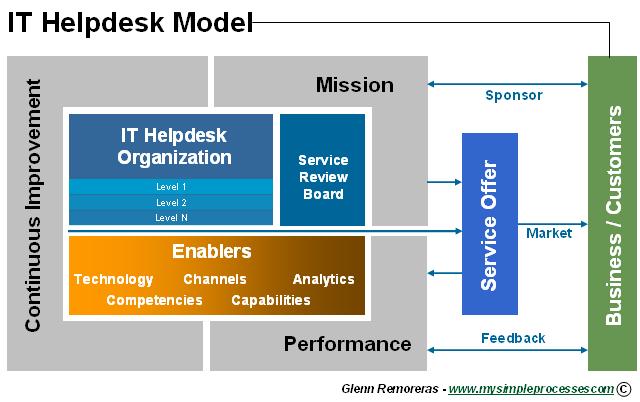
Eight Components of the IT Helpdesk Model 

  1. IT Helpdesk Organization – This component represents the managers, staff, functions and supporting groups that comprise the IT helpdesk organization.
  2. Enablers – Enablers are tangible and intangible components needed to operate the IT helpdesk. This includes technology, tools, communication channels and analytics. Other important enablers are the required competencies of the individual staff working at the helpdesk and the group’s combined capabilities. 
  3. Service Review Board – The  Service Review Board is the steering committee or sponsor of the IT helpdesk organization. The group is composed of key IT managers, business/customer representatives and (if necessary) external consultants. They are responsible for providing strategic guidance, support, resources, and feedback to the group. 
  4. Business / Customers – This represents the customers that receive the IT helpdesk services. Your customers are everyone in the company; not just everyone who has computers, but everyone who has access to one that uses it as part of his / her function. It is important for IT helpdesk to know its customers and be able to identify and segment them. 
  5. Mission – The mission statement is the declaration of purpose, values, direction and tactics. It governs how the IT helpdesk will run its service delivery to its customers and guide every interaction it has with the users. 
  6. Service Offer – Your service offer represents the scope of your services to your customers. The services that your IT helpdesk provide are determined by business or customer needs. A good service offer is composed of service elements that are manageable and provide the best value to the business. 
  7. Performance – It is critical for part of the IT helpdesk function to be tied up with performance measures.  Performance should be measured periodically if the service offers are attained in a satisfactory manner. This component represents performance indicators that have to be defined and tracked. Performance also includes how the IT Helpdesk receives and handles feedback from surveys and customer focus groups.  
  8. Continuous Improvement – This component is tied up with performance measures. Your IT helpdesk will have to adjust services regularly — as business changes and as your customers demand more. Continuous improvement includes working on actionable items from performance monitoring or data analysis. 

Five Ways to Improve Your IT Helpdesk

1. Understand your Purpose, Involve your Customers and Set the Right Expectations  – Understand what senior management and your internal customers expect. Have focus group discussions with business leaders and key customers. Listen to feedback—positive and negative. Understand their concerns and identify opportunities. Invite your key customers to join and participate in your Service Review Board. When you and your customers communicate and understand what your service offers are, it easier for you to keep them satisfied because you have set the right expectations for your services. 

2. Establish a Clear Mission Statement  – Your mission statement is your declaration of purpose and values. This will set the direction of the group on how to interact with customers. It governs every interaction that deals with a call, request or problem. Putting together a mission statement must be a collaborative process. Let key members of the helpdesk and internal stakeholders participate in putting together a mission statement. A sample mission statement could read, “Focus on the needs of the business and support the customer in making the best use of technology in business.”  A sample value statement would read, “We aim to minimize downtime by restoring service as fast as we can. We solve problems, not symptoms, and work to resolve the root causes.”

3. Develop Needed Competencies and Roles. – To have an effective helpdesk organization, there needs to be clearly defined roles and an effective way of performing them. The major competencies and roles within helpdesk are: stakeholders, problem solver or experts, data analyst, communicator, and the customer service liaison. Stakeholders are represented in the IT Helpdesk Model as the Service Review Board. This group is established to provide sponsorship, guidance and support to the IT helpdesk organization. Problem solver and experts are senior members (level two or higher) of the helpdesk whose task is to solve escalated problems and find solutions to recurring incidents. Data analysts consistently mine helpdesk databases for trend analysis. The Communicator is responsible for the continuous improvement of helpdesk communication and customer service competencies. They are also responsible for call quality assurance. Customer Service Liaisons are members of the helpdesk who manage customer relationship and gather feedback from the customer through surveys and focus group discussions. 

4. Develop Your Service Offer – Your service offer should be tied up with your mission, customer need, budget and internal capabilities. Focus on providing services that give the best value to the business. Eliminate non-value creating services from your portfolio. If you provide too many services on a broad range of domains, you are setting your helpdesk group up for failure. Avoid situations where your resources are thinly spread and customers with important needs are forced to wait while you attend to a service that does not create value. Services are manageable, supportive of the business needs, well defined and well understood. After defining your service offer, communicate and market services to your customers. Remember that the service offer needs to be adjusted on a regular basis in order cope with changes in business needs, budget and customer expectations. An example of service offers are: “Provide support between 6am to 7pm daily. Allow customer channels such as email, call, voice mail, chat, and intranet site. Provide consulting on software recommendations. Broadcast information about system availability and planned maintenance. etc.” 

5.Have a Culture of Continuous Improvement – Most existing IT Helpdesks have massive amounts of data at their disposal—yet fail to utilize it in any meaningful way. Running an IT Helpdesk means gathering a lot of data for the purpose of evaluating service performance and resolving problems. Use data effectively to discover valuable insights and evaluate performance versus set target and objectives. Use data to conduct trend analysis on recurring issues so as to implement proactive measures in reducing the number of calls and incidents. Have a culture of continuous improvement. Don’t settle for mediocre performance. Always challenge your IT Helpdesk to continuous improvement in every aspect of the service it provides.

Please share with us your experiences in implementing and managing your IT Helpdesk. What were the challenges and key learnings? You can also post your questions about the topic so that I and readers can respond to them. Thank you.

Follow Glenn Remoreras and IT Branding on Twitter.

25 lessons for work (and life)! — 3-minute coaching sessions

in collaboration with Ira Fialkow and Ivy Remoreras

” You can have as many mentors as you need – people that excel in different disciplines and that exemplify different values. In my career, I’ve learned that mentoring is a process of engagement and inspiration, in as much as it’s a process of learning from someone. Truly successful people raise others up. They don’t feel threatened. Instead, they find reward in seeing others succeed. “

Is there a secret formula for success in business – and in your career?  Probably not. But I believe it makes sense to learn from the people I respect and who have been successful themselves.

Case in point: Ira Fialkow was the Executive Vice President for Shared Services at CEMEX, until recently. His career spans 25 years and he is a highly respected leader in his field. I consider myself fortunate in having had the opportunity to work in his organization. Our collaboration continues, even today. I continue to learn from Ira, and he says he continues to learn from me! I believe that people thrive best, and succeed, when they have the opportunity to develop under the tutelage of those who precede them.

This series marks the culmination of 25 business lessons documented and developed by Ira over the past 25 years of his career. They were learned the hard way: through experience. Ira used to distribute these lessons to the team every year. The lessons changed slightly, over time, as new ideas emerged and new learnings were incorporated. In this series of 25 short articles, I will endeavor to share the 25 business lessons that I’ve learned from Ira and our shared services team.

The series is split across five sections.

  • Section 1 is about continuous self-improvement. In any endeavor, change begins with oneself. You cannot create a successful organization, nor be successful yourself, without the drive to do better and be better.
  • Section 2 is about creating a better work environment, and leads on from Section 1: Improving oneself means improving one’s professional atmosphere; no real change can be achieved without this.
  • Section 3 is about customer service: Every business unit has a customer, whether internal or external. And just because you don’t have direct dealings with the company’s external customers doesn’t mean you don’t have customers of your own. If you work for the payroll department of a large fast-food company, your customers are the employees in the payroll, and you need to know how to provide good customer service.
  • Section 4 relates to improving productivity. This includes eliminating bureaucracy and other things that hamper good service delivery. Let’s say you have great products and can provide good service. If it’s not affordable, easy to use, and timely to the customer, then it just doesn’t matter. 
  • Section 5 involves competitive advantage.  Much has already been written about competitive advantage, I know. But you’ll be surprised at some of the simple things you can do.

Section 1: Become addicted to constant and never-ending self-improvement

Each journey begins with a single step. In terms of change, this means starting with oneself. The six business lessons in this section suggest that everyone, irrespective of the successes already achieved, benefits from continuous self-improvement.


Business Lesson 1 : Have a mentor (even if they don’t know it). Be a mentor (someone is watching you).


Have a mentor (even if they don’t know it)

Most guides to mentoring start with advice on how to find the right mentor. This generally takes the following approach: (1) you have to look for a mentor with broad knowledge about the industry as well as expertise in the area you specialize in; (2) you have to find a mentor who is successful and on whom you can model your career; and (3) you have to formalize the relationship between mentor and mentee to make it long lasting and successful.

Given all that – how can you have a mentor(s), and they don’t know it?

Ira explains his philosophy: “Formal mentoring programs are great but why wait for one to come around? Mentoring is about  behavior. It’s about doing the right things in the workplace, because first and foremost, it’s about personal integrity and character – as well as the fact that someone is watching you, and will emulate your behavior. I was extremely lucky, early in my career, when I was able to work with some great co-workers and supervisors who had a solid set of personal values coupled with results-oriented work disciplines. I emulated many of these behaviors and they helped shaped my leadership style.”

What you do in the office is observed by the people you work with. Positive behavior creates positive impressions, which people will emulate. On the other hand, consistently below-par behavior can cause problems in the organization by creating dysfunctional teams.

Having a mentor means finding someone to emulate and learn from (even if they don’t know it). You can have as many mentors as you need – people that excel in different disciplines and that exemplify different values. In my career, I’ve learned that mentoring is a process of engagement and inspiration, in as much as it’s a process of learning from someone.

At its very core, mentoring (whether mentor or mentee) is about wanting to improve yourself, in alignment with your goals.

Be a mentor (someone is watching you)

The shared services organization that Ira established and led for many years was the first recipient of the SSON’s “Best Mature Shared Services” Award in 2003. How did the organization earn this prestigious award? Ira has always attributed success in shared services to excellence in providing service to customers at an overall value that is better than other options. We have a very strong customer service culture within the organization, and this culture actively encourages mentorship.

Ira explains: “If you choose a positive attitude, show respect towards your customers, and treat them as if they are the reason for your organization’s existence (which they are!), this behavior develops into norms and values and permeates your culture, subsequently becoming the core of your service culture.

“But creating an excellent service culture requires that you practice the positive behaviors that will govern the value system of all the members of the organization. Mission and values statements are all well and good, but it’s the consistent behaviors that are emulated and put into practice, that become the values of the organization.”

This lesson reminds me that I can become a mentor simply by doing the right thing. And I can do this in every aspect of my life, wherever I interact with people – in the office and at home. Mentoring is two-way, or multi-way, each individual learning from the other. However, if I want to be a mentor, I need to understand myself first. I have to work hard in pursuit of excellence and integrity, and I have to be generous in sharing my knowledge.

Douglas Lawson describes it well: “We exist temporarily through what we take, but we live forever through what we give.”  I believe truly successful people raise others up. They don’t feel threatened. Instead, they find reward in seeing others succeed.

Being a mentor means inspiring commitment, building insights and motivating people to focus on the goals and behaviors that matter.

Business Lesson 1 Takeaways:

  • Mentoring is about behavior and doing the right things in the workplace; not just because it’s right, but because someone is watching you and will copy your behavior. It becomes the norm, and the norm underpins the values of the organization.
  • Positive behaviors create positive impressions and people emulate them. Consistently observed poor behavior, on the other hand, could spell problems in the organization and create dysfunctional teams.
  • Creating an excellent service culture requires that you practice the positive behaviors of the organization’s value system. “Customers” are the reason you are there! 
  • At its core, mentoring (or having a mentor) is about seeking inspiration to improve yourself in alignment with your goals. Mentoring is two-way or multi-way, each individual learning from another.
  • Whether you know it or not, you are a mentor to someone right now.

 We encourage you to write (as comments in the post) your own thoughts and experiences about mentoring (in business and life). This will enrich the topic and discussion for all the readers. Thank you.


About the collaborators:

Ira Fialkow is the SVP of Member Services at Peeriosity. Peeriosity is a confidential network of leading companies from across the world committed to collaborating openly with each other in a completely secure environment with interactions free of consultants and vendors. Prior to Peeriosity, Ira was EVP of Shared Services at CEMEX and Rinker Group (acquired by CEMEX is 2007) from 1990 through joining Peeriosity in October 2010. Rinker Group was the initial recipient of the Best Mature Shared Services Award in 2003. Ira lives in Palm Beach Gardens, Florida and has been the champion of his fantasy football league in three of the past five years.

Glenn Remoreras is an IT Manager at CEMEX. He brings over 12 years of experience as an IT director, business processes manager, project leader, and consultant. He has focused on enabling business solutions through the use of IT capabilities. Glenn has been involved with various post merger integration projects. 
 
Ivy Remoreras is a marketing professional with eight years of extensive experience, particularly in product management, communications and promotions as a manager, university instructor and consultant. She believes in constant learning and has a Masters degree in Business Administration (MBA). Having resided in Europe, Asia and North America, she speaks four languages.

Photos courtesy of www.ssonetwork.com.

Of Donuts and Pep Boys – My Most Bizarre Customer Experience Ever!

Can you remember your most bizarre customer experience ever? Let me tell you mine.  It just happened today! There are lessons to be learned in all experiences — even the most bizarre one. After reading this, I encourage you to write your comments or share your own customer service story. 

I went to a Pep Boys car service center for routine service maintenance today. I parked my car outside and immediately proceeded to the service counter. When I walked in, there was only one service staff member at the counter and he was busy assisting another customer.  So I waited in line. Soon after, he greeted me warmly and told me that he’ll attend to me shortly. As a customer waiting in the line, it feels good to be acknowledged. After a couple minutes, it was my turn. I told the service staff member that I was there for routine periodic maintenance. He asked me for pertinent information about my car, the mileage and went on to suggest maintenance work recommended for my car. He provided me with valuable information to help me decide on a service option. After that, we chose a service package. I didn’t have to spend time giving other additional information; they’ve got my data in the system from my previous visits.

Aside from taking my car for maintenance, I had another motive for going to Pep Boys today. I needed copies of my previous maintenance service documents. My car dealer, where I purchased my car a few years ago, needs proof of periodic car maintenance for a service warranty issue. So I asked the Pep Boys service member for my maintenance records in the last two and a half years. I was impressed on how he was able to quickly pull up information and print records. He even explained to me – one by one — the types of maintenance service my car has gone through. I thought it was really impressive service—above and beyond expectations. It was so much better than I thought it would be. I was a happy customer.

At the end of that initial interaction, the service member told me that my car will be ready in 45 minutes. I normally ask how much time it would take, but this time the service staff beat me to it. He gave the promise promptly and so I told him I will come back in 45 minutes.

When I left the service center, I was their happiest customer.  I walked to the nearby Dunkin Donuts store to get myself some breakfast. I was so overjoyed with the customer experience that I even bought a dozen donuts for the service staff member who assisted me and for the other service crew working at Pep Boys. I thought it was the least that I can do to express my appreciation for the excellent service they provide their customers. If I can’t give monetary tips—for sure a dozen of donuts will express my gratitude.

While waiting at Dunkin Donuts, I wrote a tweet on my Blackberry that I intended to send shortly after I leave Pep Boys. I was tempted to send the tweet right away, but decided at the last moment to save it as a draft and wait. The draft tweet went like this:

“Today I bought a dozen Dunkin Donuts as a gesture of appreciation for the Pep Boys staff and service crew for their excellent customer service.”  (Tweet that I never got to send)

I ended up staying an hour and a half at Dunkin Donuts as I enjoyed my cup of coffee and worked on my book. I got so preoccupied with writing that I lost track of time. I only realized that more than an hour had passed when my wife called me. She was at her baby shower, was packing up and ready to go. She told me that I could pick her up as soon as I was ready. Because I was so sure that my car was ready and waiting for me at Pep Boys, I told her I will pick her up shortly. It was almost two hours since I left Pep Boys and I was promised the car would be ready in 45 minutes.

I walked back with my dozen donuts and looked forward to giving it to the staff and service crew as a token of gratitude. Opportunities to affirm service personnel for their excellent service always make me happy. I always look forward to opportunities where I can affirm people for excellent work that they do. Upon entering Pep Boys, I noticed my car was parked just outside the store, so I was assured that the service was finished and the car had been waiting for pick up all this time.  So I walked to the counter where two service personnel were talking. They were not assisting anyone but I thought they were discussing something work-related. Unlike earlier that morning, no one acknowledged or greeted me. I thought it was a big difference from that morning’s experience.

I just continued standing by the counter and observing the personnel carry on their conversation, with my dozen donuts now on top of the counter.  I didn’t say a word. After a couple of minutes, I saw the same service staff member who assisted me earlier. He walked past me and went back outside. He didn’t acknowledge me and I thought that maybe he was just busy.

I decided to just stand there by the counter and wait (ever-patient customer that I am). Finally after waiting for several minutes, one of the service personnel (perhaps realizing that I have been waiting a while) at the counter finally asked, “Has someone attended to you already?” I answered, “No, but I am here to pick up my car that was serviced this morning.” She asked for my name and immediately tried looking for my paperwork. I had a feeling something was wrong when she could not find my papers on the pile of finished work. The lady started asking around if someone had serviced an Audi. It was only then that my original service person responded and told me that they haven’t even started work on it yet.

What?!  I had reason to be mad as hell but I wasn’t. I could complain to the manager but I didn’t.  Instead, I very patiently reminded the service person that helped me earlier that he promised the car will be ready in 45 minutes. It was now nearly two hours later. As a customer, I just expected an apology and explanation. But to my surprise, he became very defensive and explained that the service crew busy servicing other cars and 45 minutes was just an estimate, not a promise. He did not apologize and was very close to being rude.

I did not argue nor complained; I just told them that I will wait. So I took my dozen donuts and sat in the waiting area. I took out my tablet and proceeded to write about my experience – most of what is written here – and waited for another 45 minutes.

It was so strange. My customer experience form earlier that morning to what happened afterwards was as different as night and day. I thought about how things could change so abruptly in just two hours — how inconsistent and how bad. But this is not the end of the story—you will be surprised at how it concluded.

My plan was to just get my car after the service, drive home, eat my donuts and post this blog. I approached the counter after 45 minutes and a different service person arrived with my car key. He sincerely   apologized. He told me that I did not owe them anything for the service and they were sorry for making me wait for so long. I thought it was a nice gesture. I surely did not expect to get something out of it because I kept my cool and did not even complain. How did they know that I was furious and so frustrated inside? I thought they read the situation well.  I also thought that the last service person I spoke with responded well and turned things around a bit.  I tried to explain to him what happened earlier that morning and even told him about the donuts intended as a token of appreciation for the excellent service I anticipated (but sadly did not get).  In the end, I wasn’t completely satisfied but decided to give the donuts to the hardworking service crew (that did the actual work on my car) and left.

As you can imagine, this was such a weird customer experience—a definite roller coaster ride. I wouldn’t wish anyone to experience what I went through today but I learned a lot. I took the opportunity to observe rather than complain. I did this with the intention of writing about it and providing customer service insights to my readers.

From today’s experience, here are my customer service takeaways:

  • Customer service delivery must be consistent. That is how you will win customer loyalty.
  • Don’t make promises unless you will keep them. Be careful of what you promise to your customer. That will create the expectation of the service. Reliability is one of the keys to any good relationship, and good customer service is no exception. Try to keep your promise or exceed your promise as best possible. That’s how you wow customers with your service.
  • When you fail to deliver, it is very crucial to acknowledge, empathize, explain and give a sincere apology. More importantly, don’t be rude and defensive.
  • When a mistake is made, customers want it to be handled quickly and to their satisfaction. They want some kind of action that acknowledges a mistake was made and every effort is being done to correct it. When you recover, you may find that your customer is even more loyal than before.  

What do you think about my experience today? What would you have felt or what would you have done if you were in my situation? Have you had the same bizarre customer experience before? Would you return to Pep Boys if this happened to you?

Photos courtesy of Ivy Remoreras Photography.

Follow Glenn Remoreras on Twitter.

Build Value Proposition That Improves IT Customer Experience In and Out

Refine Your Service Value Proposition

IT organizations are service organizations. They don’t become service leaders through sightless evolution. IT leaders must engage their counterpart business unit leaders (i.e., the heads of logistics, purchasing, etc.) to have a good grasp of their own departmental goals, plans and objectives. Understanding the strategy and goals of the business it serves is critical to the alignment of objectives. The IT organization can provide better service if it understands the objectives of internal customers.

Revisiting the IT value proposition during annual planning sessions is an important exercise for IT managers. This will help IT managers understand the real and softer elements that are the differentiators of IT services. For internal customers, Value Proposition is the collective services they receive upon investing in IT capabilities and services. We have to understand that it includes more than just the core IT services (equipments, applications, and connectivity), and even more than just quality— it also involves several softer variables that will differentiate the total service offering such as responsiveness, innovation, collaboration and commitment.

These are two perspectives representing the two words of the terminology “Value Proposition” itself— “Value” and “Proposition”. This is broken down into: 

  • Value (Internal Customer’s Perspective) = The benefits received by the business upon investment on IT capabilities and services. 
  • Proposition (IT’s Perspective as Service Provider) = The total offering to the customer in exchange for their investment. 

IT best practices such as Information Technology Infrastructure Library (ITIL) and IT Services Management (ITSM) ensure that IT is aligned with the goals of the business organization. IT’s challenge is beyond technology. Its challenge is to deliver services that enable the business to balance performance, quality, risk and cost. IT’s attention is shifting from discrete technology initiatives to optimizing the value of business services delivered by IT, driving positive business outcomes and improving customer experience. 

Commitment to the business’ end-customer

Although the IT organization’s direct customers are typically internal (the business units), IT is expected to play an important part in the ultimate value proposition— the value proposition to the customers of the business units (the end-customers). When I was an IT business process manager in the Philippines, we used to program appointments that will require IT personnel and managers to accompany Area Sales Managers on their sales visits with customers. These visits allowed us to experience the action from the frontline and engage our end-customers. At the time, we were implementing Internet and mobile applications to enhance customer service management. These personal meetings with end-customers allowed me to hear first-hand the affirmations, complaints and suggestions. That experience enriched our perspective and allowed us to improve and design better customer solutions for our commercial organization to sell and serve to our end-customer.

Do your information technology (IT) capabilities enhance the experience of your internal customers (business users) and external customers (customers of your internal customers)? Do IT managers throughout your organization recognize their responsibilities for effective customer relationship and business alignment? What’s it like to actually walk in your customers’ shoes?  Do you know what your customers actually experience? Simply put, do your IT capabilities achieve meaningful differentiation by enhancing customer experience, in and out? 

Photo courtesy of Ivy Remoreras Photography.

Follow Glenn Remoreras on Twitter.

What Prioritization and Planning Can Do for You

Prioritization and planning are two sides of the same coin. Planning is thinking about the tasks required to achieve the desired goal on some scale . Prioritization is ensuring you are doing the right tasks. Planning and prioritization are two of the best skills a manager can have. They ensure good use of your own efforts and those of your team. 

Prioritization is making the best use of your limited time and resources when demands are seemingly limitless. Every single day a manager is bombarded with demands with “ASAP” written all over it. Unending meeting requests, continuous daily reports, pressing operative issues and urgent project tasks — you name it—the list goes on and on and on! If you get into that vicious cycle of trying to do everything, you’ll end up burned out, frustrated and unhappy.   

Prioritization in principle means doing “first things first;” as a process it means evaluating a group of items and ranking them in order of importance and urgency.    – Business Dictionary

Your day only has a limited number of hours, this is the same for your week, your month, your year etc. There is a maximum number of things that you can possibly do (with good quality) in a period of time— therefore you need to prioritize.

If everything is important then nothing is important. If you qualify the “not-so-important-tasks” as very important it devalues any other “more-important-tasks”. 

Start your day by devoting a fair amount of your creative energy to planing your day. This will jump start your day on the right track. You will know your action items (things that matter) and backburners (tasks that can wait).

Perhaps a year is a much longer period but even though, there is a maximum number of things you can do in a year—therefore, you still need to prioritize. Annual planning sessions are important endeavors for companies wanting to set priorities right for the year and align objectives with strategic goals. Nothing beats starting the year in the right direction; you have a game plan and you understand what needs to be done to accomplish your goals.

By planning ahead you are in the best position to adjust priorities. Proper planning is building enough room into your plans for additional demands. New demands pop-up and they may also be important. Adjusting priorities is commonplace; you should always assume that there will be unexpected requests. Set aside time for them. As long as they are important tasks that bring you closer to you goal, they must be done!

Photo courtesy of Ivy Remoreras Photography.

Building an Excellent IT Services Culture

Why do your employees feel uncomfortable about being empowered? Why don’t they follow the instituted risk and change management processes? Why don’t they put customers first? The answers may lie in your control systems — and the fact that mediocrity is too easily accepted.

Whenever an IT organization excels in providing services to its customers, its customer service orientation is guaranteed to be deeply embedded into its culture.

Culture is one of the softer elements of an organization’s identity but it’s extremely important when you want your organization to improve its service delivery system.

Culture offers answers to some really difficult issues in IT services delivery, such as:

  • Why employees feel uncomfortable and somehow do not want to be empowered (Review your control systems — your controls might be too tight to encourage empowerment. You might also be surprised to find that making mistakes is severely punished.)
  • Why employees don’t follow the instituted risk and change management processes. (Check the extent to which anyone actually follows protocol.)
  • Why getting employees to put customers first is so complicated and why there are so many complaints about poor service. (Review what happens when employees fail repeatedly in tasks and have so many complaints against them—most likely nothing! Mediocrity is tolerated!)
  • Why critical IT problems are recurring. (Check approach to problem management. Most likely you are reactive in terms of issues resolution. You do not address the root causes of the problems. Do you have a culture of preparedness, contingency and proactive problem management?)
  • Why employee turnover is so high even though they are paid competitively well relative to market standards. (Check the extent of camaraderie, teamwork and cooperation. Review learning practices. Are employees mentored or coached by managers and leaders of the organizations?)

If you want to improve the IT service culture of your organization, you have to understand that it is not an overnight endeavor.

Organizations don’t create culture overnight. Culture develops. There is no instant formula for creating culture or else you will end up with an artificial one with a weak foundation. Such type of culture is not sustainable. You don’t create culture by merely creating or declaring mission statements and rules. You don’t create culture by simply implementing new applications and best practices copied from other successful IT organizations. Culture happens through consistent behavior over time embedded and encouraged by leaders.

What does an excellent IT services culture look like? Like any culture, it is a collection of service traits, and behaviors that get repeated over time and embedded in the organization’s subconsciousness. The values, behaviors or traits you need to nurture and develop in your team to improve your IT services culture are as follows:

1. Customer First – Internally and Externally. 

Fostering a “customer first” attitude means creating a work culture that values the customers. It needs to be applied internally and externally. Customer-friendly behavior should be encouraged. It is important for IT, at every level of the organization, to build a meaningful relationship with its customers. This practice will help IT to understand the requirements and needs of the business and allow them to align their services accordingly. Every interaction point — from frontline service desk personnel to managers handling customer engagements — should provide a consistent level of customer service.

This “customer first” focus must also be practiced at every unit of the group — and even between themselves. Customer service behavior should not only apply to the external customers of the organization. Each individual, department or function is interdependent. At any point in time, one could either be a supplier or a customer to the other. It is simple logic. If one part is a weak link, it will impact the service of the whole. If customer service behavior is practiced on a consistent basis, externally and internally, it becomes part of the IT group culture.

2. Collaboration and Teamwork

The best teams have a commitment to help each other. The culture of shared responsibility is all about teamwork and collaboration. Developing teamwork is about creating a group culture that values collaboration. With teamwork, no one completely owns an area of work or responsibility. It is shared by members of the team. Each member is encouraged to be involved and contribute to the attainment of the group objectives. In a group that has teamwork, members believe that working, planning and deciding is better done collaboratively.

3. Proactive Approach, Not Reactive

It is important to find or identify patterns and get to root causes of recurring issues. There has to be a strong drive to solve problems and stop recurring critical issues. In addition, teams need to prepare for critical incidents because these will happen. Problem management and disaster preparedness should be built into the IT culture. This is not an individual task. It should be managed collectively and involve all areas of IT.

4. Learning Organization 

Learning is the best way to create culture and transmit culture. IT must have a culture of continuous learning. Employees who are well trained take more ownership and have an active role in operations. Attitudes become more positive and people aim to do things better. Learning in an organization should start early. This means starting the moment you hire an employee. An on-boarding program is one of the best ways to prepare employees and cultivate the kind of traits and behaviors you expect from them. In organizations with a strong service culture, new hires — who are selected in part for their service skills — quickly find out that the organization is serious about customer service.

5. Creativity and Empowerment 

Creative people don’t accept standards as a given. They are obsessed with innovation and change. They are impatient for progress and will always look for ways and means to improve how things are done. For IT organizations to embed creativity and empowerment into their culture, IT leaders must learn to value negative results as well as positive ones. When you create something new, you don’t always succeed. The culture of encouraging creativity and empowerment will lead employees to be more collaborative, effective and innovative.

Being service oriented, or more specifically, being successful and excellent with providing services can’t be achieved swiftly. A service culture has many attributes that may be difficult to achieve. If you are trying to make your organization more customer-oriented, you need to assess what customer service traits are more prevalent and what needs more work. Creating a culture of service requires that you practice the service traits we covered earlier consistently in order to develop the attitudes and norms that will govern the behavior of all the members of the organization.

Photo courtesy of Ivy Remoreras Photography.

Follow Glenn Remoreras on Twitter.

2010 in review

The stats helper monkeys at WordPress.com mulled over how this blog did in 2010, and here’s a high level summary of its overall blog health: The Blog-Health-o-Meter™ reads Wow! 

Crunchy numbers


Healthy blog!

The average container ship can carry about 4,500 containers. This blog was viewed about 16,000 times in 2010. If each view were a shipping container, your blog would have filled about 4 fully loaded ships.

In 2010, there were 29 new posts, growing the total archive of this blog to 45 posts. There were 103 pictures uploaded, taking up a total of 21mb. That’s about 2 pictures per week.

The busiest day of the year was September 5th with 232 views. The most popular post that day was Social Shared Services.

Where did they come from?

The top referring sites in 2010 were facebook.com, twitter.com, ssonetwork.com, shift.cemex.com, and itsmportal.com.

Some visitors came searching, mostly for shared services, support, monterrey mexico flooding, monterrey, and services.

Attractions in 2010

These are the posts and pages that got the most views in 2010.

1

Social Shared Services September 2010

2

Monterrey Mexico – Beyond Recognition! July 2010

3

Three Reasons Why You Need a Project Management Office (PMO) May 2010

4

Forecast 2020: Web 3.0+ and Collective Intelligence July 2010

Values My Parents Taught Me

When I reflect on where I am today, I remember the journey that I have been through — my childhood in the humble hometown of Catbalogan (in the Philippines) where our parents raised us three boys.  I see how the daring dream of parents, nurturing love, and early childhood lessons can shape a wonderful life. I know that by truly knowing who you are, your strengths and core values, you can relate to others better, gain more friends and be successful in life.

This is the time of the year when you reflect on what happened during the year and the years that have gone by. Christmas is always filled with emotions and longing to be with your family and loved ones. I have spent 31 out of 33 Christmases in my life with my family in Catbalogan. Last year, I was there too. This Christmas is the second one that I won’t be spending at home. We are pregnant with twin boys and obviously, the doctor won’t allow my wife to travel. So we are spending this holiday season in Florida for the first time. 

I would like to dedicate this post to my parents, Ignacio and Leonita Remoreras. They are the best parents in the world and I attribute most of what I am and what I have become to them. These are the values and lessons they have taught me and my two other brothers, Lemuel and Ryan, when we were growing up. 

Hardwork 

The importance of hardwork was a lesson I learned early in life. Leading to Christmas, at this time of the year, I remember my brothers and I would be busy helping our parents operate the store. My parents own a small store in our hometown in the Philippines. We initially sold mostly school and office supplies but eventually offered more and more gift items, especially in the months leading to Christmas.  December had always been a special month for the family — a month of lots of preparation and work. After school breaks for Christmas, my classmates looked forward to vacation while my brothers and I looked forward to working everyday during the Christmas break. Our parents instilled in us the culture of shared responsibility. They did not hire store helpers early on and they expected us to help in every aspect of the business. 

About 30% of our store’s annual gross sales come from the month of December. That’s how important the month is for our livelihood. You can just imagine the amount of work that it represented to us. It was a family affair to help out, and it was a tradition admired even by other friends of the family. My parents tasked us to help in the store in different ways — wrap gifts, man the cashier, assist customers and move stocks around. It was just the five of us operating the store. When I was in high-school, my parents began to entrust me with managing the store during the summer when they both travelled to Manila to buy inventory for the school opening. When I went to university in Manila, my younger brother Lemuel took over this role. (I think he was better at it than I was.) When my brothers and I moved to Manila to go to university, my parents started hiring people to help in the store.

“Cenintavo” and Malasakit (Deep Caring and Empathy) 

During the store’s off season, the business mostly concentrated on retail of school and office supplies. We sold ballpens, pencils, scissors, crayon, and many others. We even sold paper (typewriting paper, yellow pad paper and the like) by piece to customers — mostly to students of Samar College (located across the street from our store). I wondered why we sold paper by piece. My father explained that it’s about earning “cenintavo” (meaning — earning by centavo or the cent) and centavos put together make a good sum. That’s how we earn a living — “cenintavo”. That’s how my father taught me the value of working hard for small things. My parents were raising us to be responsible and self-motivated, to understand the value of initiative and caring, to appreciate the value of money and earning a living the hard way. Filipino values were inculcated in our upbringing. Values such as “pagmamalasakit” (deep caring and empathy) and “kusang loob” (initiative).

Again, when I reflect where I am today, knowng the journey is far from over,  I see that my next step is daring to dream big for my children, pursuing the same lessons and discipline, and passing on the same core family values my parents taught me.

I am citing a very old poem that I wrote during my childhood (this one is from 1992, when I was 15 yrs old).  I will leave you this year, with this poem about me, my parents and my hometown. Merry Christmas and Happy New Year!!!

My mother lives by the sea,
eats fish, crabs, shrimps for her everyday meals
She wanders the Samar island.
Walks with bare emptiness.
Crying with droplet tears of pearls.

My father braves the bridges and the soars.
He leaves home through a nightingale cast
and reaches the island of dreams,
searching pearls from oysters undersea.

Then came…
the last day of the first month known,
the mild brook begins singing songs.
The billowing wind excites
the crystal water to fall downstream.
No mural drawn, no trumpet sung
no fuming incense and amber cunning.
My rapture to the gates of the world
bears no wonder and warmth.

The firmament where I seek residence
is a town of willow and grass.
Treat and retreat come the waves
ashore to the town of wedge.
Strait of San Bernardino to the north,
the great Pacific to the east,
Strait of San Juanico to the south
the Maqueda Bay to the west.
Waters I see in every point I trudge.
Water I see in every edge.
I can go nowhere without the sea I see,
I can’t live without the sea.

Perspective view of Catbalogan with Maqueda Bay at the background

I print the map of my hometown,
roaring through, the pins print
the old town’s map.
Printing pins, printing pins,
It prints the narrow street of Rizal,
Del Rosario, San Francisco and San Roque.
It prints the narrow street of Mabini,
where I live and grow.
I print the map of Catbalogan
its schools, churches, halls and parks.
The pins go tired and weary-
they print for years now,
ever printing the changes of the town.

Photo Courtesy of http://catbalogan.lgu-ph.com/

Learning IT Organizations

We’ve all heard the saying that leading by example is one of the most powerful ways of leadership. But ironically, it’s often the most overlooked. “You must be the change you wish to see in the world,” Gandhi once said.

The best way to create culture is to transmit culture. The most obvious ways to transmit culture is through teaching and coaching. IT managers and staff look up to their senior leaders for directions.  IT leaders should not limit their engagement with their employees with discussions about operation work. They should engage their subordinates in other meaningful ways so as to help them develop themselves.

The best IT teams must have a culture of continuous learning.  In IT organizations, developing employees is not optional, it is a necessity. Development is necessary to acquire the skills and learn the knowledge needed to keep up with new technology and processes in order to achieve business goals. Additionally, development programs in volatile and competitive organizations like IT are important in attracting and retaining employees. 

Information Technology needs future-oriented leaders. Arguably, it is the most unpredictable and most innovative area of the company. If the CIO is not forward-looking, IT will most likely neither be as competitive nor at par with competitors who are relentlessly pursuing innovation. IT leaders are fascinated about the future. They are relentless about change and impatient for progress. CIOs should always be looking forward to new technology and practices that are developing, searching for new processes, tools and methodologies and experimenting how it will make sense in business in the future.  

  • How many types of developmental conversations occur in your organization?
  • How can you create a culture of learning that goes beyond traditional classroom training?
  • In what ways do your communication tools and practices help build your team’s skills for participating in conversations about goals, changes, and barriers they face?

Photo coutesy of Ivy Remoreras Photography.

Transforming the IT Customer Experience: Helpdesk and Field Support (a story…)

Imagine crashing your PC after having a virus issue. You need to call the IT helpdesk. You pick up the phone and call the 1-800 hotline number. Your expectations of the quality of IT’s response time is so low that you’ll settle for a day or two without a workstation. You imagine that perhaps you lost all your files and important documents in your computer. Service? Forget it.  Your previous experiences with the IT helpdesk were terrible, if a service agent answers your call after 5 minutes waiting on call queue, it would be a small miracle. 

IT Helpdesk

Instead— you must be dreaming— your call gets picked up after two rings and a friendly service agent greets you with, “Good morning ,sir.  My name is Kyra, how are you? How can I be of service to you today?” You are surprised but refreshed with the friendliness of the agent’s greeting. It’s unusual and has never been the case before — even during the last time you called them a month ago. You reply, “I’m good, thank you. I have a problem with my desktop. When I started it this morning, I got a blue screen after a couple of minutes. I don’t know what’s wrong. I think it might be a virus or something. It was working last Friday when I left.”  The agent quickly and confidently replies, “Actually sir, we have a virus alert this morning that affected several users. We already sent a notice by email, and of course you didn’t receive it. We were about to call you but you beat us to that. We know the root cause of the problem for certain because of the new proactive monitoring tool that we recently implemented. Your desktop is one of those affected because you run one of our old desktop models with an older OS version on it. That made your computer more vulnerable to this new virus attack.” You are astonished with the level of information the service agent has already but still you have reservations as to whether this will impact the resolution time. Sure, she is friendly and she knows what’s going on but can she solve it?

Then you ask, “Then what should we do? It sounds like I won’t be able to use my computer today or for a couple of days perhaps?”  Kyra replies confidently, “No sir, definitely not. We won’t allow that. As a matter of fact, our field-support team members are on their way to the offices of the users affected. They are making rounds as we speak.  The person assigned to assist you is scheduled to arrive at 10:00 am. I think he’ll be there in minutes.”

Communication of the Service Deal

Kyra continues, “In the meantime, if you have a minute of your time to spare, I would be glad to tell you our new service mission statement. Do you have some time, sir?” You don’t have a workstation anyway so surely you have time and this wonderful service agent deserves a few extra minutes. You reply willingly, “Yes of course. I noticed a big difference in your over-all service today so far and I am pleasantly surprised. I’d be glad to hear about your new mission statement.” Kyra continued, “Thank you, sir. I am proud to say that our management and the whole IT organization came up with a common objective of improving our overall service delivery. Particularly, our technical support department which includes first level support agents, field-support service personnel and second level specialists, have the objective of providing our customers the fastest, high quality, friendly and effective IT support.”

“Sir, do you have any questions about our new mission?”  You decide that it is good for IT to communicate its service offer and you feel special to be treated an important customer. You say, “No questions, Kyra, and congratulations. I’m really happy about your service.  This is not what I expected. You guys really improved your service in such a short time. I’m impressed. Oh wait, I think the field support is here already. I have to go.” Kyra concludes, “Okay, sir, I will call you back after the service call to check if everything is fine. I know JB will take good care of you. Thank you and please don’t hesitate to call us again if you need anything.”

IT Field Support

Then as the field support agent comes into you office, he greets you warmly, “Good morning, sir. My name is John Bryan but you can call me JB. I am here to help you with your Desktop and I want to tell you about the two choices.” “Choices?”, you wonder incredulously. Now he is going to tell you the bad news that he needs to pull out your desktop for one day. Or maybe you get a loaner — something you’ve experienced before. At that time, you were given an incredibly old PC that was so slow you couldn’t even use it. You brace yourself for the bad news but instead he says.” I brought you a new computer. It’s a laptop. I need two hours to set it up fully with all your programs and files in it, or I can try fixing your virus problem for 30 minutes so you can work and then I can set up your new laptop for delivery next week.  What do you think? ” Already impressed with the customer experience so far, you think that two hours doesn’t seem so bad. Plus, you are getting a new laptop when you were expecting at least a day of no computer.  You reply, “OK, get on with the setup of the new one. I’ll wait here.” John Bryan says, “Good choice, sir. I’m sure you’ll be pleased with this new one. And finally sir, I can give you a general overview of the many capabilities of your new laptop and programs while we wait for the installations and file transfer to finish, or I could keep my mouth shut. What would you prefer?” 

After everything was done, you realize that not only has the IT support services improved but you also just had a transforming experience. Talk about exceeding expectations! 

I believe IT leaders have the power to embed a strong customer service culture through their influence…but culture embedding is not easy…organizations don’t create culture, it is an outcome of consistent behavior (demanded or influenced by leadership). If you provide the best customer service always, it becomes your culture. We try to make positive stories like these everyday… not always the case of course, what I am painting is the perfect world of IT support services, but this is what we aspire for.

Photo courtesy of Ivy Remoreras Photography.

Follow Glenn Remoreras on Twitter.