Stories and Leaders

The senior vice president of the shared service organization that I work with is retiring after 25 years of service to the company. In a farewell gathering last week to honor his years of service and great accomplishments, 25 selected employees (old and new) took turns to share 25 business lessons learned from our retiring boss. Many of those 25 employees who stood and spoke about the 25 business lessons accompanied them with remarkable stories. They were stories that in many ways embodied the values and meaning of each of the business lessons. Being relatively new to the organization, I felt that the hour and a half of stories and messages provided me a glimpse of the organization’s founding stories, its key tenets, culture and identity. I felt a stronger sense of belongingness and understanding that I know will only help me in how I interact and collaborate with my colleagues.

Stories are powerful messages that shape the organization’s understandings of relationships and of how members deal with the mix of harmony, successes and failures that are always present in the workplace. These are past events that people talk about internally—and even externally. In some cases, leaders choose what stories to tell and immortalize. They are stories that best represent the organization’s values and culture.

Stories can also be critical experiences, major incidents, conflicts and problems that the members of the organization experienced together. The way leaders and members approached, worked through and solved critical experiences help shape the group’s dynamics. The daily actions and decisions of leaders and managers signal appropriate responses to wide-ranging issues. Because of social influence, leaders are the single most important factors and determiners of organizational culture.

Organizational culture is influenced by the leadership style. In other words, the personality, philosophy and experience of the leaders get embodied in its group’s culture. Leaders facilitate the development of organizational culture through different embedding mechanisms that align culture with the organization’s common goal and strategy.

Seven Business Lessons from 7-Eleven

I have long been intrigued by the series Undercover Boss (currently shown in CBS) but never got the chance to watch it— until last Sunday. I am so happy I did. I learned a lot of business insights from the one and only episode that I have watched so far. I just saw a replay of an episode that was first aired in February 2010. It’s the one where Joe DePinto, CEO of 7-Eleven, goes undercover in his own company by working in different operations jobs. Among DePinto’s responsibilities were: working the night shift, making donuts, and driving a delivery truck.

DePinto tells his executive team before embarking on his temporary assignments:

“I’ll be focusing on spending time in the field, where the rubber meets the road. I’m going to see what we’re not doing well, and that’s only going to make us better in the long run.”

In the end, Joe DePinto witnessed a lot of great and inspiring things from ordinary employees of varying backgrounds and at the same time he saw some areas of opportunity. I think his undercover stint was a worthwhile learning experience for him and will only improved the way he manages 7-Eleven. Here are seven management lessons that I learned from this Undercover Boss episode: 

1. Know your customers 

DePinto’s first stint as undercover boss was in Shirley, NY where he worked the early morning shift at the store that sells the most coffee among all the 7-Eleven stores. He wanted to understand the secret as to why this branch was selling more coffee than other stores. Here DePinto met Dolores — 7-Eleven employee for 18 years. He saw her passion and dedication despite her sickness; she has only one kidney and has to undergo dialysis every single day. What’s amazing was how Dolores knew all the customers by name and greeted them affectionately. She showed an up-beat and positive attitude all the time. DePinto quickly realized that the reason why that store was selling 2,500 cups of coffee per day was because of Dolores and her relationship with her customers — definitely not just because of their coffee. 

2. Replicate what works

By going undercover, DePinto discovered what he set out to discover. He learned and observed first hand how Dolores’ personal relationship with her customers brought them back to her store again and again. DePinto wanted to replicate the success of Dolores’ store in order to improve 7-Eleven’s business in coffee sales. Duplicating what Dolores does is not an easy task, but if 7-Eleven can develop a customer service culture patterned after how Dolores treats her customers, it could work! 

3. Know your employees 

DePinto’s next stint was working at 7-Eleven’s largest bakery in Baltimore, Maryland.  Here he was trained by Phil, the shift supervisor and aspiring artist. DePinto was visibly impressed byPhil’s talent as he was shown a sketch pad-full of great drawings inspired by, what else, donuts. This casual encounter in the break room led DePinto to spot a talent that could be harnessed by the company’s marketing department. Just like DePinto, I think managers should seek to know more about their employees and discover their other talents and capabilities. They must be open to harness these talents if it creates mutual value for the employee and the company. Providing employees the training and opportunities to showcase their other talents is a win-win situation for the company and its people. 

4. Employees can inspire management 

The last day of Undercover Boss finds DePinto working with Igor on a delivery truck. Igor, an immigrant from Kazakhstan, inspired DePinto with his humble story. DePinto affirmed Igor for his hard work, can-do attitude, and passion for the job during their meeting at the company’s headquarters when he finally revealed himself as the CEO. Igor replied, “I can’t say anything, I’m just doing my job.” Igor talked passionately about his “American Dream” and how grateful he is to be living it. He told DePinto how he and his wife work only see each other during the weekends because of Igor’s night shifts. Igor’s inspiration and dedication was rewarded— he is now managing one franchise for 7 Eleven.  

5. Communication is key 

Remote operations and thousands of franchisees makes the communication of programs and messages challenging for companies like 7-Eleven. During the show, DePinto was surprised to find out that one store routinely trashed day-old bakery items which were supposed to go to charity. He was visibly disappointed that these items — that should have been sent to charities as per company policy — were being thrown into the trash. It showed his real concern for the homeless and hungry.  However, he understood that it was a case of miscommunication and it something that can surely be improved through better coordination and communication from the head office. 

6. Support your frontline 

In addition, the episode showed one store that needed to replace many of its lights in the store area and in the storage area.  It was one of the chain’s highest grossing stores and its lights had been out for some time. It  not only negatively affected 7-Eleven’s image to its customers (the store did not seem well-maintained due) but was also a potential safety hazard for the employees. DePinto, as “Danny” the entry level employee, was actually tasked to call maintenance and request for the lights to be changed.  As “Danny”, he was told that it was a low priority request and the store’s lights can only be fixed in 30 days during the monthly maintenance visit. DePinto had to call his chief operations officer to prioritize the maintenance job. How we support our frontline is important to our business. They are the people that serve our customers directly. Managers need to know the reality of what’s happening in the field in order to make more sensible decisions according to the situation in the frontline.

7. Great people make great companies 

While working on the donut production line, DePinto couldn’t keep up with the speed of the conveyor belt.  This was until his trainer, Phil, showed him the trick to doing it more efficiently. That’s the case with every task in business, no matter how big or small and strategic or operational. In another segment, DePinto asked Waqas — a young Pakistani who served as boss for the night — about career plans and discovered that Waqas doesn’t consider his job at 7-Eleven to be a “career.” Waqas works the night shift in order to finish his college education during the day. Despite earning a college degree, Waqas views his position in 7-Eleven as a dead-end job because there are no opportunities for him to move up in the company. DePinto was saddened to hear this.  The CEO felt that an employee who has already worked four years for the company and is working for higher education should feel that they have other possibilities and opportunities within the company. DePinto went to say, “Great people make great companies; we can’t let them think their jobs are dead-end, we can’t win without our great soldiers.”

Image courtesy of 7-Eleven.

CEMEX’s Innovation Through Collaboration


“Self-organization, the most recent technology-fueled transformation. It’s employing technology to let people interact as they wish, with few or no workflows, rules, or hierarchy, then harvesting the good results that emerges.” – Andrew McAfee

Recently CEMEX was selected to participate in the Forrester Groundswell Awards for innovation in social media among employees. Learn more about what CEMEX is doing to leverage social tools for collaboration and its enabling platform called Shift. Participate in the Forrester Groundswell discussion online where you can vote, comment and learn more about Shift. 

CEMEX has embraced this Collaborative Revolution. It shows the commitment of the company to continue innovating for its customers. It demonstrates how it values collaboration without boundaries. CEMEX has joined the Collaboration Revolution by introducing an internal collaboration platform called Shift, designed to innovate and help make the company more efficient and agile by letting employees or groups of employees with similar objectives share opinions, thoughts, information, experience, knowledge and best practices. Since its launch more than 200 communities have been created and employees are sharing best practices across all operative units. The collaboration platform is also helping CEMEX to create new value propositions in order to maintain and improve the company’s competitive edge.

There are over a billion users of social media sites on the Internet. Between Facebook and Twitter alone there are more than to 700 million unique user accounts. Companies have stepped up to leverage these new social tools to enable self organization teams in the business with the objective of encouraging more collaboration, information sharing and innovation. One of the defining principles of social media is collaboration. Groups of people and even virtual teams with members from different geographic locations and organizational levels can work together in a project. These new collaborative tools are designed to change the way we collaborate with our extended network. It is designed to provide less structure, simple mechanics, and allows users to lead the way. This approach requires employees to communicate, to share, to interact and to generate contents and value output.

Again, you can join in the ongoing Forrester Groundswell discussion online where you can read more about Shift, comment and submit your rating.

How Gerry Dasco Brought Us Together

Our old alma mater is the only Catholic school in the small and quiet city of Catbalogan (Philippines) of around 90,000 people. Just like me, most of my classmates hail from Catbalogan and other surrounding small towns and barrios. Most of us spent our formative years together— a year in kindergarten, six years in elementary and four years in high school. We knew that our high school graduation was sort of our break-off point. From there, each one of us headed our separate ways, chased separate dreams. I went to Manila, the nation’s capital. It was common for people like us who grew up in the province to move to the big city to study and then work. A few would return home. I attended university at De La Salle University. Some chose to stay in Catbalogan and many of them now work and serve our hometown. I am proud of what we’ve accomplished individually. We are now successful accountants, engineers, doctors, nurses, pilots, educators, judge (youngest in the country), businessmen, politicians (vice mayor of Catbalogan) and many other professionals. 

Our Ultimate Social Media Guy

It is seldom that someone brings together 30 or more friends from 20 years back to reminisce the years spent together. That was what Gerry Dasco managed to accomplish for us, his high school batch mates of ‘93 from Sacred Heart College (now called St. Mary’s College). I see updates from classmates and old friends in Facebook almost everyday.  I am often just browsing and curious about what they do now and how their families are. From time to time I look at their pictures and am amazed at how older and mature we’ve become and how fate have brought us to different journeys. On a few occasions, when I am able to, I greet classmates on their birthdays and congratulate them on their triumphs. It was always limited, sporadic chance encounters and more often without  frills, without conversations… until Gerry brought us together! 

I remember Gerry as being a shy, quiet, simple gentleman in school. He was definitely not the type to gather folks together for a party with the promise of conversations, dancing and beer. Gerry waited for his moment and he did the most amazing thing— something most of us wouldn’t dare do or couldn’t do for many years now.

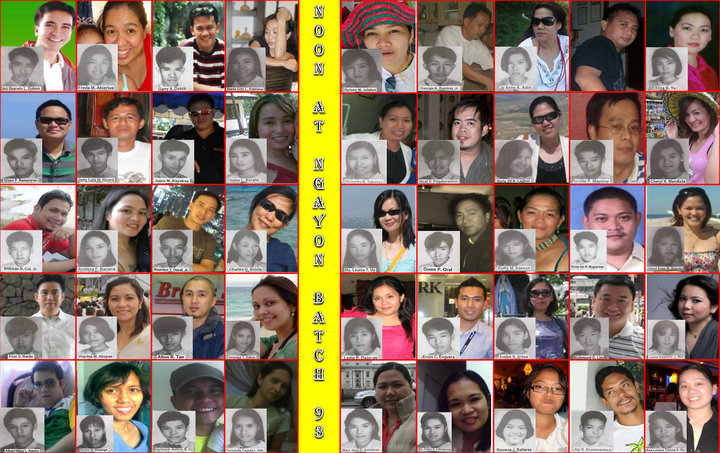
He orchestrated an event conceived so creatively. How he managed it with simplicity amazes me. First, Gerry posted old scanned pictures from his high school photo album in Facebook. He then tagged everyone, wittingly and knowingly inviting us to look.

That started the flow of conversations, sharing, questions, and remembrance. He didn’t stop there; Gerry made a collage of old photos and new photos (picked from Facebook) put them side by side — kind of showing the before and after photo of each one of us. The collage brought even more friends and classmates into Gerry’s organized (virtual) high school reunion. The beauty of it was that he even got us to take it to the next level… all the way to how we would organization the hosting of the alumni homecoming event in 2017. 

It’s amazing! A lot of us thanked Gerry for what he did; he clearly gets this social media thing that many of us are still just starting to grasp. Gerry is my ultimate social media guy! He understood that the key to successful social-networking and reunion is to be deliberate. 

He understood that the simple concept of  Web 2.0 and social media revolves around the convergence and interconnectivity between links, users, and information. 

He transformed interactions between his batch mates from just sharing meaningless frivolity to being purposeful and it naturally led to real-time conversations. Gerry was focused and thought about how to capture what is important from the network, and organized our interactions accordingly.  Most of all, he created for us our own social space. 

Thanks again, Gerry!

How IT Leaders Transmit and Embed Culture

The group’s culture provides structure and meaning to its members—in many ways it controls members’ interactions with one another and with external parties.  In this post, this concept is applied in the Information Technology (IT) group setting. The IT group culture can influence the success of the IT organization. Culture is socially constructed through leaders that embed their beliefs, values and assumptions upon the group that it leads. The culture of any IT organization is formulated and impacted by several variables. The strongest and the most obvious is the influence of its leader. According to E. H. Schein, leader’s primary embedding mechanism is seen in how they pay attention to, measure and control aspects of organization’s operations and decision making. They initiate great conversations that tie cultural norms to the organization’s goals. If the current culture is not aligned with the new realities, leaders need to be the catalyst to create new understanding and help individuals select new behaviors and, eventually, beliefs. Leaders must also define, clarify and reinforce understanding of the actions and beliefs that build the desired culture. 

To examine how IT leaders influence the IT organizational culture and IT branding let’s use some of E. H. Schein primary embedding mechanisms and apply it in the IT perspective. Each one comes with a set of questions you can use to assess the impact of such embedding mechanism in your IT organization right now: 

What Leaders Pay Attention To, Measure, and Control on a Regular Basis  

Although performance measures presented in the leader’s reporting dashboard change from time to time, most of the leaders that I know only pay attention to a small set of key performance indicators. IT leaders rely on a subset of key measures that they believe is the best indicator of the overall performance of the organization. As an IT manager, you know what your CIO is looking at and controlling most of time. Your CIO gets your attention and tracks certain aspects of operations based on these key performance indicators. In some instances, the CIO will try to drill down and find more information about a perceived problem and base his request for action on this. The performance measures that IT leaders pay attention to, measure, and control on a regular basis dictate the importance given by the organization to a service, a problem or a project. 

It is but a natural tendency for managers, staff and different groups within IT to keep track of the performance measures that IT leaders are more attentive to. More likely, these people discuss these controls in daily IT operations meetings. Some will even set alarms so as to act swiftly on incidents before they become major problems. Performance measures and controls are powerful mechanisms that IT leaders use to forge a working culture based on what they think is important. How current are your departmental metrics? Do they measure against your current organizational objectives? Do they reflect the coming changes and help prepare your team for new ways of working? 

How Leaders React to Critical Incidents and Organizational Crises  

Companies in this day and age rely on an integrated set of digitized platforms and infrastructure to run and manage its business operations. When a critical IT incident occurs, it often impacts mission-critical systems and processes that affect business operations. These days, it is not hard to imagine how something like this can directly impair the ability of the company to serve its customers. These kinds of problems could unfavorably hurt the company’s profits and reputation in the short term. When a major IT incident disrupts most critical processes of the company, the credibility and reputation of the IT organization is heavily dependent on their perceived preparedness and responses during the situation. The CIO is at the forefront of disaster recovery measures and business continuity management and continues to work hand-in-hand with business managers. For mature IT groups, the planning, work and infrastructure that that is used to run disaster and business continuity situations are completed way before major incidents occur. 

Business continuity and disaster recovery is part of an organizational learning process. In the wake of a crisis, IT leaders adopt a learning orientation and use prior experience to develop new routines and behaviors that ultimately change the way the organization prepares and responds to crisis. The best leaders recognize this and are purposeful and skillful in finding the learning opportunities inherent in every crisis situation. Is your organization proactive about problem management, disaster recovery, and business continuity preparedness? What can you do to better build your team’s capabilities to manage critical incidents and crisis situations?   

How Leaders Allocate Resources

IT leaders have control on the allocation of resources in the organization. This applies to operational and projects resource assignments. The CIO controls the budget allocation to key projects, resource assignment to operations areas, and the time IT members spend on certain initiatives. On the other hand, the CIO also controls how and where to slash resources during budget optimization. How leaders allocate the resources of the organization creates a natural signal to its members about their priorities and what they think creates more value to the company. His or her interpretation of the business strategy and the expectations of the company’s shareholders impact the leader’s decision making process. Resources mean money and time. Therefore, when the CIO decides on the operating and capital budget portfolio allotment, this provides managers an indication of where in the organization best efforts and priorities are expected.

Another strong indication of the CIO’s priorities can be observed on how he spends time. To better understand the job of the CIO, Peter Weill, MIT profession and co-author of the book IT Savvy, examined how CIOs allocate their time. CIOs allocate time in four major areas: managing IT Services, working with non-IT colleagues, working with customers, and managing enterprise processes. Time allocation varies a lot because of individual management style but in most cases, where the CIO spends the most time sends a strong message. As an IT leader, examine how you spend your time. How do you think it impacts the desired cultural values of your organization? In what ways should you change your managerial regimens to better present, explain, and reinforce the desired culture?

Deliberate Role Modeling, Teaching, and Coaching

We all naturally know that leading by example is one of the most powerful ways of leadership, but ironically it’s often the most overlooked. As Mahatma Gandhi once said, “You must be the change you wish to see in the world.” The best way to create culture is to transmit culture. I think the most obvious ways to transmit culture is through teaching and coaching. IT managers and staff look up to their senior leaders for directions.  Leaders should be engaged with IT operations but their engagement in it should not be limited to supervising and running operations but also guiding, teaching and coaching managers.

Information Technology needs future-oriented leaders. Arguably, it is the most unpredictable and fast innovating area of the company. If the CIO is not forward looking, it can’t provide the business with a platform to continue to be competitive and at par with competitors who are relentlessly pursuing innovation. IT leaders are fascinated about the future. They are relentless about change and impatient for progress. CIOs are always looking forward to new technology and practices that are developing, looking for ways of plotting a course of new processes, tools and methodologies and experimenting how it will make sense in business in the future. How many types of developmental conversations occur in your organization? How can you create a culture of learning that goes beyond traditional classroom training? In what ways do your communication tools and practices help build your team’s skills for participating in conversations about goals, changes, and barriers they face? What can you do to better build your team’s capabilities for participating in transformative conversations? Is learning embraced at all levels?

The values and priorities of the IT leader- may it be the CIO, CTO, IT VP or IT Director— are reflected in the culture of the information technology (IT) organization. This is true also for other organizations, big or small, that has its members working together for some time. A positive organizational culture reinforces the core beliefs and behaviors that a leader desires while weakening the values and actions the leader rejects (Kaufman 2002). A negative culture becomes toxic, poisoning the life of the organization and hindering any future potential for growth. Obviously, there is an inevitable bridge joining organizational culture and the level of success it enjoys (Peters and Waterman 1982).

Photo courtesy of Ivy Remoreras Photography.

Six Things to Know about Shared Services

1. Convergence 

Shared Services is the convergence of a company’s essential business functions to an internal service provider as opposed to outsourcing it. Shared Services Organizations (SSO) or Shared Service Centers (SSC), as they are often called, ensure the delivery of required services to the business as effectively and efficiently as possible. The most common business support functions integrated to Shared Services are Human Resources, IT, Finance, Procurement, Office Services and Legal.     

2. Cost and Quality 

Shared Service is more than just centralization and is different from outsourcing (or the use of an external third party).  Some successful Shared Services Organizations are managed as a business — providing efficient and effective services at a cost and quality better than other alternatives.     

3. Business Value Creation 

Traditionally, the development of a Shared Services group within an organization was a result of the need for cost reduction through economies of scale, centralization and standardization of processes. Businesses nowadays drive even more value creation from its Shared Services out of other functions like process management, knowledge management, product and service innovation, customer solutions, project and portfolio management, and business performance solutions among others. This allows the business to focus on its core activities.     

4. Integrated Business Systems 

Most Shared Services Organizations rely on an integrated set of electronic business processes, technology and IT applications —  usually anchored in a major piece of enterprise resource planning software. This integrated business system standardize and automate Shared Services processes, thereby increasing reliability, decreasing operational cost, and ensuring quality.     

5. Organizational Transformation 

Shared Services implementation entails significant executive management sponsorship to carry out needed process and organizational transformation as its implementation may require changes in processes, roles and work practices.     

6. Service Level and Performance 

Shared Services make use of Service Level Agreements (SLA) to establish an accord with internal customers. SLA quantifies the target quantity, quality, and cost of services in a period of time. Shared Services make use of benchmarking and measurement of strategic, tactical and operative key performance indicators to drive performance improvement.     


If you are looking for a book about Shared Services, I would recommmend Shared Services: A Manager’s Journey By Daniel C. Melchior. This book is a fantastic and a very enjoyable read with its unique story-like style. The dialogue between the characters explains many concepts and allows readers to understand why take certain decisions. It presents the realities of living the journey of implementing a shared services  organization. It provides excellent insights into the methodology behind managing day-to-day Shared Services operations.

 
If you are interested in learning more about Shared Services and want to collaborate with other Shared Services professionals, you can visit www.ssonetwork.com. It is the website of the Shared Services and Outsourcing Network (SSON), the largest and most established community of shared services and outsourcing professionals.  SSON provides a lot of references, tools and collaboration opportunities on Shared Services and many other related to it. I am a monthly contributor to SSON.       

Forecast 2020: Web 3.0+ and Collective Intelligence

“We know what we are, but we know not what we may become”   – Shakespeare

The ancient Chinese curse or saying — “May you live in interesting times.” — is upon us. We are in the midst of a new revolution fueled by advancements in the Internet and technology. Currently, there is an abundance of information and the size of social interaction has reached a colossal scale. Within a span of just one generation, the availability of information and our access to them has changed dramatically from scarcity to surplus. What humans will do or try to do with such powerful surplus of information will be the main topic of this article. First, let’s understand what brought us to this current state. 

Past and Present (Web 1.0 and Web 2.0) 

The best way to explain what Web 2.0 is to compare it to Web 1.0, its earlier version. Web 1.0 is a general reference to the World Wide Web before the developments of advanced Internet collaborative applications. This was the period when the Internet was dominated by companies maintaining heavy and static sites for promotions and marketing. At that time, it was difficult to maintain personal websites.

Afterwards, there was a sudden shift to Web 2.0. Web 2.0 is what many commonly refer to as the Social Web. It is the portion of the Internet that is developed continuously and interactively by participating Internet users. It is commonly associated with web development and web design that facilitates interactive information sharing, interoperability, user-centered design. Web 2.0 is a catch-all term used to illustrate a variety of developments on the web and a perceived shift in the way the web is utilized. This has been characterized as the evolution of web use from passive consumption of content to more active participation, creation and sharing – to what is sometimes called the read/write web. 

Fast Forward to 10 Years from Now (Web 3.0 and beyond) 

In 10 years, humans and computers will join forces to create “collective intelligence”. Technology will evolve as such that the Internet (and information within it) will be accessible and available to everyone— this will exponentially increase the already massive data we exchange today. How we (and machines) will make sense of as well as analyze and synthesize this collective information, is what will bring us to Web 3.0 and beyond. 

Let’s focus on the resulting element — the “collective intelligence”. Think about it as billions of human brains working using future super computers as a platform. Massachusetts Institute of Technology (MIT) professor Srini Devadas described “collective intelligence” as consisting of two pillars: cloud computing and crowd computing. Cloud computing is using the Internet as a platform and making access to information available to everyone. Crowd computing, according to him, involves the analysis of information into “collective intelligence” far beyond what we have today. 

Please refer to the following diagram where I illustrate how man and machines will achieve such an amazing accomplishment. This involves the process of filtering, synthesis, validation and application that will result into “collective intelligence”. 

  • The “Web 2.0 clutter” – the surplus of information – is the raw material for “collective intelligence”.
  • Web 3.0 is essentially the high-quality content resulting from the Web 2.0 mash ups using Web 2.0 technologies as an enabling platform.
  • In the future, more effective “Web 3.0 Filter Services” will allow us to mine billions of gigabytes of information and organize them into sets of knowledge-based containers for synthesis and development.
  • The next filter is the human element- the “facilitators”. This is the cult of experts and gurus. The “future philosophers” in the “future universities”.  I believe they will be highly organized and moderated.
  • They will organize the results (the branch of new thinking) into highly specialized information silos. This output is what I call “new things” or “collective intelligence”.  New Information, New Technologies, New Discoveries, New Knowledge, New Inventions, New Philosophy — New things! 

Obviously this is part thought-experiment and part prophesy. I meant to write this to explain how we got to the present state and where it will lead us in a decade. I am encouraging more conversations about the topic. Feel free to comment and post your ideas.

Understanding IT’s Value in Organizational Transformation

Do you spend a significant amount of time measuring performance and looking for ways to improve your service? When you delve into that process of evaluating your effectiveness and efficiency of service, you are, in fact, evaluating your value. Typically, big companies invest one percent to four percent of revenue in IT. This investment is usually spent on integrated digitized platform implementations, continuous innovations, and day-to-day IT operations. Businesses must see the value and return of these investments; otherwise, they won’t put their money in it. What are businesses doing with all that hardware and software IT is providing?

Andrew McAfee is a principal research scientist at the Center for Digital Business in the MIT Sloan School of Management. In one of his articles for the Harvard Business Review entitled IT’s Three Key Organizational Transformations, he outlined what he thinks are main organizational transformations that IT provides the businesses. He wrote that companies in all industries are using Information Technology to accomplish three broad and deep transformations: they’re becoming more scientific, more orchestrated, and more self-organizing.

Run Scientific Methods 

Andrew McAfee mentioned the need for making the company more scientific. He meant that companies are able to use advanced scientific methods using new technology. “Computers, of course, are amazing tools for science” he wrote, “they can gather huge amounts of data, conduct sophisticated analyses of it in the blink of an eye, run elaborate simulations, and serve as experimental testbeds.”

I attended the most recent SAPPHIRE conference hosted by the German software giant SAP in Orlando, Florida. SAP presented its newest innovation on In-Memory computing. Co-founder of SAP, Hasso Plattner, declared that by using In-Memory Computing technology, companies can now store data of the whole enterprise in memory. This technology will increase the computing and processing speed of enterprise applications and will give rise to next generation business analytics. You can just imagine the type of scientific analysis companies can run with such high speed databases.

Orchestrating End-to-End Business Processes 

In this article, McAfee defined orchestration as designing how work will be done, and then assuring that it is actually executed as designed. Once re-engineered processes gets embedded in ERP and other enterprise systems it becomes much easier to ensure compliance. He gave an example to illustrate his point saying that applications like— CRM, sales force automation, supply chain management, procurement, and so on have brought tight orchestration to every part of the company, and pushed it down to almost microscopic levels.

One of IT’s major roles in most big firms is to implement and run digitized platforms. It is usually anchored on a major piece of purchased enterprise resource planning software- such as SAP and Oracle. Software companies are moving quickly on innovating applications to keep up with business demands. The unforgiving global economy brokers no excuse. Business expects IT to provide solutions that help them to stay competitive and in position for growth.

Enable Self-Organization 

“Self-organization, the most recent IT-fueled transformation”, McAfee wrote, “is the exact opposite of orchestration. It is employing technology to let people interact as they wish, with few or no workflows, rules, or hierarchy, and then harvesting the good results that emerge.” The paradigm of self organization has exploded in this part of the decade. In some ways, it started outside the confines of enterprises. There are over a billion users of social media sites on the Internet. Between Facebook and Twitter alone there are more than to 500 million unique user accounts. Companies, with the help of IT organization, have stepped up to leverage these new social tools to enable self organization teams in the business with the objective of encouraging more collaboration, information sharing and innovation.

How does your IT contribute to these key organizational transformations in your company? Does the business you serve view you as a value creator and partner? What’s your value proposition?

The New York City and Facebook Analogy

You can never have enough of New York City! We made our trip to the Big Apple for the second time in less than a year. Last week I spent a grueling — but rewarding — five days there with my wife, Ivy, and her family. We went on several sightseeing tours, bay cruises and museum visits. The tours brought us to a number of boroughs in the city and historic places where great residents have lived (often proudly mentioned by tourist guides). Those great names have, in one way or another, contributed to the major development of the city. New York City, for many decades now, exerts a powerful influence over global commerce, finance, media, culture, art, fashion, research, education, and entertainment. 

Concrete Jungle Where Dreams Are Made Of

While traversing New York City, one thought kept coming back to me. I wondered how it came to be that scores of great people and so many great things came from this city. Why is there so much celebration and life in the Big Apple? 

I listened to the song Empire State of Mind — I heard it everywhere I went, fueling my thoughts even more… 

“New York! Concrete jungle where dreams are made of, there’s nothing you can’t do, now you’re in New York!  These streets will make you feel brand new, the lights will inspire you….”  

Unknowingly, the answer to my question was waiting for me at home. I got the answer when I came across an enlightening article from the New York Times entitled “Yes, People Still Read, but Now It’s Social.”  I will quote the part of the article that struck me and provided response to the questions in my mind. 

“It’s no accident that most of the great scientific and technological innovation over the last millennium has taken place in crowded, distracting urban centers. The printed page itself encouraged those manifold connections, by allowing ideas to be stored and shared and circulated more efficiently.”  

Echoing the author’s sentiment— I think it is no accident that crowded  and buzzing metropolises (like Rome in Italy, Paris in France, Berlin in Germany, New York in the United States, Tokyo in Japan, Mexico City in Mexico and many others) were cradles of human society’s progress. Great minds from all walks of life converged in crowded cities that provided a “natural” environment for mass connections and collaborations. 

Natural Facebook – Using People as Platform

Now, I see big cities like New York, as a “natural Facebook” that seamlessly permits several magnitudes of connections and allows residents a fast-paced and persevering lifestyle. New York provides a unique environment to push innovations and inventions forward by harnessing community forces- using people as platform

In big cities like New York there are so much things going on and so much stuff to do that you can’t possibly concentrate on one thing; therefore, you work on loads of “focused items” by multitasking your way and leveraging people and connections. You build on the “popular highlights” of important things. I think that’s how New Yorkers succeed!

Photo courtesy of Ivy Remoreras Photography.

World Cup and Social Media – Perfect Match

We were living in Germany when the country hosted the FIFA World Cup four years ago. I still vividly remember the hundreds of thousands of people from all over the world that came to Germany — not to only to watch the games but also to experience this cultural phenomenon. We were just lucky to be there. Although Germany failed to win the World Cup, bowing to Italy in the Semi-Finals game, the tournament was considered a great success.  Before the World Cup, waving the German flag in public was not common.  During the games, Germany experienced a sudden increase in patriotic spirit and paraded their flag on the streets with pride.

The 2010 World Cup is coming up— commencing on June 11 in South Africa. Thirty-two countries will field their teams. They will be closely followed by 3 billion raving fans, all part and parcel of the largest sporting event in the world. Not that anyone needs help getting into the World Cup spirit but the games’ organizers and businesses have turned to Social Media to get to as many fans as possible around the world. 

This is the first World Cup since the amazing rise of Twitter, Facebook, Blogs, YouTube,  and the unprecedented acceptance of Social Media as part of the business communication arsenal. Social media already existed way before the 2006 World Cup in Germany but the degree of application was fairly small compared to what we have now. I think social media and the World Cup is a potent combination for social interaction never before experienced. The World Cup is arguably the number one participatory sports in the world.  According to statistics, it has been the most widely followed sporting event — even besting the Summer Olympic Games in magnitude. 

All of the World Cup official sponsors like Adidas, Coca Cola, Sony, Visa, Budweiser, McDonalds, Nike, Hyundai (and a host of unofficial ones as well) have released apps that could help them connect to the fans. They are pushing the connection boundaries while leveraging on the strength and reach of the World Cup games. 

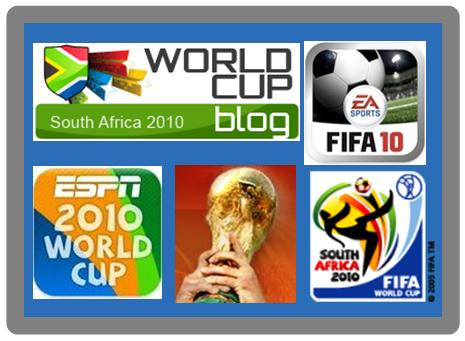
Sites, Games and Apps You Need to Follow the 2010 FIFA World Cup 

ESPN 2010 World Cup – ESPN’s World Cup app (ESPN, Free) includes profiles of all 32 countries competing, in addition to breaking soccer news from around the globe. The app also offers tournament schedules and the opportunity to make your own fantasy prediction bracket.  

EA Sports FIFA 2010 – If the World Cup inspires you to play soccer, why not do it on your iPhone? FIFA 10 (EA Sports, $4.99) is a realistic, action-packed soccer game that uses the iPhone’s accelerometer and touchscreen to control the action. 

FIFA Official Website – Traditional online access to news, games, teams, players and information. 

World Cup Blog – Follow live updates about your team and join conversations online through the World Cup blog. 

FIFA World Cup Twitter – You can get up-to-the-minute scores and breaking news from World Cup twitter.

Adidas Fast vs Fast – This is in Facebook. A no-nonsense tactical approach by Adidas, relying on a big budget TV ad  titled Fast vs Fast to sell the new F50 adizero boot and spark social media conversation.

It is clear that a new kind of phenomenon is at work – one that orchestrates interaction beyond previous boundaries. I hope it creates value not only to FIFA, to the sponsoring companies but more importantly also to the fans around the world passionately following the games and supporting their teams. I hope social media will take the World Cup experience to a whole new level.

Photos courtesy of www.worldcupblog.org