Work-life Lesson 4: Learn how to give first-rate presentations so that the message you’re trying to deliver is the same one the audience receives

By: Glenn Remoreras, in collaboration with Ira Fialkow and Ivy Remoreras

No matter how insightful, or powerful, innovative or fantastic your solution or idea is, if  your target audience doesn’t “get it”, then none of it matters. 

Is there a secret formula for success in business – and in your career?  Probably not. But I believe it makes sense to learn from the people I respect and who have been successful themselves. 

Case in point: Ira Fialkow was the Executive Vice President for Shared Services at CEMEX, until recently. His career spans 25 years and he is a highly respected leader in his field. This series marks the culmination of 25 business lessons documented and developed by Ira over the past 25 years of his career. Ira used to distribute these lessons to the team every year. In this series, I will endeavor to share the 25 business lessons that I’ve learned from Ira and our shared services team. 

This is part four of the series: 25 Lessons for Work (and Life!) – 3-Minute Coaching Sessions 

Nowadays, having good presentation skills seem to be a no-brainer.  In fact, there is plenty of information out there about how to give good presentations – for example, how to be a good speaker, which gestures to use, correct posture, how to capture your audience’s attention, etc.  However, I think it is just as important that the message of each presentation is delivered concisely and effectively.

First of all, if your audience doesn’t get your message, then you didn’t deliver it.  This is part of accountability – a common theme in all these 25 work-life lessons. The audience must be considered first.  It is your responsibility to ensure that the message your audience receives is exactly the same as what you intended to deliver. Secondly, if you are not able to deliver your idea or solution, then there is no innovation – the second repeating theme on these work-life lessons. No matter how insightful, or powerful, innovative or fantastic your solution or idea is, if  your target audience doesn’t “get it”, then none of it matters.

Make sure your message is the one they receive

Before you even create your presentation start with the end in mind by asking yourself: With what message do I want the audience to leave?  Business leaders that develop exceptional presentation skills do it by analyzing both their audience and their purpose for presenting. This message needs to be the exact message the audience receives.  To do this, you will need to consider  how your audience best processes information. For instance, will a story that relates to the solution you are offering going to engage your audience, or will it make them impatient?

In discussing this with Ira, he mentioned that whenever it came to issues related to change management, he would always try to engage the audience with a story that they can relate to. The story should be relevant to the current situation and help explain the “Why behind the what?” For people to engage in change, they first need to understand the need for the change. Without that understanding, there will be no desire to hear the message.

In giving a presentation to executives, usually they know the “why” and are primarily interested in the “what”, “who” “how much” and “by when”. However brief the presentation is, that too  needs to have a good story flow, but delivered in a much more summarized manner.

The success of your presentation is best measured by how well the audience understands or appreciates the subject matter after you finish speaking. Naturally, presentations will be very different depending on the target audience and the message being delivered. Your presentation should have a logical sequence and the message should tell a story that can be readily retold by the audience.  

Be brief. Be bright. Be gone.

A 2009 report on American consumers, published by the Global Information Industry Center of  the University of California – San Diego, stated that the average American receives about 33.80GB or more than 100,000 words of information per day. (Bohn & Short, 2009)  That’s a lot of information to process! If you want your message to be heard and understood, keep it short and relevant. Studies show that the average adult’s “undivided attention span” is roughly 30 seconds. So even if you have the most interesting topic or are the most exceptional presenter, you still can’t keep the audience’s undivided attention for so long. That’s why our advice in this lesson is, “be brief be bright, be gone.” The story or message needs to be brief and focused — compelling and worth retelling for it to stick. Everybody is busy and you have to be able to cut through the clutter.  You need to be able to present your idea concisely. We call it the “elevator speech” – a 30-second presentation you would give to your audience (such as your CEO) if you found yourself alone in an elevator with them (and you have their undivided attention).

Secondly, your message needs to be memorable. This is what “be bright” means. Your presentation needs to be impressive enough to cut through all of the other information that your audience receives. And finally, after you have delivered your message concisely and memorably, finish your presentation, and “be gone”. There’s nothing worse than having a drawn out presentation. For this, you need to assess your audience and determine if the message has been received or if more information is required. Remember that the closing part of the presentation is what the audience will remember the most. Repeat your purpose statement. By doing so, you deliver your key messages one final time.

Work-life Lesson 4 Takeaways: 

  • Know your audience. Each presentation must be tailor-made for the audience.
  • No matter how insightful, or powerful, innovative or fantastic your solution or idea is, if  your target audience doesn’t “get it”, then none of it matters.
  • Make sure that your message is the one they receive.  Your message should tell a story and it should be one worth retelling.
  • “Be brief, be bright, be gone”. It is important that you deliver your message concisely and memorably.

Link to Previous Lesson: Set your performance standards high and never give in to “good enough”. Be your own toughest critic.


About the collaborators:

Ira Fialkow is the SVP of Member Services at Peeriosity. Peeriosity is a confidential network of leading companies from across the world committed to collaborating openly with each other in a completely secure environment with interactions free of consultants and vendors. Prior to Peeriosity, Ira was EVP of Shared Services at CEMEX and Rinker Group (acquired by CEMEX is 2007) from 1990 through joining Peeriosity in October 2010. Rinker Group was the initial recipient of the Best Mature Shared Services Award in 2003. Ira lives in Palm Beach Gardens, Florida and has been the champion of his fantasy football league in three of the past five years.

Glenn Remoreras is an IT Manager at CEMEX. He brings over 12 years of experience as an IT director, business processes manager, project leader, and consultant. He has focused on enabling business solutions through the use of IT capabilities. Glenn has been involved with various international post merger integration projects.

Ivy Remoreras is a marketing professional with eight years of extensive experience, particularly in product management, communications and promotions as a manager, university instructor and consultant. She believes in constant learning and has a Masters degree in Business Administration (MBA). Having resided in Europe, Asia and North America, she speaks four languages.

Photos courtesy of Jscreationzs and Pixomar.

Work-life Lesson 3: Set your performance standards high and never give in to “good enough”. Be your own toughest critic.

By: Glenn Remoreras, in collaboration with Ira Fialkow and Ivy Remoreras 

Is there a secret formula for success in business – and in your career?  Probably not. But I believe it makes sense to learn from the people I respect and who have been successful themselves.

Case in point: Ira Fialkow was the Executive Vice President for Shared Services at CEMEX, until recently. His career spans 25 years and he is a highly respected leader in his field. This series marks the culmination of 25 business lessons documented and developed by Ira over the past 25 years of his career. Ira used to distribute these lessons to the team every year. In this series, I will endeavor to share the 25 business lessons that I’ve learned from Ira and our shared services team.

This is part three of the series: 25 Lessons for Work (and Life!) – 3-Minute Coaching Sessions

Set your performance standards high and never give in to “good enough”. Be your own toughest critic.

Success in your work and personal life is directly related to your productivity, commitment and performance. Therefore, setting performance standards for oneself is taking responsibility for one’s own career and life. Today, performance standards and goal setting in companies is routine and frequently performed in contexts as diverse as every level of the organization. In an individual’s life, setting one’s own standards can touch one’s personal and family life so as to significantly alter social, economic and personal well-being. As such, lesson three teaches us that setting high performance standards can beat mediocrity and achieve highflying goals.

Ira explained why this lesson made the list. He said, “I think one of my biggest frustrations as a manager is seeing someone with unlimited potential give in to ‘good enough’. On the other hand, it’s always a pleasure when someone takes accountability for their own career and always looks for an opportunity to improve things and themselves in the process.”

Personally, Ira had this epiphany when he was passed over for a promotion early in his career. He was upset, went to his manager and pointed out that he “had done everything expected and that had been asked of me.”  His manager simply answered, “Exactly. That’s why you have a job.”  The promotion was given to someone who wanted a career – someone who did things above and beyond what was expected.  He got the message.

This message is best articulated in Jim Collins’ book, “Good to Great”.  According to Collins, “Good is the enemy of Great”. Nothing is more true. We are driven to change when we hit bottom or get bad results – but nothing kills the energy and drive to being better than being “good”. We have to take personal accountability to ensure that we are always our own toughest critic and never give in to “good enough”.

Set your own goals first and set it with a high performance standard

Setting performance standards should start as a personal endeavor. Set performance standards high and don’t settle for mediocrity. If you are serious with achieving success in your career, regularly conducting self-assessment and goal setting is very important. Goal setting is a powerful process that not only ensures your performance standards support your goals, but also motivates you to turn your vision into reality. This necessitates setting high performance standards — not only for your team or organization — but more importantly, for yourself. You cannot expect high performance from others if you yourself cannot perform at the same or higher level.

In addition, setting your own high standards and goals prepare you better for commitment to work objectives expected of you. Self-assessment helps you determine your own capabilities and limitations. If you did your own self-assessment, you are in a better position to set performance standards and goals with others. Knowing your own skills and shortcomings allows you to determine if the performance standard expected of you (by your boss, for example) is reachable or not. And if not, you will be able to ask for the resources you need in order to be successful. Constant self-assessment is critical. You cannot expect nor wait for other people to critique your work. It is in your best interests to do it yourself, especially after every work objective (such as a project or implementation) is achieved (or not, as the case may be).  The basic questions to ask would be: Am I a good boss or co-worker? How could this have gone better? What can we learn out of this?

The process of setting high performance standards keeps you motivated. It increases the chances of success. If you have mediocre goals then you miss them, you totally fail. If you have high performance standards, it helps you go much further in your work and in life. By knowing precisely what you want to achieve, you know where you need to concentrate your efforts. You’ll also quickly spot the distractions that can, so easily, lead you astray. Make sure you get agreement on how the performance will be monitored and how frequently. In order for the process to go forward, you need to monitor your own performance.

There are many formal methodologies for setting high performance standards. One method I like to use is “SMART” goals. SMART means they are: specific, measurable, attainable, results-oriented and time-bound. The technique in controlling your productivity and success is knowing the extent of what you can achieve. Know your safe, reach and stretch targets. Safe targets are attainable goals. Your reach targets are goals that you can achieve with complete control and influence. Stretch targets are attainable but with certain conditions beyond your control. It should be attainable but if it isn’t, you should know the reasons why it is not.

I know Ira is a big fan of Steven Covey’s 7 Habits of Highly Effective People. In fact, for a few years, Ira had some of our team members become certified 7 Habits trainers and teach courses to their peers in shared services as a supplement to TQM training.  There are a number of methods for setting high performance standards; the key is to find something that works for you!

Why Your Inner Critic Is Your Best Friend

If you want to be the best you must always view your work with contempt and reservation. Not because you hate what you do but because you want to have the best result. Always critique your own work thoroughly and have a high standard. Come to think of it, you’d be in big trouble without an Inner Critic. Critics are actually a very important part of your performance, productivity and creative process. Since you can’t expect others to always criticize and challenge you, you can begin by making yourself your toughest critic. Your Inner Critic is your first level of assessing the quality of your performance and without it; you could end up with mediocre results. With yourself as your toughest critic, you will also raise your self-confidence, as you recognize your own ability and competence in achieving the goals that you’ve set.

Work-life Lesson 3 Takeaways: 

  • Your personal success in your work and life is directly related to your attitude, productivity, commitment and performance. Setting performance standards for oneself is taking responsibility of one’s own career and life.
  • Setting performance standards should start as a personal endeavor. Set performance standards high and don’t settle for mediocrity.
  • Critics are actually a very important part of your performance, productivity and creative process. Since you can’t expect others to always criticize and challenge you, you can begin by making yourself your toughest critic.
  • The enemy of great is good. Never give in to ‘good enough’.

Link to Previous Lesson: If Your Don’t Know, Say “I Don’t Know”


About the collaborators:

Ira Fialkow is the SVP of Member Services at Peeriosity. Peeriosity is a confidential network of leading companies from across the world committed to collaborating openly with each other in a completely secure environment with interactions free of consultants and vendors. Prior to Peeriosity, Ira was EVP of Shared Services at CEMEX and Rinker Group (acquired by CEMEX is 2007) from 1990 through joining Peeriosity in October 2010. Rinker Group was the initial recipient of the Best Mature Shared Services Award in 2003. Ira lives in Palm Beach Gardens, Florida and has been the champion of his fantasy football league in three of the past five years.

Glenn Remoreras is an IT Manager at CEMEX. He brings over 12 years of experience as an IT director, business processes manager, project leader, and consultant. He has focused on enabling business solutions through the use of IT capabilities. Glenn has been involved with various international post merger integration projects.

Ivy Remoreras is a marketing professional with eight years of extensive experience, particularly in product management, communications and promotions as a manager, university instructor and consultant. She believes in constant learning and has a Masters degree in Business Administration (MBA). Having resided in Europe, Asia and North America, she speaks four languages.

Photos courtesy of Renjith Krishnan and Simon Howden

Five Ways to Improve Your Customer Service Center

Read full article in Associated Content: Five Ways to Improve Your Customer Service Center

Gain Customer Loyalty by Improving Customer Services

Connecting to current and potential customers is one of the biggest challenges facing businesses today. Significant resources are invested in creating and improving customer experiences. Even at this time of economic uncertainties, it’s hard to find a business that is not actively pursuing customer service improvements. The competition is stronger than ever as the economy begins to show signs of recovery. Initiatives related to customer relationship management are embraced by many companies as a critical component of their overall business strategy. Organizations continue to spend heavily on CRM — $11 billion annually starting 2010 according to Forrester. But how do you improve your customer service center besides investing in CRM applications and tools? Here are five ways:

1. Understand your Purpose and Establish a Clear Mission Statement

2. Set the Right Expectations and Be Consistent in Your Service Delivery

3. Develop Your Service Offer

4. Have a Culture of Continuous Improvement

5. Foster a “Customer First” Attitude and Strengthen Your Back-office Support Groups

Read more

Web and Social Media Provide Japan Needed Resources

Google Crisis Response - a google.org project

It’s not that successful people are givers; it is that givers are successful people. – Patti Thor

I was up early Friday morning to monitor news about the massive earthquake that hit Japan. An 8.9-magnitude earthquake followed by a 35-foot tsunami hit the coast of Japan at 2:46 p.m. Tokyo time Friday. It was the most powerful recorded in the Japan’s history, and the seventh largest ever recorded worldwide. The tsunami warning was issued in virtually all areas of the Pacific Rim. Also, I was closely monitoring news about the effect of the tsunami back home in the Philippines through local news outlet Inquirer. The Philippine government ordered the country’s mostly rural Pacific seaboard cleared of people on Friday. Inquirer reported that 224,243 people were moved off the coasts overnight, either on their own or using military trucks.

Web and Social Media Resources at Work

Beyond Twitter traffic and Facebook, many media organizations like CNN are live-blogging information as it comes in. Click here to access CNN live blog. Government agencies are also providing valuable information on their sites. Citizens have also taken to Flickr to post pictures of the disaster.

I also followed real-time updates from Twitter where thousands of tweets per minute came in. Most can be filtered using two primary hashtags — #tsunami and #prayforjapan. They are trending on Twitter since Friday. (Click on the hashtags to view real-time twitter feed.)

Shortly Google deployed People Finder tool that was so effective during the 2004 Tsunami and 2010 Haiti Earthquake:

“Google Person Finder available after earthquake in Japan to help you get information about loved ones. http://goo.gl/rlR07” – @Google >> (Twitter)

If you are looking for first-person accounts, a lot of residents from affected areas have also posted eyewitness videos in Youtube from inside their homes and public buildings, and from the streets with their neighbors. Click here to see videos posted in Youtube pertaining to the earthquake and tsunami.

How you can help:

Thanks for helping out.@GlennRemoreras

Blogging, Learning, Profexor.com and Social Responsibility

Read this article in Spanish

“One attribute of true learning is a sense of curiosity and wonder. A second is an experience of openness to new possibilities. A third is that the process of searching for an answer is more important that having an answer. Finally, it is necessary to have an approach to one’s environment characterized by experimentation: accessing information, analyzing that information, and looking for connection and relationships.”- John W. Thompson

Blogging and Online Learning

Why do you maintain a blog? You seem to spend so much time making sure that there is a continuous flow of relevant contents- what do you get from it? These are common questions friends and colleagues ask me.  For me, writing is all about sharing knowledge (even the little that I know in my profession) and learning in the process by interacting with my readers. We learn in all kinds of ways, whether through conversation, reading books, attending formal training, and even writing. By doing those things we are taking in and processing new ideas. If you are an Internet user who is accessing websites for your regular news, using social media to interact with friends, reading Wikipedia, doing routine searches– you are bombarded with tons of information. Whether you like it or not, you are already absorbing a lot of information online. You are learning in one way or another.  Come to think of it, the jump to more formal learning – using online teaching platform with the latest computer applications – is not such a big leap. We are already familiar with finding, sharing and processing information online. 

My former boss, mentor and friend Tony Molares – who recently joined Profexor.com, an online learning platform, as their CEO – talks passionately about his amazing opportunity, to lead a company that leverages technology to provide knowledge through web platforms.  He explained to me that online learning tools, because they are so accessible and affordable now, eliminate barriers to learning. They improve the knowledge and competitiveness of people who use them. In the long run they contribute to a better learning society. Providing learning opportunities is the most important mission of Profexor.com — a company providing online training programs. The website caters to the Spanish-speaking market. Profexor.com brings together the knowledge of many professionals worldwide, including experts in computer media applications, process engineers, editors, web designers, marketers, and researchers. Profexor.com is current developing learning contents related to self improvements, leadership, and other competencies that will enable professionals to be competitive in the business environment. It is the company’s goal to offer via this alternative online educational platform an ongoing, rewarding personal experience that fosters growth, self improvement and innovation.

Social Responsibility by Providing Learning Platform

What’s so noteworthy about Profexor.com is its target audience—the Spanish-speaking market. I know most, if not all of the courses in Profexor.com are delivered in Spanish. I remember when Tony showed me the website; the first thing I asked him was, why not offer the courses in English as well? I thought that for sure they will have a wider reach and much larger customer segment. When Tony explained to me that one of the company’s purposes is to bring more learning opportunities to Spanish-speaking people and provide them access to information and more contents (otherwise available only in English), I understood right there that the company has a deeper mission. The individual’s ability to learn and innovate is a direct driver of his capability to compete and succeed. Tony is right, there are countless websites offering online courses in English but only handful that provide the same level of quality of content in Spanish and competitiveness in pricing as Profexor.com. I think it is very inspiring and remarkable for a start-up company to have that sense of social responsibility from the beginning. 

Just as the world has changed, so too has the platform for learning. I am not saying online learning tools like Profexor.com replaces the traditional and formal education provided in schools and universities. Also, I am not saying that blogs and other forms of online clutter should replace the traditional forms of knowledge media like journals, magazines and books. Both platforms: old and new, traditional and modern, are applicable to the learning process of today’s world. The great parallelism that I see between Profexor.com’s mission (be it the platform of learning for Spanish speakers) and my personal purpose for blogging (sharing knowledge) are the acts that benefit society at large—call it “Social Responsibility“.

Follow Glenn Remoreras and IT Branding on Twitter.

See Youtube video about Profexor.com.

Los Blogs, el Aprendizaje, Profexor.com y la Responsabilidad Social

Traducido al español por Alicia Palmero

“Una de las cualidades de un verdadero aprendizaje es provocar curiosidad y propiciar asombro; otra cualidad es abrir la puerta a nuevas posibilidades y una tercera es mostrar que el proceso para encontrar una respuesta es más importante que la respuesta en sí. Finalmente, se requiere disponer de un enfoque hacia el propio ambiente caracterizado por la experimentación y que conlleve a tener acceso a la información, analizarla y buscar posibles conexiones y relaciones.”- John W. Thompson


Los blogs y el aprendizaje en línea 

¿Para qué mantener un blog? Parece que se dedicara demasiado tiempo en asegurar un flujo constante de contenido adecuado pero, ¿qué se obtiene a cambio? Son preguntas que con frecuencia me hacen amigos y colegas. Para mí, escribir es compartir conocimiento (incluso lo poco que conozco en mi profesión) y aprender en el proceso mientras interactúo con mis lectores. Nosotros aprendemos de muchas maneras: conversando, leyendo libros, participando en cursos formales de capacitación e, incluso, escribiendo. A través de todas esas actividades, tomamos y procesamos nuevas ideas. Un usuario de Internet, que entra en una página para enterarse de las noticias, interactuar con sus amigos en las redes sociales, leer Wikipedia o hacer búsquedas de rutina, es bombardeado con toneladas de información. Le guste o no, está absorbiendo ya una enorme cantidad de información en línea, y aprendiendo de una u otra forma. Si nos ponemos a pensar, de ahí a un aprendizaje más formal –por la vía de una plataforma de enseñanza en línea que haga uso de las más recientes aplicaciones tecnológicas– no hablamos de un salto muy grande. Por otra parte, ya estamos familiarizados buscando, compartiendo y procesando información en línea. 

Mi ex jefe, mentor y amigo, Tony Molares, quien desde fecha reciente ocupa el puesto de CEO de Profexor.com, una plataforma de aprendizaje en línea, habla con genuino entusiasmo sobre la increíble oportunidad que tiene de dirigir esta compañía, la cual utiliza la tecnología para ofrecer conocimiento a través de plataformas en la red. Él me explicó que estas herramientas en línea han eliminado muchas barreras en el aprendizaje por el fácil acceso y bajo costo que tienen ahora; dichas herramientas incrementan, además, el conocimiento y la competitividad de la gente que hace uso de ellas, contribuyendo en el largo plazo a una sociedad con un nivel mucho más elevado de educación. La misión más importante de Profexor.com es brindar nuevas oportunidades de aprendizaje, para lo cual ofrece programas de capacitación en línea.  Profexor.com sirve al público hispanoparlante y reúne el conocimiento de un gran número de profesionales de todo el mundo, incluyendo expertos en aplicaciones de computación, ingenieros en procesos, editores, diseñadores de sitios de Internet, especialistas en mercadeo e investigadores. Hoy en día, Profexor.com está desarrollando contenidos de aprendizaje relacionados con mejoramiento personal, liderazgo y otras destrezas que capacitan a los profesionales para ser competitivos en el ambiente de negocios. El objetivo de la compañía es ofrecer, a través de esta plataforma alternativa de educación en línea, una experiencia continua y gratificante que fomente el crecimiento, el mejoramiento personal y la innovación. 

La responsabilidad social a través de una plataforma de aprendizaje

Lo que cabe destacar respecto a Profexor.com es la audiencia en la que se ha enfocado: el mercado hispanoparlante. Tengo entendido que la mayoría, si no la totalidad, de los cursos disponibles en Profexor.com están en español. Recuerdo que cuando Tony me enseñó la página en Internet, lo primero que pregunté fue por qué no ofrecían también los cursos en inglés; pensé que así seguramente tendrían un mayor alcance y un segmento de mercado más amplio. Cuando me explicó que uno de los propósitos de la compañía es ofrecer más oportunidades de aprendizaje al público hispanoparlante, dando acceso a mayores contenidos de información –que, de otro modo, sólo estarían disponibles en inglés–, de inmediato entendí que la compañía tenía una misión más profunda. La capacidad individual para aprender e innovar es un impulsor directo de la capacidad para competir y ser exitoso. Tony tiene razón en afirmar que hay innumerables sitios en Internet que ofrecen cursos en línea en inglés pero sólo unos pocos que brinden el nivel de calidad en contenidos en español y los precios competitivos de Profexor.com. Es especialmente inspirador y digno de mencionar que una compañía tenga desde sus inicios tal sentido de responsabilidad social. 

Igual que el mundo ha cambiado, así ha cambiado la plataforma para aprender. No estoy diciendo que las herramientas de aprendizaje en línea como Profexor.com puedan reemplazar la educación tradicional y formal impartida en escuelas y universidades. Tampoco estoy afirmando que los blogs y otras fuentes de información en línea deberían sustituir las formas tradicionales de difusión del conocimiento, como son las revistas y los libros. Ambas plataformas, las antiguas y  las nuevas, las tradicionales y las modernas, pueden ser utilizadas hoy en día en el proceso de aprendizaje. El gran paralelismo que veo entre la misión de Profexor.com –ser la plataforma de aprendizaje para el público hispanoparlante– y el propósito que personalmente me motiva a mantener mi blog –que es compartir conocimiento– es que ambas son acciones que benefician a la sociedad  en general; en otras palabras, hablamos de “Responsabilidad Social”.  

Lea el artículo en Inglés.  

Sigue a Glenn Remoreras y IT Branding en Twitter.

Business Lesson 2: If You Don’t Know, Say “I Don’t Know”

in collaboration with Ira Fialkow and Ivy Remoreras

Is there a secret formula for success in business – and in your career?  Probably not. But I believe it makes sense to learn from the people I respect and who have been successful themselves.

Case in point: Ira Fialkow was the Executive Vice President for Shared Services at CEMEX, until recently. His career spans 25 years and he is a highly respected leader in his field. This series marks the culmination of 25 business lessons documented and developed by Ira over the past 25 years of his career. Ira used to distribute these lessons to the team every year. In this series, I will endeavor to share the 25 business lessons that I’ve learned from Ira and our shared services team.

This is part two of the series: 25 Lessons for Work (and Life!) – 3-Minute Coaching Sessions

Business Lesson 2: If You Don’t Know, Say “I Don’t Know”.

Ira once told me, “This isn’t a school test where, if you don’t know the correct answer, you take a guess based on what you think is the best answer. If you don’t know the answer, then simply say ‘I don’t know.’ The worst thing that can happen is that decisions will be made and actions taken based on wrong or incomplete information.” Admitting that you don’t know something is taking responsibility and having accountability. 

This second lesson is about attitude. I once overheard Ira telling someone, “You’re lucky you KNOW that you don’t know. You now have an open mind and the opportunity to learn something new and find a real solution!”  This is simple and yet so difficult for many people to practice. In this article, we will look at two perspectives of this essential lesson – (a) learning to say “I don’t know” per se; and (b) openness to learning through the humble attitude of genuinely “not-knowing.”

Saying, “I Don’t Know”

The fact of the matter is, it is so difficult for people to say, “I don’t know.” Of course, it’s normal that you would always want to project yourself as knowledgeable to others; showing that you know (all the time!) is one of the best ways to look good. Most of us don’t like it when we ask subordinates at work to explain what went wrong, and instead of getting facts we are met with three little words: “I don’t know.” It’s frustrating, isn’t it? It’s worse, though, when you get “answers” composed of hardly verified truths and opinions. What happens when you take what you are told as fact and respond accordingly – for example, a customer complaint – and later find out that something completely different happened? By then, conflict has been created and it has further complicated the problem.

Of course, you can’t expect somebody to know everything. Here are two simple ways to say “I don’t know” and still be accountable:

  • The obvious – say: “I don’t know.” You can include an action or commitment, though, so say “I don’t know, but I’ll take responsibility to find the facts, or answers, for you and I’ll suggest a solution.”
  • If you have some knowledge to begin with, but you need to verify it, you may say, “I’m not as informed as I would like to be but this is what I think, based on the information I have. I will look into this further and get back to you right away.” Here you are being honest about the fact that what you think you know may not necessarily be accurate. So, if you are asked to speak out, your audience knows that it’s an opinion.

We grow up afraid of our own ignorance and terrified that it may show. I admire people who have the ability to admit, “I don’t know.” There are many ways to say this, but the most important thing is to be honest, concise and responsible about what you say.

“Not Knowing” as a Powerful Openness to Learn

Think about going to a meeting, seminar or training with the arrogant attitude that there is absolutely nothing new to be learned. Surely, you will arrive disinterested and full of your own perception of the subject matter. Chances are, you won’t learn anything new. The advantage of not knowing is the opportunity to experience learning. Genuine “not-knowing” is a sign of humility and openness that precedes the leap into finding true meaning. We question not only whether we’ll find answers to questions, but also how to learn new things. How many times have you gone to similar work sessions or training programs but learned something new every time? Maybe it’s from hearing someone else’s perspective and how they applied the knowledge. Maybe it’s an insight that helps you link multiple ideas together and come up with a new way of applying the knowledge to a problem. Or maybe it’s an open attitude that allowed you to listen in a new way.

Being open to new ideas shows a willingness to transcend what you know, to look beyond the conventional and obvious view, and to come up with new insights and use these to find solutions.

When people talk about innovation – this is what they are talking about!

Business Lesson 2 Takeaways:

  • Acknowledging that you don’t know something is akin to taking responsibility and having accountability.
  • People should not be discouraged from saying “I don’t know” in a company.
  • There are many ways to say, “I don’t know,” but the most important thing is to be honest, concise and responsible about what you say.
  • The positive side of not knowing is the opportunity it provides to experience learning, gain insights, and come up with a better solution.  
  • Genuine not-knowing is a sign of humility and openness that can lead to expanding one’s knowledge.

Link to Lesson 1: Have a mentor (even if they don’t know it). Be a mentor (someone is watching you).


About the collaborators:

Ira Fialkow is the SVP of Member Services at Peeriosity. Peeriosity is a confidential network of leading companies from across the world committed to collaborating openly with each other in a completely secure environment with interactions free of consultants and vendors. Prior to Peeriosity, Ira was EVP of Shared Services at CEMEX and Rinker Group (acquired by CEMEX is 2007) from 1990 through joining Peeriosity in October 2010. Rinker Group was the initial recipient of the Best Mature Shared Services Award in 2003. Ira lives in Palm Beach Gardens, Florida and has been the champion of his fantasy football league in three of the past five years.

Glenn Remoreras is an IT Manager at CEMEX. He brings over 12 years of experience as an IT director, business processes manager, project leader, and consultant. He has focused on enabling business solutions through the use of IT capabilities. Glenn has been involved with various post merger integration projects. 
 
Ivy Remoreras is a marketing professional with eight years of extensive experience, particularly in product management, communications and promotions as a manager, university instructor and consultant. She believes in constant learning and has a Masters degree in Business Administration (MBA). Having resided in Europe, Asia and North America, she speaks four languages.

The Helpdesk Model – What It Means to Put Helpdesk to Work and Improve

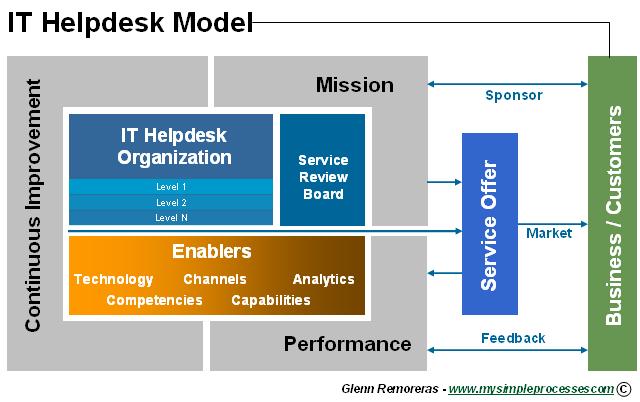
Have you considered the impact your IT helpdesk has on the business you support? Think about your company’s reliance on technology and IT applications— when service interruptions happen, they impact processes and cause business disruption. The IT Helpdesk is much more than answering the phone and helping users solve their IT problems. Helpdesk has a direct impact on running the business, providing quality customer services and ensuring business profitability. If you are implementing an IT helpdesk in your company or in the process of improving your existing one, this article is for you. First, let’s discuss the IT Helpdesk Model. The diagram model shows the eight components of the IT Helpdesk Model. Each is briefly described below.  

Eight Components of the IT Helpdesk Model 

  1. IT Helpdesk Organization – This component represents the managers, staff, functions and supporting groups that comprise the IT helpdesk organization.
  2. Enablers – Enablers are tangible and intangible components needed to operate the IT helpdesk. This includes technology, tools, communication channels and analytics. Other important enablers are the required competencies of the individual staff working at the helpdesk and the group’s combined capabilities. 
  3. Service Review Board – The  Service Review Board is the steering committee or sponsor of the IT helpdesk organization. The group is composed of key IT managers, business/customer representatives and (if necessary) external consultants. They are responsible for providing strategic guidance, support, resources, and feedback to the group. 
  4. Business / Customers – This represents the customers that receive the IT helpdesk services. Your customers are everyone in the company; not just everyone who has computers, but everyone who has access to one that uses it as part of his / her function. It is important for IT helpdesk to know its customers and be able to identify and segment them. 
  5. Mission – The mission statement is the declaration of purpose, values, direction and tactics. It governs how the IT helpdesk will run its service delivery to its customers and guide every interaction it has with the users. 
  6. Service Offer – Your service offer represents the scope of your services to your customers. The services that your IT helpdesk provide are determined by business or customer needs. A good service offer is composed of service elements that are manageable and provide the best value to the business. 
  7. Performance – It is critical for part of the IT helpdesk function to be tied up with performance measures.  Performance should be measured periodically if the service offers are attained in a satisfactory manner. This component represents performance indicators that have to be defined and tracked. Performance also includes how the IT Helpdesk receives and handles feedback from surveys and customer focus groups.  
  8. Continuous Improvement – This component is tied up with performance measures. Your IT helpdesk will have to adjust services regularly — as business changes and as your customers demand more. Continuous improvement includes working on actionable items from performance monitoring or data analysis. 

Five Ways to Improve Your IT Helpdesk

1. Understand your Purpose, Involve your Customers and Set the Right Expectations  – Understand what senior management and your internal customers expect. Have focus group discussions with business leaders and key customers. Listen to feedback—positive and negative. Understand their concerns and identify opportunities. Invite your key customers to join and participate in your Service Review Board. When you and your customers communicate and understand what your service offers are, it easier for you to keep them satisfied because you have set the right expectations for your services. 

2. Establish a Clear Mission Statement  – Your mission statement is your declaration of purpose and values. This will set the direction of the group on how to interact with customers. It governs every interaction that deals with a call, request or problem. Putting together a mission statement must be a collaborative process. Let key members of the helpdesk and internal stakeholders participate in putting together a mission statement. A sample mission statement could read, “Focus on the needs of the business and support the customer in making the best use of technology in business.”  A sample value statement would read, “We aim to minimize downtime by restoring service as fast as we can. We solve problems, not symptoms, and work to resolve the root causes.”

3. Develop Needed Competencies and Roles. – To have an effective helpdesk organization, there needs to be clearly defined roles and an effective way of performing them. The major competencies and roles within helpdesk are: stakeholders, problem solver or experts, data analyst, communicator, and the customer service liaison. Stakeholders are represented in the IT Helpdesk Model as the Service Review Board. This group is established to provide sponsorship, guidance and support to the IT helpdesk organization. Problem solver and experts are senior members (level two or higher) of the helpdesk whose task is to solve escalated problems and find solutions to recurring incidents. Data analysts consistently mine helpdesk databases for trend analysis. The Communicator is responsible for the continuous improvement of helpdesk communication and customer service competencies. They are also responsible for call quality assurance. Customer Service Liaisons are members of the helpdesk who manage customer relationship and gather feedback from the customer through surveys and focus group discussions. 

4. Develop Your Service Offer – Your service offer should be tied up with your mission, customer need, budget and internal capabilities. Focus on providing services that give the best value to the business. Eliminate non-value creating services from your portfolio. If you provide too many services on a broad range of domains, you are setting your helpdesk group up for failure. Avoid situations where your resources are thinly spread and customers with important needs are forced to wait while you attend to a service that does not create value. Services are manageable, supportive of the business needs, well defined and well understood. After defining your service offer, communicate and market services to your customers. Remember that the service offer needs to be adjusted on a regular basis in order cope with changes in business needs, budget and customer expectations. An example of service offers are: “Provide support between 6am to 7pm daily. Allow customer channels such as email, call, voice mail, chat, and intranet site. Provide consulting on software recommendations. Broadcast information about system availability and planned maintenance. etc.” 

5.Have a Culture of Continuous Improvement – Most existing IT Helpdesks have massive amounts of data at their disposal—yet fail to utilize it in any meaningful way. Running an IT Helpdesk means gathering a lot of data for the purpose of evaluating service performance and resolving problems. Use data effectively to discover valuable insights and evaluate performance versus set target and objectives. Use data to conduct trend analysis on recurring issues so as to implement proactive measures in reducing the number of calls and incidents. Have a culture of continuous improvement. Don’t settle for mediocre performance. Always challenge your IT Helpdesk to continuous improvement in every aspect of the service it provides.

Please share with us your experiences in implementing and managing your IT Helpdesk. What were the challenges and key learnings? You can also post your questions about the topic so that I and readers can respond to them. Thank you.

Follow Glenn Remoreras and IT Branding on Twitter.

25 lessons for work (and life)! — 3-minute coaching sessions

in collaboration with Ira Fialkow and Ivy Remoreras

” You can have as many mentors as you need – people that excel in different disciplines and that exemplify different values. In my career, I’ve learned that mentoring is a process of engagement and inspiration, in as much as it’s a process of learning from someone. Truly successful people raise others up. They don’t feel threatened. Instead, they find reward in seeing others succeed. “

Is there a secret formula for success in business – and in your career?  Probably not. But I believe it makes sense to learn from the people I respect and who have been successful themselves.

Case in point: Ira Fialkow was the Executive Vice President for Shared Services at CEMEX, until recently. His career spans 25 years and he is a highly respected leader in his field. I consider myself fortunate in having had the opportunity to work in his organization. Our collaboration continues, even today. I continue to learn from Ira, and he says he continues to learn from me! I believe that people thrive best, and succeed, when they have the opportunity to develop under the tutelage of those who precede them.

This series marks the culmination of 25 business lessons documented and developed by Ira over the past 25 years of his career. They were learned the hard way: through experience. Ira used to distribute these lessons to the team every year. The lessons changed slightly, over time, as new ideas emerged and new learnings were incorporated. In this series of 25 short articles, I will endeavor to share the 25 business lessons that I’ve learned from Ira and our shared services team.

The series is split across five sections.

  • Section 1 is about continuous self-improvement. In any endeavor, change begins with oneself. You cannot create a successful organization, nor be successful yourself, without the drive to do better and be better.
  • Section 2 is about creating a better work environment, and leads on from Section 1: Improving oneself means improving one’s professional atmosphere; no real change can be achieved without this.
  • Section 3 is about customer service: Every business unit has a customer, whether internal or external. And just because you don’t have direct dealings with the company’s external customers doesn’t mean you don’t have customers of your own. If you work for the payroll department of a large fast-food company, your customers are the employees in the payroll, and you need to know how to provide good customer service.
  • Section 4 relates to improving productivity. This includes eliminating bureaucracy and other things that hamper good service delivery. Let’s say you have great products and can provide good service. If it’s not affordable, easy to use, and timely to the customer, then it just doesn’t matter. 
  • Section 5 involves competitive advantage.  Much has already been written about competitive advantage, I know. But you’ll be surprised at some of the simple things you can do.

Section 1: Become addicted to constant and never-ending self-improvement

Each journey begins with a single step. In terms of change, this means starting with oneself. The six business lessons in this section suggest that everyone, irrespective of the successes already achieved, benefits from continuous self-improvement.


Business Lesson 1 : Have a mentor (even if they don’t know it). Be a mentor (someone is watching you).


Have a mentor (even if they don’t know it)

Most guides to mentoring start with advice on how to find the right mentor. This generally takes the following approach: (1) you have to look for a mentor with broad knowledge about the industry as well as expertise in the area you specialize in; (2) you have to find a mentor who is successful and on whom you can model your career; and (3) you have to formalize the relationship between mentor and mentee to make it long lasting and successful.

Given all that – how can you have a mentor(s), and they don’t know it?

Ira explains his philosophy: “Formal mentoring programs are great but why wait for one to come around? Mentoring is about  behavior. It’s about doing the right things in the workplace, because first and foremost, it’s about personal integrity and character – as well as the fact that someone is watching you, and will emulate your behavior. I was extremely lucky, early in my career, when I was able to work with some great co-workers and supervisors who had a solid set of personal values coupled with results-oriented work disciplines. I emulated many of these behaviors and they helped shaped my leadership style.”

What you do in the office is observed by the people you work with. Positive behavior creates positive impressions, which people will emulate. On the other hand, consistently below-par behavior can cause problems in the organization by creating dysfunctional teams.

Having a mentor means finding someone to emulate and learn from (even if they don’t know it). You can have as many mentors as you need – people that excel in different disciplines and that exemplify different values. In my career, I’ve learned that mentoring is a process of engagement and inspiration, in as much as it’s a process of learning from someone.

At its very core, mentoring (whether mentor or mentee) is about wanting to improve yourself, in alignment with your goals.

Be a mentor (someone is watching you)

The shared services organization that Ira established and led for many years was the first recipient of the SSON’s “Best Mature Shared Services” Award in 2003. How did the organization earn this prestigious award? Ira has always attributed success in shared services to excellence in providing service to customers at an overall value that is better than other options. We have a very strong customer service culture within the organization, and this culture actively encourages mentorship.

Ira explains: “If you choose a positive attitude, show respect towards your customers, and treat them as if they are the reason for your organization’s existence (which they are!), this behavior develops into norms and values and permeates your culture, subsequently becoming the core of your service culture.

“But creating an excellent service culture requires that you practice the positive behaviors that will govern the value system of all the members of the organization. Mission and values statements are all well and good, but it’s the consistent behaviors that are emulated and put into practice, that become the values of the organization.”

This lesson reminds me that I can become a mentor simply by doing the right thing. And I can do this in every aspect of my life, wherever I interact with people – in the office and at home. Mentoring is two-way, or multi-way, each individual learning from the other. However, if I want to be a mentor, I need to understand myself first. I have to work hard in pursuit of excellence and integrity, and I have to be generous in sharing my knowledge.

Douglas Lawson describes it well: “We exist temporarily through what we take, but we live forever through what we give.”  I believe truly successful people raise others up. They don’t feel threatened. Instead, they find reward in seeing others succeed.

Being a mentor means inspiring commitment, building insights and motivating people to focus on the goals and behaviors that matter.

Business Lesson 1 Takeaways:

  • Mentoring is about behavior and doing the right things in the workplace; not just because it’s right, but because someone is watching you and will copy your behavior. It becomes the norm, and the norm underpins the values of the organization.
  • Positive behaviors create positive impressions and people emulate them. Consistently observed poor behavior, on the other hand, could spell problems in the organization and create dysfunctional teams.
  • Creating an excellent service culture requires that you practice the positive behaviors of the organization’s value system. “Customers” are the reason you are there! 
  • At its core, mentoring (or having a mentor) is about seeking inspiration to improve yourself in alignment with your goals. Mentoring is two-way or multi-way, each individual learning from another.
  • Whether you know it or not, you are a mentor to someone right now.

 We encourage you to write (as comments in the post) your own thoughts and experiences about mentoring (in business and life). This will enrich the topic and discussion for all the readers. Thank you.


About the collaborators:

Ira Fialkow is the SVP of Member Services at Peeriosity. Peeriosity is a confidential network of leading companies from across the world committed to collaborating openly with each other in a completely secure environment with interactions free of consultants and vendors. Prior to Peeriosity, Ira was EVP of Shared Services at CEMEX and Rinker Group (acquired by CEMEX is 2007) from 1990 through joining Peeriosity in October 2010. Rinker Group was the initial recipient of the Best Mature Shared Services Award in 2003. Ira lives in Palm Beach Gardens, Florida and has been the champion of his fantasy football league in three of the past five years.

Glenn Remoreras is an IT Manager at CEMEX. He brings over 12 years of experience as an IT director, business processes manager, project leader, and consultant. He has focused on enabling business solutions through the use of IT capabilities. Glenn has been involved with various post merger integration projects. 
 
Ivy Remoreras is a marketing professional with eight years of extensive experience, particularly in product management, communications and promotions as a manager, university instructor and consultant. She believes in constant learning and has a Masters degree in Business Administration (MBA). Having resided in Europe, Asia and North America, she speaks four languages.

Photos courtesy of www.ssonetwork.com.

Of Donuts and Pep Boys – My Most Bizarre Customer Experience Ever!

Can you remember your most bizarre customer experience ever? Let me tell you mine.  It just happened today! There are lessons to be learned in all experiences — even the most bizarre one. After reading this, I encourage you to write your comments or share your own customer service story. 

I went to a Pep Boys car service center for routine service maintenance today. I parked my car outside and immediately proceeded to the service counter. When I walked in, there was only one service staff member at the counter and he was busy assisting another customer.  So I waited in line. Soon after, he greeted me warmly and told me that he’ll attend to me shortly. As a customer waiting in the line, it feels good to be acknowledged. After a couple minutes, it was my turn. I told the service staff member that I was there for routine periodic maintenance. He asked me for pertinent information about my car, the mileage and went on to suggest maintenance work recommended for my car. He provided me with valuable information to help me decide on a service option. After that, we chose a service package. I didn’t have to spend time giving other additional information; they’ve got my data in the system from my previous visits.

Aside from taking my car for maintenance, I had another motive for going to Pep Boys today. I needed copies of my previous maintenance service documents. My car dealer, where I purchased my car a few years ago, needs proof of periodic car maintenance for a service warranty issue. So I asked the Pep Boys service member for my maintenance records in the last two and a half years. I was impressed on how he was able to quickly pull up information and print records. He even explained to me – one by one — the types of maintenance service my car has gone through. I thought it was really impressive service—above and beyond expectations. It was so much better than I thought it would be. I was a happy customer.

At the end of that initial interaction, the service member told me that my car will be ready in 45 minutes. I normally ask how much time it would take, but this time the service staff beat me to it. He gave the promise promptly and so I told him I will come back in 45 minutes.

When I left the service center, I was their happiest customer.  I walked to the nearby Dunkin Donuts store to get myself some breakfast. I was so overjoyed with the customer experience that I even bought a dozen donuts for the service staff member who assisted me and for the other service crew working at Pep Boys. I thought it was the least that I can do to express my appreciation for the excellent service they provide their customers. If I can’t give monetary tips—for sure a dozen of donuts will express my gratitude.

While waiting at Dunkin Donuts, I wrote a tweet on my Blackberry that I intended to send shortly after I leave Pep Boys. I was tempted to send the tweet right away, but decided at the last moment to save it as a draft and wait. The draft tweet went like this:

“Today I bought a dozen Dunkin Donuts as a gesture of appreciation for the Pep Boys staff and service crew for their excellent customer service.”  (Tweet that I never got to send)

I ended up staying an hour and a half at Dunkin Donuts as I enjoyed my cup of coffee and worked on my book. I got so preoccupied with writing that I lost track of time. I only realized that more than an hour had passed when my wife called me. She was at her baby shower, was packing up and ready to go. She told me that I could pick her up as soon as I was ready. Because I was so sure that my car was ready and waiting for me at Pep Boys, I told her I will pick her up shortly. It was almost two hours since I left Pep Boys and I was promised the car would be ready in 45 minutes.

I walked back with my dozen donuts and looked forward to giving it to the staff and service crew as a token of gratitude. Opportunities to affirm service personnel for their excellent service always make me happy. I always look forward to opportunities where I can affirm people for excellent work that they do. Upon entering Pep Boys, I noticed my car was parked just outside the store, so I was assured that the service was finished and the car had been waiting for pick up all this time.  So I walked to the counter where two service personnel were talking. They were not assisting anyone but I thought they were discussing something work-related. Unlike earlier that morning, no one acknowledged or greeted me. I thought it was a big difference from that morning’s experience.

I just continued standing by the counter and observing the personnel carry on their conversation, with my dozen donuts now on top of the counter.  I didn’t say a word. After a couple of minutes, I saw the same service staff member who assisted me earlier. He walked past me and went back outside. He didn’t acknowledge me and I thought that maybe he was just busy.

I decided to just stand there by the counter and wait (ever-patient customer that I am). Finally after waiting for several minutes, one of the service personnel (perhaps realizing that I have been waiting a while) at the counter finally asked, “Has someone attended to you already?” I answered, “No, but I am here to pick up my car that was serviced this morning.” She asked for my name and immediately tried looking for my paperwork. I had a feeling something was wrong when she could not find my papers on the pile of finished work. The lady started asking around if someone had serviced an Audi. It was only then that my original service person responded and told me that they haven’t even started work on it yet.

What?!  I had reason to be mad as hell but I wasn’t. I could complain to the manager but I didn’t.  Instead, I very patiently reminded the service person that helped me earlier that he promised the car will be ready in 45 minutes. It was now nearly two hours later. As a customer, I just expected an apology and explanation. But to my surprise, he became very defensive and explained that the service crew busy servicing other cars and 45 minutes was just an estimate, not a promise. He did not apologize and was very close to being rude.

I did not argue nor complained; I just told them that I will wait. So I took my dozen donuts and sat in the waiting area. I took out my tablet and proceeded to write about my experience – most of what is written here – and waited for another 45 minutes.

It was so strange. My customer experience form earlier that morning to what happened afterwards was as different as night and day. I thought about how things could change so abruptly in just two hours — how inconsistent and how bad. But this is not the end of the story—you will be surprised at how it concluded.

My plan was to just get my car after the service, drive home, eat my donuts and post this blog. I approached the counter after 45 minutes and a different service person arrived with my car key. He sincerely   apologized. He told me that I did not owe them anything for the service and they were sorry for making me wait for so long. I thought it was a nice gesture. I surely did not expect to get something out of it because I kept my cool and did not even complain. How did they know that I was furious and so frustrated inside? I thought they read the situation well.  I also thought that the last service person I spoke with responded well and turned things around a bit.  I tried to explain to him what happened earlier that morning and even told him about the donuts intended as a token of appreciation for the excellent service I anticipated (but sadly did not get).  In the end, I wasn’t completely satisfied but decided to give the donuts to the hardworking service crew (that did the actual work on my car) and left.

As you can imagine, this was such a weird customer experience—a definite roller coaster ride. I wouldn’t wish anyone to experience what I went through today but I learned a lot. I took the opportunity to observe rather than complain. I did this with the intention of writing about it and providing customer service insights to my readers.

From today’s experience, here are my customer service takeaways:

  • Customer service delivery must be consistent. That is how you will win customer loyalty.
  • Don’t make promises unless you will keep them. Be careful of what you promise to your customer. That will create the expectation of the service. Reliability is one of the keys to any good relationship, and good customer service is no exception. Try to keep your promise or exceed your promise as best possible. That’s how you wow customers with your service.
  • When you fail to deliver, it is very crucial to acknowledge, empathize, explain and give a sincere apology. More importantly, don’t be rude and defensive.
  • When a mistake is made, customers want it to be handled quickly and to their satisfaction. They want some kind of action that acknowledges a mistake was made and every effort is being done to correct it. When you recover, you may find that your customer is even more loyal than before.  

What do you think about my experience today? What would you have felt or what would you have done if you were in my situation? Have you had the same bizarre customer experience before? Would you return to Pep Boys if this happened to you?

Photos courtesy of Ivy Remoreras Photography.

Follow Glenn Remoreras on Twitter.