Manila Flood Disaster Update – Social Media as Channel for Disaster Coordination

I won’t have my usual article this week. I want to use my free time following updates about the flooding in Manila, which happens to be my home country’s capital. The widespread flooding was due to tropical typhoon Ondoy (international codename Ketsana) that brought record-breaking rainfall. The most affected region of the Philippines is the Greater Manila area which has a population of around 20 million people. A state of national calamity has been declared over 27 provinces in 7 regions.

According to PAGASA (Philippine Atmospheric, Geophysical and Astronomical Services Administration), the average rainfall in Manila during September is about 390 millimeters.  But last Saturday, according to the Philippine Inquirer, the typhoon poured 340 millimeters of rain in a period of six hours. This is more rain than 2005’s Hurricane Katrina in New Orleans. The six-hour flood surged across Manila and submerged houses, swept away thousands of cars and turned main thoroughfares into raging rivers. It forced residents to seek refuge on rooftops where some waited for more than 24 hours.

Rising Death Toll

According to Philippine Star, the typhoon left the country yesterday, leaving behind a trail of 95 people dead, 29 missing. According to the NDCC (Philippine National Disaster Coordinating Council), the number of affected people across Luzon has swelled to more than 300,000 people. This agency also reports that the partial total number of evacuees has reached nearly 60,000 people in 118 evacuation centers.  The Philippine government expects those numbers to rise.

Social media as channel for disaster coordination

twitter2I followed updates regarding the flooding from Facebook, where friends and groups posted up-to-date photos and news of what was happening on the ground. Many of those sites turned into assistance centers and channels that ask for and provide support for rescue and relief efforts. Through social media, I saw the resilience of the Filipino people in the face of adversity — showing once again our strong Bayanihan spirit.

I am also overwhelmed by the support of famous people in twitter like Aston Kutcher, Josh Groban, Demi Moore and Paulo Coelho. They have helped rally support for flood victims in Manila. These celebrity twitters have huge followings—Aston has 3.7 million followers online. Below are retweets from their sites.

  • @joshgroban RT The situation in the Philippines is becoming very dire. this is a good way to start helping. http://www.redcross.org.ph/
  • @mrskutcher: typhoon victims in Philippines in need of food/clothng. Call the American Red Cross to help. 18004357669 @aplusk RT
  • @RedCross: U have mobilized 4 Philippines flooding in a big way. Philippine Red Cross is on the ground. http://www.ifrc.org/
  • @paulocoelho @philredcross I already made my donation by bank order. Ur link does not have online donations. Paypal is not an option. Open online link

I have started my own donation drive here in the US starting with my friends. We will be sending voluntary donations through CEMEX Philippines Foundation. This can assist poor families in the evacuation centers who lost their homes and belongings. If you want to help also, please let me know. Our assistance, however small, goes a long way in my country; a dollar can buy half a kilo of rice and some canned goods that can feed a family a single meal while $20 could feed a family for a week.

Thank you for taking time to read this article. I will continue to post updates and news about the aftermath of the flooding and relief efforts of different concerned groups.

“New Internet Version” is All About Participation

Just by reading this article in this weblog, you become an official user of Web 2.0.  If you have a Facebook account, keep track of 200 or more friends, tweet at least once a day, have a professional LinkedIn account and rely on Wikipedia for the definition of things – you are an active user of Web 2.0. Congratulations! You are officially part of “generation Web 2.0 plus”! It might surprise you to know that although you might be hearing about Web 2.0 for the first time, you have actually been active users of it for quite some time.   

Comparing Web 1.0 vs Web 2.0

I think the best way to explain what Web 2.0 is to compare it to Web 1.0 which is its earlier version. Web 1.0 is a general reference to the World Wide Web before the developments of advance internet collaborative applications. This was during the period when the internet was dominated by companies who maintained heavy and static sites for promotion and marketing. At that time, it was difficult to maintain personal websites. Many attributed the dot-com-bubble in 2001 as the turning point of the internet. 

Web 1.0 and Web 2.0Basically, what happened was a change in paradigm. This was due to two main factors: people and technology. With people, I refer to us.  Yes — you and me. We who make up the critical mass of internet users who use the internet as a platform for simple, light-weight services that leverage interactions for communication and collaboration. Additionally, advancement in technology enabled these platforms, network and services. The attached illustration contrasts the differences between Web 1.0 and Web 2.0. Look at the boxes closely and try to imagine how the internet has evolved from the time you started going online until now.

Web 2.0 is the portion of the Internet that is being developed continuously and interactively by participating Internet users. It is commonly associated with web development and web design that facilitates interactive information sharing, interoperability, user-centered design. Web 2.0 is a catch-all term used to illustrate a variety of developments on the web and a perceived shift in the way the web is utilized. This has been characterized as the evolution of web use from passive consumption of content to more active participation, creation and sharing – to what is sometimes called the read/write web. 

Example of Web 2.0 Tools

Web 2.0 is a platform that enables the user to comment, tag, modify, improve and rank. The most well-known examples of this technology are found in sites like YouTube, Amazon, and Google where user ratings make it easier for other users to find what they are looking for. Social media tools like Facebook and Blogs allow users to write stories and stay connected with friends. Twitter opened up the world of sharing short thoughts. And Wikipedia is powered by users who provide and keep content up-to-date and accurate. 

Personally, I am particularly attracted to the aspects of communication and free online expression of ideas. That’s the reason why I invest time writing articles. A few years ago, it would have been extremely difficult for me to find a medium to express my ideas.  Web 2.0 tools have reduced barriers to the publication and distribution of information. 

In its most basic form, Web 2.0 is about participation. It is about communication and collaboration. It has indeed change the way of life of this generation and it is still evolving! 

Enterprise 2.0 – A Peek into my next Post 

Many of the Web 2.0 platforms began as customer-facing sites designed for marketing and communications until people looked for ways to apply these ideas to the enterprise. You might have noticed already that blogs, social media and microblogs have evolved as key components of the corporate internal and external communications arsenal. This use of the Web 2.0 paradigm and technologies in business is now widely known as Enterprise 2.0. On my succeeding posts, I will elaborate on this further and provide business practical applications of Enterprise 2.0.

Keep it Simple- Build a Little, Benefit a Lot

Typically, big companies invest one percent to four percent of revenue in IT. This investment is usually spent on integrated business model implementations, continuous innovations, and day-to-day IT operations. There must be a way to assess and take full advantage on the return of these investments; otherwise, IT organizations cannot move from being cost centers to value centers. Optimizing the value of IT is a top priority in today’s tough economy. Companies rush to reduce IT operating cost and IT capital expenditures mainly because of falling revenue sources. 

Many companies are so focused on evolution in order to always be steps ahead of competitors. They, at times, push themselves hard through IT implementations and afterwards, fail to take advantage of the benefits. They resort to old habits, making change process difficult to achieve. 

Keep it simpleOnce you implement new systems and processes, you need to aggressively drive value creation from it. Peter Weill, in his book IT Savvy wrote, “The firms that are best at this start driving value early. If you start driving value early as you take the first small steps towards building it, you will reduce the disruptions of major transformation. The goal should be—build a little, benefit a lot; build some more, benefit some more; and so on.” 1 In other words, keep it simple! Now is probably the best time to resort to this time-tested principle where investment is placed only on IT solutions that are cost effective and that deliver better value and greater performance for the business. Below are just some key initiatives that can help organizations maximize value of IT in a company. 

Define Clear Strategic Vision 

The first step is to have clarity of strategic vision for each of your IT portfolios. Executive managers in Steering Committees have the responsibility to clearly define the main business objectives of projects and portfolio of projects. They are the ultimate architects for the organizational transformation that will happen. The objectives that they define will guide IT project leaders in their decision making and will help them prioritize business requirements. 

Maximize ERP systems 

Most big firms implement a digitized platform anchored on a major piece of purchased enterprise resource planning software such as SAP and Oracle. Implementation should be kept within the standard configuration as much as possible. This is a difficult challenge though. Of course, some business requirements cannot be addressed by standard functionalities. They will have to be developed or coded to change standard functionalities of the application to suit business needs. The challenge is to keep the balance between benefits and costs of these developments. Keeping solution within the platform configuration standards will reduce consulting cost, configuration and development effort. In the long run it will reduce cost of IT operation and application support. Additionally, companies can leverage on continuous evolution of those ERP platforms whenever new releases and versions become available. They can change to the new version without lengthy and costly upgrade process. 

IT Infrastructure Consolidation 

Data center consolidation is a major focus of many organizations today. According to Computer Economics, in 2008, 76% of organizations had some level of activity in the area of data center consolidation.  It is one of the most essential ways to lower the cost of IT operations. Bigger data centers are simply more cost-effective on a per unit basis. Therefore, for many organizations, consolidating multiple data centers into a single facility should be a primary strategy for cutting cost. Additionally, this consolidation effort can also result to mitigating risk and improving service levels. Concentrating computing resources into one or a small number of physical locations can boost the productivity of IT assets and personnel. It will also simplify IT operations management. Most organizations will realize quantifiable returns from such efforts. 

1 Weill, Peter. IT Savvy: What Top Executives Must Know to Go from Pain to Gain. 2009.

 Simple Processes

Incremental Change vs. Radical Improvement

Building an engine that generates a steady stream of innovations in processes, technology and product development is difficult, but companies that are able to do it, differentiate themselves from competitors. Innovation groups (other companies call it evolution committees or R&D groups) should focus their energy on: 

  • Incremental Improvements (streamlining, optimization, reengineering, cost reduction, reliability) 
  • Radical Periodic Improvement (New platform, new methods, new strategy, new philosophy, Enterprise 2.0, leap to Process Culture, etc)   

Examples of two companies who have mastered innovation are Toyota and Google. Both are leaders in their respective industries. Toyota’s success is tied up to its well-known business model– the Toyota Way that has been duplicated by other companies in different industries. The Toyota business model has been so successful that the company has relied on it for decades now to run its global business successfully. Toyota, for a long time, has a strong process culture and its continuous dominance is driven by its focus on incremental process improvement that is tied up to its quality operations and production management. 

Google, on the other hand, grew rapidly because of the radical rules they initiated that redefined the use of the Internet. Roberto Verganti in his book Design-Driven innovation compares this radical change to having a vision, and taking that vision to the heart of the customers.   In the case of Google, this means the Web users. Think about it.  This company has overturned our understanding of the use of information and networking. Jeff Jarvis in his book What Would Goggle Do?, talked about Google differentiating itself from the likes of Yahoo and AOL. Unlike the previous search giants, Google is not a portal; it is a network of platforms. Google, in a way, empowered the users of the internet, changed media and redefined the advertising rules. We as users have not asked for these new necessities, but when we experienced them, it was love at first sight. 

Radical vs Incremental Change

It’s hard to imagine how already huge companies such as Toyota and Google can continue to improve and sustain growth well into the future. They have perfected the fuel that keep them competitive and well ahead of everyone else. They rely on the combination of continuous incremental changes and periodic radical innovations. I think it is mandatory for companies who aim for sustainable growth and continued primary industry position in the future to push for visionary innovation. There is no single scheme to follow. It is a transversal process that depends on combining industry experience and strong innovation methodologies that create new ideas, new technologies, new products and new processes. 

Design-Driven Innovation- Book Recommendation 

Last weekend, I came across a book entitled “Design Driven Innovation: Changing the Rules of Competition by Radically Innovating What Things Mean”.  This recently-published book is written by Roberto Verganti — a professor of Management of Innovation at Politecnico di Milano. He is the founder of PROject Science, a consulting institute that provides consulting services on management strategic innovation. 

Design-Driven InnovationThe book caught my attention initially because of its title. I have a close affinity for design initiatives, having moved early last year across the Pacific from Asia to the company headquarters to join a Global Design Team. I have always believed that innovation from a well-thought out design initiative can radically improve a company and change the rules of competition in its industry — be it product innovation, organizational, technological, process and company philosophy. 
From the front flap of his book, Professor Verganti presented his vision of a bold new way of competing. He wrote, “Until now, innovation studies have focused either on radical innovation or incremental innovation pulled by the market.” He explains that “…design-driven innovations do not come from new markets; they create new markets. They don’t push new technologies; they push radically new meanings.” His book talked about innovative products like Swatch in the 80s and as well as Nintendo’s Wii and Apple’s iPod – both of which are currently dominating their respective markets.   In the fourth chapter of his book, Professor Verganti provided a comparison between the innovation strategies of Nintendo, Sony and Microsoft in the US$30 billion game console industry. Nintendo, after dominating the game market in the 80s, was experiencing a downturn, until they released their revolutionary Nintendo Wii. Meanwhile, Microsoft and Sony were focused on incremental improvements on their Xbox and Playstation products through better speed and graphics.  Nintendo, on the other hand, introduced the radical idea of using game consoles as an active physical entertaining medium. It generated new meaning to game consoles and appealed to different consumers worldwide. 

I think managers who are interested in innovation should get a hold of this book. This can be used as essential reference for all those interested in design and determined to make innovation the driving factor in their business and profession. In my case, the reason I bought this book is because I am interested in Processes and IT innovations. I believe this book will definitely provide me insights on methodologies that can drive process innovation initiatives. It is something that I want to write about and explore.

Book Cover Image Courtesy of Harvard Business Press.

Achieving the Highest Level of Process Culture Maturity

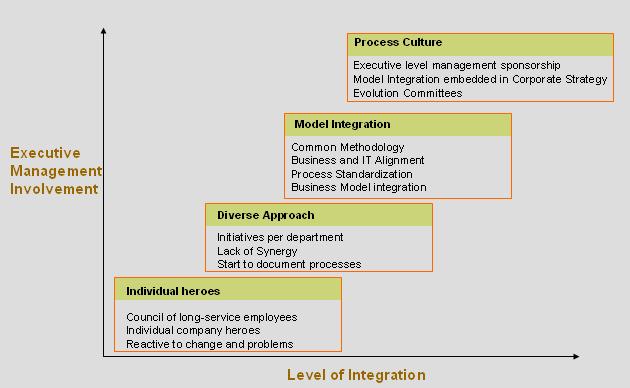
Last August 13, I published an article entitled “Accelerating Process Culture” which talked about the four different levels of process culture maturity in a company. There are two underlying criteria used to qualify the different levels of process culture maturity– level executive management involvement and level of business process integration. 

When executives exhibit a strong commitment to the process and technology evolution of the company, they always bring everyone on board. Executive management has the authority to push company-wide change as well as fund processes and IT initiatives. They are responsible for aligning the company’s structure to the business integration strategy; therefore, they enable the organization to advance to a higher process culture maturity. Let’s revisit the four levels of process culture maturity:

  • Level 1: Individual heroes – dependence on individuals or a few company experts
  • Level 2: Diverse Approach – initiatives per department but lacking in integration
  • Level 3: Model Integration – business and IT align and model integration is achieved
  • Level 4: Process Culture – executive passionately participates in process initiatives

 Process Maturity Levels

This time, let’s examine closely the highest level of process maturity—The Process Culture. The final step of process culture maturity is when the organization achieves a high level of model integration by leveraging the consistent involvement of executive management as sponsors and facilitators of change.

There are three factors that determine the right approach towards process culture maturity.  Let’s call it the “SIB factors”. S stands for senior management involvement, I for innovation and B for business model integration.

Senior managers and managers alike are the critical success factors in your organization’s process culture journey. They lead the way in building process culture and defining the operating model. Innovation in information technology is also a key component. Successful companies nowadays rely on an integrated set of electronic business processes, tools, information, and technologies. With proper support and funding, an IT organization should be able to provide the right platform and technology in which to build the foundation.

The next thing that the company needs to do is to make sure that they select the right business process model from among the many tested disciplines and existing operating models. The underlying logic here is that a company’s business model is limited by the environment. In other words, it depends on several factors, such as the industry it operates, the products and services it sells, its size and geographical diversity. Using all these factors, you determine the level of business process standardization and the level of integration of the company’s different businesses — with profitability and competitiveness requirements in mind. Shared services, outsourcing, diversification, standardization, model replication are some of the most prevalent business models multinational companies have implemented. 

The real question is: how close are you and your company to getting to the highest level of process culture? This is a guide on how to assess the level of process culture maturity of an organization. Again, the examples are outlined using the “SIB factors”. Observe the following points and evaluate how your company is doing right now.

Senior management involvement

  • Top executives participate in the IT and Processes evolution committee.
  • Requires thoroughly analyzed business cases and encourages measurement of acquired benefits.
  • Pushes for post-implementation audit to evaluate project output and acquire lessons learned.
  • Encourages collaboration across business lines and functional teams.
  • Funds IT and Process initiatives and actively support training in the use of IT.

Innovation:

  • Exhibits a strong sense of innovation, feelings of shared interest to continue to improve and be ahead of competitors
  • Holds regular management briefings on the impact of new technology developments and process innovations in the industry.
  • Establishes a consolidated IT operation that manages a standard IT platform to sustain day-to-day support functions to business areas.
  • Encourages use of IT in the business. Users possess a feeling of empowerment and confidence in the effectiveness and reliability of the processes and systems. 
  • Strives to leverage new technology, platform and methodology with sufficient effort in research and development in the area of processes and IT. 

Business Integration:

  • Defines a clear vision of model integration and process standardization.
  • Uses a best-in-class enterprise resource planning software to run an integrated set of business processes
  • Promotes implementation of end-to-end processes to ensure the efficient flow of activities and effective allocation of decision rights and accountabilities.
  • Captures business information in one area and shares it to another business area. Possesses the willingness to share and use information to measure and improve key performance.
  • Maximizes reuse of business processes and platform across different business lines.

Achieving a high level of process culture maturity presents a host of challenges to an organization. The SIB factors provide a structured framework where initiatives can be drawn and strategies derived. This will propel your company forward through its process culture maturity journey.  Achieving the highest level of process culture maturity requires strong executive sponsorship and IT leadership in order to support the company through a change process. When achieved, the company is in a good position to leverage IT for profitable growth and gain competitive advantage in a global market that knows no boundaries. This leap begins with you and your company’s senior managers.

10 Things You Need to Know About Shared Services

  1. Shared Services is the outsourcing of essential business functions to a centralized support organization.
  2. Most successful Shared Services run its organization as a business, providing efficient and effective services at competitive prices to its internal customers.
  3. Shared Services relies on an integrated set of electronic business processes, applications, information and technologies usually anchored in a major piece of purchased enterprise resource planning software.
  4. Shared Services implementation requires significant executive management sponsorship.
  5. The most common essential business support functions outsourced to Shared Services are Human Resources, IT, Finance, Procurement, Office Services and Legal.
  6. Shared Services focuses on value improvement more than cost reduction and on deliverables more than activities. Shared Services values customer service and alignment.
  7. Shared Services uses Service Level Agreements (SLA) to establish an accord with internal customers. SLA quantifies the target quantity, quality, and cost of services in a period of time.
  8. Shared Services makes use of benchmarking and measurement of strategic, tactical and operative Key Performance Indicators to drive incremental performance improvement.
  9. Shared Services locations can be on-shore, near-shore or off-shore although near-shore and off-shore are more associated to outsourcing.
  10. The value of Shared Services for an organization grows over time – from short-term to medium-term benefits of cost reduction and reengineering for productivity enhancement, to long-term continuous improvement and integrated strategic service delivery.

Shared Services

Web 2.0 is Changing the Rules of Advertising

The fast growth of technology has exponentially changed how we use the Internet. It has made businesses take a serious look into how to take advantage of the new version of the WWW or Web 2.0. Companies are forced to adapt in order to make the most of internet-enabled channels. This article talks about how social networking sites and search engines have changed the rules of the advertising game.

Social networking sites such as Facebook, Myspace, and blog service providers (such as Blogger, Blogspot and Multiply) have created a new medium that has elevated “interweb interaction” to a whole new level. Facebook, for instance, boasts having over 200 million users, LinkedIn has 40 Million, and Twitter, a leading micro-blogging site, has almost 26 million.1

Google is arguably the most influential company of the decade. It has changed advertising more than any other business. Google has revolutionized the ad business by enabling marketers to pay for performance rather than space, time and eyeballs.  It has opened up millions more places to place ads, increasing availability of ad channels.

Google has a simplified approach to advertising. It uses Google Adwords for advertisers and Google AdSense for site owners. With Google Adwords, advertisers only pay when people click on their ads. Companies can create ads and choose keywords related to its business.  These ads appear when users search online—making specific information available to an audience looking for it. Google Adsense on the other hand enables website publishers of all sizes to display relevant Google ads and earn. It gives site owners access to Google vast network of advertisers, so they can show ads that are suited to the contents.

When Universal Studios first announced they were opening the Wizarding World of Harry Potter, they did so by telling just seven people. They invited seven avid Harry Potter fans to a top secret webcast to inform them about the plans for the new theme park. By word of mouth, these seven people told thousands through emails, internet forums and blogs. Eventually, mainstream media picked up the buzz and wrote about it in magazines, news, and TV reports. In a few days, the news reached millions of people.2

The concept of advertising spaces doesn’t quite apply anymore to the world of social networking because we are not talking about static space, billboards, newspaper ad space, and television spots. The internet, where billions of users (estimated to be 70% of total population) have spent some portion of their time viewing pages and exchanging information, is the new medium. Unknowingly, social network users have become natural channels for advertising. For example, while writing this article and simultaneously facebooking, I came across a recent post from Thiago Pierson, a Brazilian colleague of mine, talking about a great steakhouse in Fort Lauderdale. He wrote, “Chima Brazilian Steakhouse in Fort Lauderdale is the best one so far!!” Naturally, being the steak lover that I am, my tendency was to google it.  I read the review and checked the menu. Now I am already making plans to visit.

1 http://helixcommerce.blogspot.com/2009/06/social-sites-are-everyones-space.html

2 The New Rules of Marketing & PR, David Meerman Scott

Web and Advertising

Taking Advantage of the IT Extended Network

The number of IT professionals expecting to see budget and head-count cuts grew significantly as more large-business decision-makers turn to cost-cutting measures in 2009 due to the failing economy. This has resulted to project postponements and headcount reduction. IT managers worldwide are scrambling for resources necessary for day-to-day operations and support without distressing IT service delivery. The good news is that IT managers don’t have to look further for help. The answer lies within the boundaries of the same organization it serves – resources are there and it could be plentiful.

During an IT project cycle, users and resource persons from the business are invited to participate. They are integrated into the project to work with the core IT and Process team. They assist in the design and validation of business processes. They conduct integral testing and facilitate training of end users. In larger initiatives, they ensure that business operation requirements are well represented.

I refer to this group as the Business Competence Team or BCT. Organizations call them in different ways: Process Teams, Power users, and Evolution Teams. BCT is composed of employees who have superior knowledge of the company’s processes and tools but do not necessarily report directly to the IT core organization. They are users from operations with extensive knowledge of applications and thus have certain privileged access to systems.  

The BCT is IT’s extended network. They represent the business during project implementation and when they go back to operations, it is the other way around. At this point, they embody IT within the business operation they serve. Their knowledge of the business model and more advanced know-how of the application differentiate them from their peers. They are IT’s partners within the organization.

The challenge for IT managers is to take advantage of this extended network and tap into a readily available resource pool and fill in the void left by headcount reduction.  It is cost effective and a perfect win-win situation for IT and the business. These are just some of the functions that BCT can perform: 

  • Support – Serve as resource persons of end users in operations and as active participants in the IT support network
  • Enabler – Assure continuous system and process evolution by participating in process forums and evolution network meetings
  • Trainer – Reinforce the standards of best practices and better use of application capabilities. Also responsible for continuously training end-users during system upgrades.

It is important that a program is established to enable the BCT team.  This initiative should have a clear set of goals, expectations and rules. IT management should initiate this program and rally top management support. The strategic intent is to relentlessly pursue involvement of BCT members so they can participate in the evolution process as well as onsite assistance to peers. Naturally there are important factors to consider in establishing a Business Competence Team Program. I will discuss more about this in my upcoming article.

Accelerating Process Culture

It seems like distant past when big companies rely on individual heroes to facilitate process initiatives. They are long-service employees who became the experts of how things and processes work in the company. They are always consulted because of their inherent authority– business owners and managers listen to them. Think about them as company elders and gurus whom we seek advice from when things go wrong and consulted whenever changes are planned.  

When a company relies and is solely dependent on its individual heroes for change and process enhancement, it is on its 1st level of process culture maturity.

Process Maturity Levels

The second stage of process culture maturity is the Diverse Approach.  This is when the company starts to utilize standard methods and best practices to drive process design and innovation. Oftentimes at this stage, different areas in the organization implore varying approaches and therefore, less synergy is achieved. Standard operating procedures (SOP) start to shape in each department and documentation becomes an integral part of process implementation. In many cases, at this point, IT and business approaches tend to clash and technology becomes the focus of project implementation.

Companies move up to the Model Integration stage when it builds more synergies throughout the organization. Very successful multinational companies such as P&G, CEMEX, and ING DIRECT take advantage of Model Integration by consolidating functions and developing its shared services. P&G, for example, has established Global Business Services (GBS) — a shared service organization that provides the company a platform for continuous global growth while maintaining values of innovation, service, customer responsiveness and business efficiency. Companies at this level adapt a consolidated method to design and implement business models using standard processes and tools. The project team discipline ultimately improves as management breaks silos and approaches process and technology implementation equally.  The common tendency is for companies to establish global standards and to consolidate both IT infrastructure and human resources, thereby reducing cost of operations.

The final step to Process Culture Maturity occurs when innovation and change in business practices through process understanding are consistently promoted within the company. When executives passionately embrace process thinking, they are able to promote innovation more confidently when implementing new technologies.

Many organizations have gone a long way from the days when company individual heroes were the sole initiators of change and process innovation.  Yet it’s difficult to predict what comes next — as technology evolves, industries consolidate, and Web 2.0 quickly becoming the new platform.

Four Key Elements of a Process Initiative

No two process implementation initiatives are the same. It varies in scope, objectives and limitations because of budget, time, resources, and complexities. Although process initiative projects may vary, there are four key elements which assure good results. These four critical items are: (1) Process Definition, (2) Process and Activity Roles, (3) Available Tools and (4) Training.

Plain and simple reality- these elements are inseparably linked. The absence of one element will hugely affect the result of the process initiative. On the contrary, if the factors all are well attended to, you can expect excellent results.             

Many process initiatives fail because:

• Processes are not well designed and documented. People in operations were not involved in the design process.
• Processes are well defined but roles are not clearly assigned in the organization as to who is responsible and / or accountable for a certain process.
• In some instances, limitations in the tool or lack thereof make the organization resort to workaround and this is time-consuming and costly.
• All systems go but people are not well trained, resulting to inconsistency in process execution

To give a more tangible example, let’s say that you are implementing a logistics dispatch system. You have selected the platform and made sure that it is customized based on the needs of the operation. During the process design, different levels of the organization were involved and consulted. You came up with a clear and concise documentation of the processes and roles that will perform the activities. Roles are defined, assigned to personnel in the organization and was clearly communicated. System procedures and policies are in place.

Then you and your team decided to forego the well planned training program that you have scheduled to speed up the rollout of the initiative and reduce travel costs for people who will need to come from different dispatch locations. You are comfortable with the training manuals and the quick guides. Communication is already done and the operational support structure is in place.

Your decision to forego one key process initiative element will result to the following possible outcomes:

• Dispatch process will be executed inconsistently depending on the user’s personal understanding of the manuals and materials.
• You can be flooded with manual errors due to the user’s unfamiliarity of the system.  This results to spending more time in correcting and stabilizing these errors.
• You risk affecting customer service delivery because of probable incidents like wrong orders and delayed deliveries

The project team in the example above seemed to have done everything correctly.  However, they made one crucial and costly mistake.  User training, as with the other elements, is equally important.  Neglecting one of the key elements could result in project failure.

This does not mean to say, that the project team must focus solely on these four key elements. These cannot substitute existing important process and project implementation methodologies and practices. These key elements are only intended to complement whatever process implementation methodology you follow.

Process Elements